A look inside the Farragut Museum with local historian Frank Galbraith
By Pete Gawda
If you want to know anything about the community of Concord, the Town of Farragut or the Navy’s first admiral, David Farragut, just ask Frank Galbraith. The 84-year-old lifelong resident of the area is a veritable storehouse of knowledge. His family was instrumental in the establishment of Concord. He taught school and coached for 40 years. Most of that time was spent at Farragut Middle School.
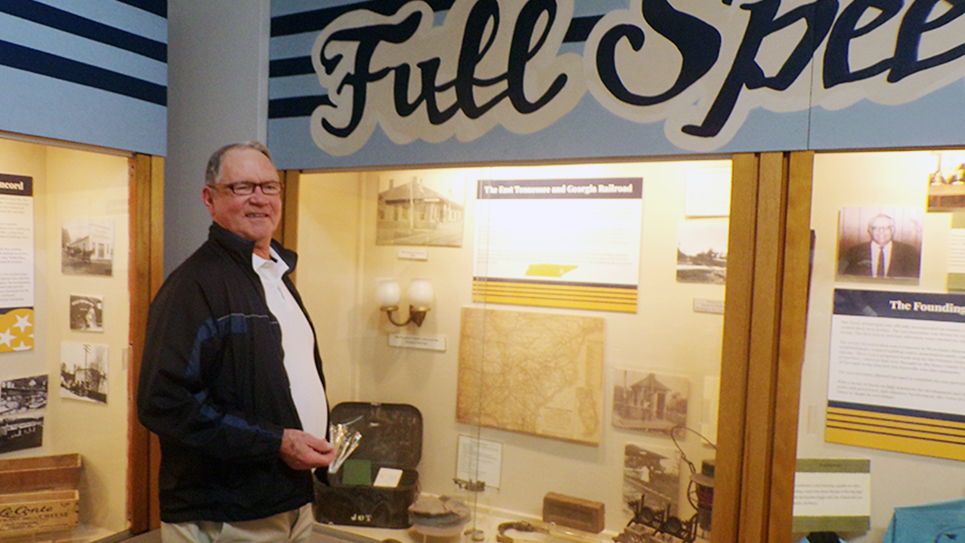
On the second Friday of each month, Galbraith can be found sharing his knowledge with all interested persons at the Farragut Folklife Museum.
The museum was founded in 1986 when the mayor of Farragut at that time, Robert Leonard, instituted a display on the community. In the beginning, it was housed in a historic building known as the old Russell Dairy and is now housed in the Farragut Town Hall. It contains a collection of photographs, newspaper articles, scrapbooks and antiques related to Concord, Farragut and Admiral David Farragut.
Galbraith said the museum is dedicated to educating the community and out-of-town visitors about the history of the area as well as the importance of Admiral Farragut and his role in the Navy.
Galbraith’s great-great uncle by marriage, James Martin Rodgers, laid out the community of Concord in the early 1850s. When the railroad came through the area, its route ran right through Martin’s farm, so Martin divided the farm into lots. A photograph in the museum shows the old train depot.
The community took its name from the nearby Concord Cumberland Presbyterian Church. Not far from the museum is the site of the 1863 Battle of Campbell’s Station, which is commemorated at the museum by a painting. In the painting, only two buildings are in sight. Both of those buildings are still standing. One of those buildings is Campbell’s Station Inn, a stagecoach station which is currently in the process of being renovated for use as a visitors’ center.
By 1883, Concord, which was never incorporated as a town, was the second largest community in Knox County next to Knoxville. There were four marble quarries as well as churches, banks and other businesses. In the museum, Galbraith points to a photograph of his grandfather, whom Galbraith is named after, standing in front of his undertaking business in Concord.
In the mid-twentieth century, Concord fell into decline as the marble industry waned. The final blow came in the early 1940s when Fort Loudoun Dam was constructed and flooded about one-third of Concord.
“Concord was the perfect place to grow up in,” Galbraith said. “Everybody knew everybody.” It seems reminiscent of Andy Griffith’s fictional Mayberry. However, Galbraith said, “Mayberry was big compared to Concord.”
When the high school was established in 1904, it was named for the Navy’s first admiral, David Farragut. In the latter half of the twentieth century, the population of the area began to increase again, and in 1980, the Town of Farragut was established, also named after the admiral.
Admiral Farragut was born in 1801 near Lowe’s Ferry on Northshore Drive, about five miles from the museum. His father died when he was 8, leaving him an orphan. He was adopted by David Porter, a family friend living in New Orleans who was a Naval officer. At the age of 9, Farragut was commissioned a midshipman and rose through the ranks to become the Navy’s first admiral. He served in the War of 1812 and the Mexican-American War. When the Civil War broke out, Farragut, who was against secession, remained loyal to the Union. He captured New Orleans from the Confederates but was unsuccessful in capturing Vicksburg due to heavy fire from Confederate ground troops. He was victorious at the 1864 Battle of Mobile Bay and became famous for the statement, “Damn the torpedoes, full speed ahead.”
Galbraith says Farragut is to be remembered for his “determination and fortitude.”
The museum contains Admiral Farragut’s personal china, uniform ornamentation, family photographs, manuscripts, letters of interest and a large collection of scrimshaw. The admiral’s desk is on display, as well as a model of his flagship, USS Hartford. Through the years, several Naval ships have been named for the admiral.