By Mike Steely
Senior Writer
steelym@knoxfocus.com
Often during the various breakfasts for veterans around our area, you’ll find military veterans gathering to commune with each other, hear speakers, share a meal, and share stories of their service.
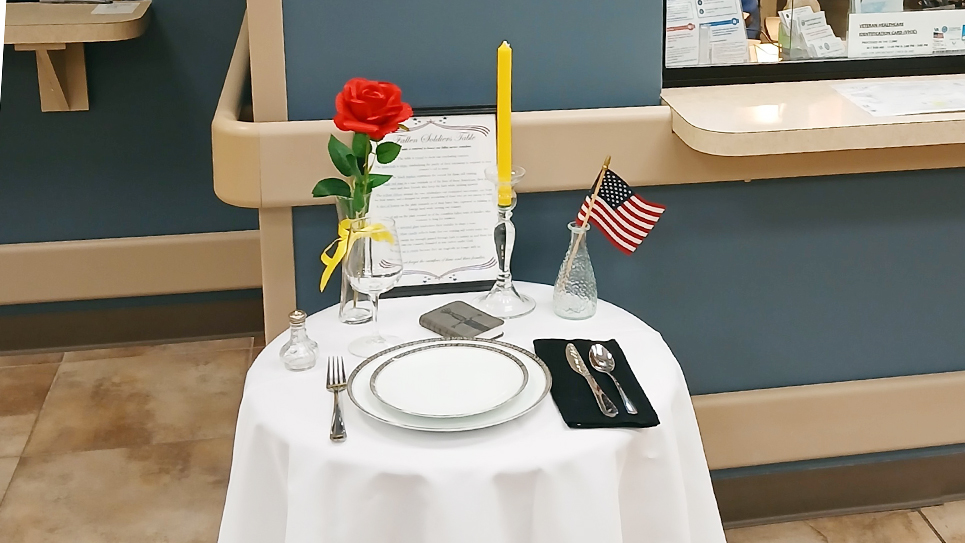
In those meetings, and on other occasions involving veterans, you may see a small round table sitting by itself with a white spread, an inverted glass, a book of faith, often a Bible, a single candle and a single rose tied with a red or yellow ribbon.
If you’re not a veteran, you probably are curious about this table, where no one ever sits and many stop to salute it.
I noticed such a table recently while visiting the William C. Tallent Department of Veterans Affairs Outpatient Clinic, located near West Town Mall. I’ve been there many times as a patient or accompanying my veteran son on medical appointments, but hadn’t noticed the solemn little table sitting on the left of the check-in windows before now.
I remember seeing a similar table at veteran events and breakfasts in Halls and South Knoxville.
The POW/MIA Missing Man Table is a dignified and sad display that appears at formal gatherings and other occasions. It always has a single chair and sometimes the dress hats of the various military services. The table is set with a slice of lemon and a small amount of salt, a salute to all the men and women who never returned from action in previous wars and conflicts.
A POW is a person held as a prisoner of war whose fate is unknown. About 80,000 people nationwide are still listed in that category.
More than 83,000 soldiers, sailors, marines and air force personnel are missing in action, or MIA, beginning with World War I. Occasionally, the remains of those missing veterans are returned and reunited with their families for burial.
For instance, the remains of U.S. Army Master Sergeant David Paul Sluder were returned to Knoxville in 2024. He was reported as missing in action in the Korean War, 76 years ago.
The names of the known deceased POW or MIA Vietnam soldiers are added to the Vietnam Veterans Memorial in Washington, D.C., as they are identified.
When a veteran’s remains are returned to our area, it often is noted on local television news and the return marks the completion of that person’s history for their loved ones. The burial of remains is a family decision, often followed by a full military funeral at a veterans cemetery or a private graveyard.