By Ray Hill
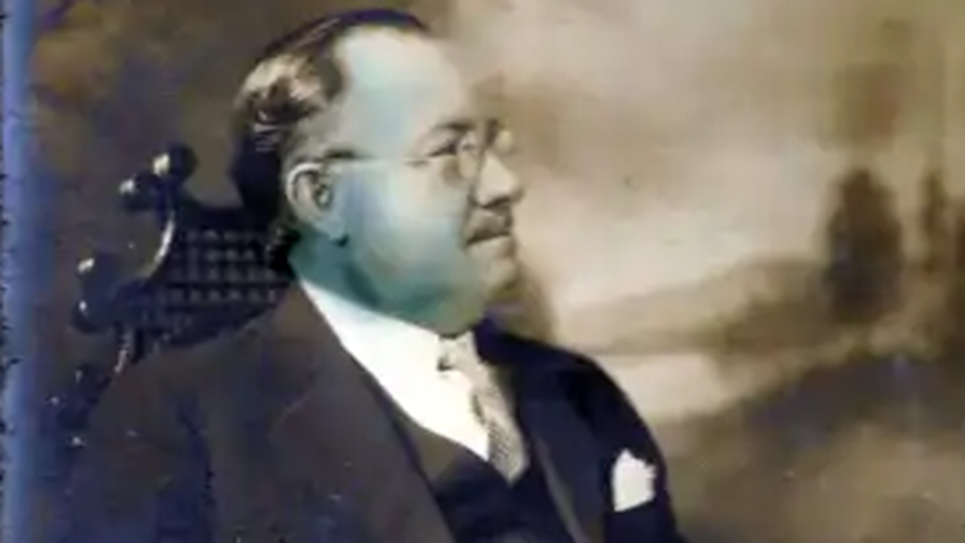
Among Tennessee’s most colorful characters is Harvey Horatio Hannah. Doubtless, few readers today recognize Hannah’s name, but during his lifetime, he was one of Tennessee’s most notable public figures, a man widely renowned for his speaking ability. Shortly before he died, Harvey Hannah speculated he had made more political speeches than any other man in Tennessee. Because of his extremely black hair and dark, piercing eyes, plus his aggressiveness, Mr. Hannah was known in his political campaigns as “The Little Black Bull From Roane.” Harvey Hannah was from Roane County and lived in Oliver Springs.
When Harvey Hannah passed from the political scene, one Tennessee newspaper recalled, “Long before the days of automobile and radio, public speaking still meant the easy day-by-day political tours, the rousing type of oratory, the tickling of the clouds, the crusading spirit.” That was when Harvey Hannah flourished with his talent for oratory. A great admirer of both Governor Robert L. Taylor and U.S. Senator Edward Ward Carmack, Hannah’s heart was attuned to the vocal harp which a fellow orator could play so well.
The son of a major in the Confederate Army and his wife, Hannah was born on August 30, 1868, in Louisville, Kentucky, although the future politician was raised in Oliver Springs. Hannah attended a military school and the University of Tennessee before graduating with a law degree in 1891. Hannah joined the state militia and quickly rose through the ranks. Eventually, Hannah became the chief of staff, then called the “private secretary,” to Governor Robert Love Taylor and was named adjutant general in 1897. For the rest of his life, Harvey Hannah was referred to as “General.” It was no mere honorary title, as when the United States went to war with Spain in 1898, Hannah, full of the Volunteer State spirit, became the lieutenant colonel of the Fourth Tennessee Volunteer Infantry. One of those serving under Hannah was a young man named Cordell Hull.
After America’s victory over the Spanish Empire, Harvey Hannah served as the military governor of Sancti Espiritus, a province of Cuba. From 1902 through 1906, he was once again adjutant general of the State of Tennessee. 1906 was also the year Hannah was first elected to what was then known as the State Railroad Commission. Five times, Harvey Hannah was elected to serve as a member of the Tennessee Railroad & Public Utilities Commission. Commissioners were elected to a six-year term, and Hannah served for 30 years as a member of the Railroad & Public Utilities Commission.
The State Railroad Commission was comprised of three members, all elected statewide by the voters of Tennessee. The Railroad Commission eventually became the Tennessee Public Service Commission. Originally, the Railroad Commission was first created in 1897 and was given the authority to regulate and investigate the rates and practices of the railroads. It was also within the authority of the State Railroad Commission to approve the tariffs charged by the railroads for carrying products, goods, livestock and people. With the progress of people and society came more responsibility. By 1919, the State Railroad Commission was given the additional authority to regulate public utilities and street railways, or trolley cars. At that time, the General Assembly changed the name of the body to the Tennessee Railroad & Public Utilities Commission. By 1933, the additional authority over motor carriers was added to the responsibilities of the commission. Although its members were the only state officials aside from the governor who were elected statewide, none of the members of the Railroad & Public Utilities Commission was ever elected to higher office, although many tried, including Harvey Hannah, who lost races for the gubernatorial nomination and Congress from Tennessee’s heavily Republican Second District.
Hannah was a Democrat in East Tennessee, which was then, as it is now, largely Republican. Harvey Hannah’s political activity began in earnest as soon as he left college. Hannah was a presidential elector for William Jennings Bryan in 1896 during the first of Bryan’s three presidential campaigns. At the time, presidential electors took to the stump to speak and work for the election of the candidate for whom they served as electors. In tandem with Judge Will Wright, Hannah and Wright campaigned across Tennessee “for 40 days and 40 nights.” Hannah spoke for Bryan while Judge Wright talked for GOP nominee William McKinley. When Bryan was nominated by the Democrats for president for the third and final time in 1908, Hannah was dispatched to Indiana, Illinois and Maine to speak for the party and its candidates.
Harvey Hannah was related to Robert L. Taylor and his brother Alf, who also served as governor of Tennessee, albeit as a Republican, through marriage. Hannah’s wife, Gertrude Taylor, was the daughter of James P. Taylor, a brother of Bob and Alf Taylor. A joiner, Harvey Hannah was a member of the Elks, Junior Order of American Mechanics, the Masons, the Knights Templar, the Shriners, Sigma Nu fraternity, Knights of Pythias and Royal Order of Lions.
General Hannah was not one to cater to the many high-priced lawyers hired to practice before the Railroad and Utilities Commission. “You’re quite an orator,” Hannah told one such lawyer, “but let’s get down to the evidence. The law says we must have a hearing. And we can’t have a hearing without hearing something.”
As one “expert” witness gave testimony before the commission, General Hannah interrupted. “I have a high regard for these ‘expert witnesses,’” Hannah said. “But my experience has shown me that ‘expert testimony’ is based on nothing in the world but common sense.”
There were two things that Harvey Hannah tried never to do without. One was black cigars. General Hannah always carried a pocketful of cigars, and one newspaperman noted, “It was a rare occasion when he was not smoking.” The other was milk. Exactly at 2:30 p.m. every day, Harvey Hannah drank a pint of “sweet milk,” although the General never interrupted the proceedings of the commission for his daily dose of milk. As one attorney was speaking, he abruptly stopped when he saw the chairman of the commission, General Hannah, produce a pint bottle of milk and a straw. As he removed the bottle cap and inserted the straw into the milk, Hannah said, “Go ahead. I’ll hear you – – – at least until I hit bottom with this straw.”
Another newspaper reporter who covered the doings of Harvey Hannah recalled that, despite being well-educated, the General was not one to spare the word “ain’t.” “No word is so expressive as that one,” Hannah retorted.
Harvey H. Hannah was a man of very firm convictions and principles, and when Governor Malcolm Rice Patterson pardoned Colonel Duncan B. Cooper for his involvement in the killing of Edward Ward Carmack, the General was one of the first to stir the rebellion inside the Democratic Party. Eventually, the revolt grew so strong that it drove Patterson to surrender the Democratic nomination for a third term as governor, although it split the party asunder and resulted in the election of Republican Ben W. Hooper.
Hannah was a candidate himself for reelection in 1912 as his party was still rent by division and while Benton McMillin lost the governorship to Ben Hooper, Hannah won another six-year term.
In 1936, Harvey Hannah was 68 years old and, at least in his own mind, there was no doubt he would seek reelection to another six-year term as a member of the Tennessee Railroad & Public Utilities Commission. Hannah had been sick for some months with an illness, while unspecified, caused him to be unable to once again make the rounds of political meetings, renew his acquaintances with old friends and make new ones, much less take the stump and make the forceful and eloquent speeches for which he had become so well known. Hannah faced a serious challenge inside the Democratic primary from Leon Jourolmon, a 34-year-old Knoxville attorney. The Nashville Tennessean published an editorial reminding voters that the General’s political fate was in their hands as he was unable to campaign on his own behalf. The editorial noted, “There is no man now living in this state who has served his party more loyally and unselfishly than Harvey Hannah.” Hannah had faithfully campaigned for his party and its candidates in good times as well as in those bleak times. The editorial frankly stated Harvey Hannah had not grown rich while working in public service and “he remains a poor man dependent on his earnings, as has been the case of many other honorable public servants.” The Tennessean praised Hannah as a man who had given his best years and the better part of his life toiling on behalf of the people where he had always done his best to protect the public interest. The newspaper was owned by Silliman Evans at the time, and Evans was opposed to the Shelby County political machine headed by E. H. Crump. Evans was opposed to Crump less for altruistic reasons than perhaps a desire to play the kingmaking role himself. Yet, as might be expected under Evans, the Tennessean noted Jourolmon’s candidacy was backed by the Shelby County machine.
The opposition to Leon Jourolmon by the Tennessean was mild compared to that of its more conservative rival, the Nashville Banner, which published its own editorial flatly urging voters to “Defeat Jourolmon.” The editorial furiously denounced Jourlomon’s record, saying the candidate should not be the nominee of any political party, save that of the Communists. The Banner pointed to the fact that Jourolmon was the attorney for the League of Industrial Democracy, which the Nashville newspaper noted the Army and Navy Register had “linked directly with Moscow.”
Aside from Hannah’s inability to campaign on his own behalf, his candidacy suffered from the attacks made by Leon Jourolmon, who ran as an avid supporter of the Tennessee Valley Authority and criticized Hannah as being too close to the private power interests. It was Jourolmon’s attitude towards TVA that won him the support of Crump. Jourolmon promised to be an advocate for the consumer.
While Leon Jourolmon traveled the state to meet with important Democrats, he made very few speeches, preferring to run his campaign through press releases issued from his law office supporting TVA and chastising General Hannah for having favored the private power companies in his decisions. Hannah’s name recognition helped him to carry both East and Middle Tennessee, but he lost West Tennessee, and Jourolmon won a large majority in Shelby County of some 55,000 votes. Harvey Hannah carried six of Tennessee’s nine congressional districts but still lost the primary election.
Times were changing in Tennessee. As the results of the August primary were tallied, Jourolmon thanked his supporters and said, “I realize that I am deeply indebted to the consumers of Tennessee who have given me their votes and when I go on the commission I shall do so with my pledge to truly represent their interests bearing heavily on my conscience. Likewise I shall continue my determination to cooperate in every possible way with the Tennessee Valley Authority.”
Harvey Hannah’s defeat for reelection to Tennessee’s Railroad & Public Utilities Commission in the 1936 Democratic primary came as a distinct shock to many voters. The Memphis Commercial Appeal editorialized, “The defeat of the veteran Harvey Hannah for railroad commissioner in Thursday’s primaries means more to thousands of Tennesseans than the mere triumph of one candidate over another. It means the passing, for the moment at least, of a figure, an institution which for 40 years has been conspicuous in the history of the state.”
The editorial was a melancholy farewell to a man in the sunset of life, which noted Hannah’s unmatched love for Tennessee, and it was profoundly sad to see the General “sick, broken, defeated.” “It is not too much to hope that his days of usefulness are not yet over,” the editor wrote mournfully. “Tennessee will hardly be the same without Harvey Hannah,” the editorial concluded.
As it happened, Harvey Hannah likely would not have lived to serve another term. The commissioner had long been ill and had required surgery from which he never entirely recovered. The General slipped into unconsciousness and never came out of his coma, and died three days later on November 8, 1936, at his home. © 2026 Ray Hill