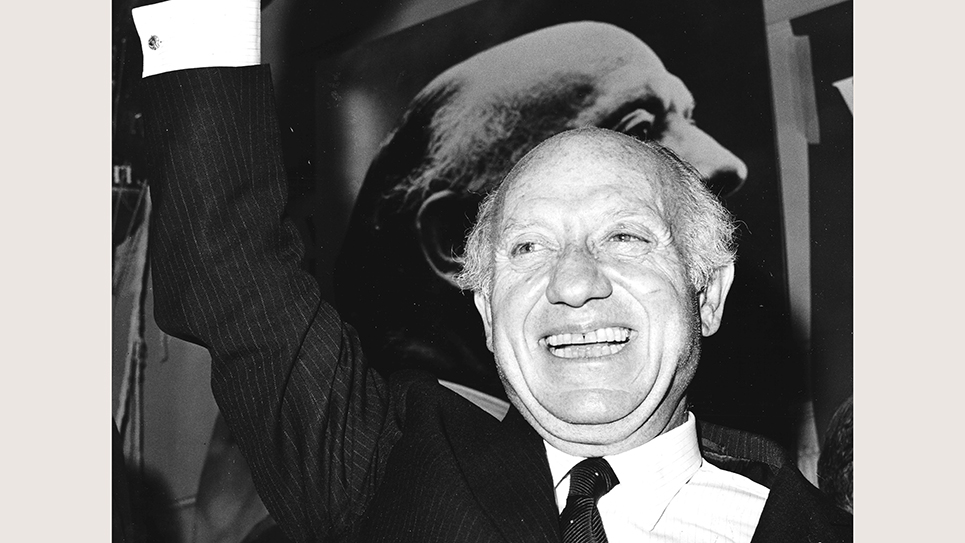
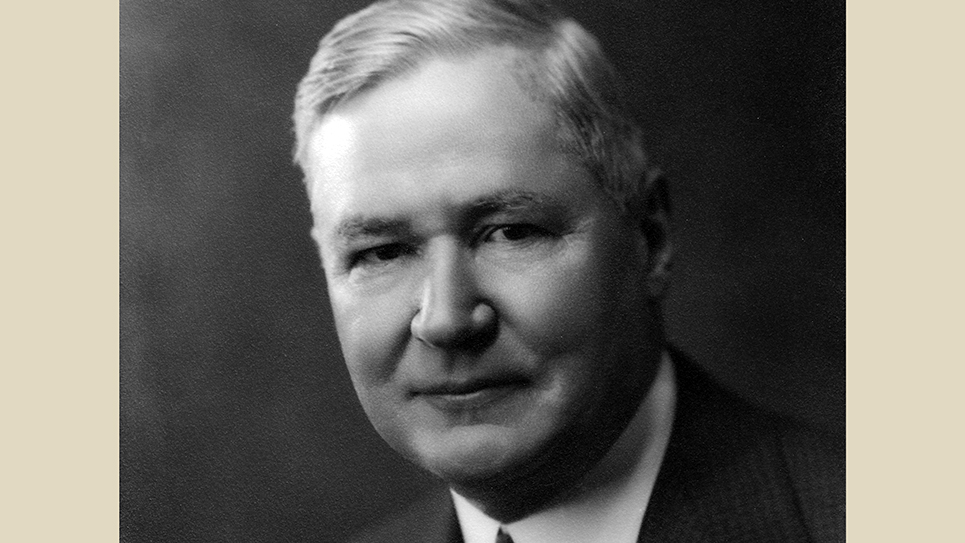
Arthur Harry Moore is not a name familiar outside of New Jersey, but in his time, Harry Moore was one of the best vote-getters in the Garden State’s history. Three times Moore was elected to nonconsecutive terms as governor of New Jersey and was also elected to the United States Senate.
Redheaded when he was younger, Harry Moore was always ambitious and quit school to take a job as a clerk when he was only 13 years old. Moore continued his education and learned accounting and typing. Moore was something of a political prodigy, being an able and effective speaker at an early age and was known as “the boy orator of Lafayette” in his section of Jersey City. Having involved himself early as a volunteer and worker in New Jersey’s Democratic politics, Moore became secretary to H. Otto Wittpenn when the latter was elected to serve as mayor of Jersey City. The boss of Hudson County politics was Robert “Bob” Davis, who also held a post in Jersey City City Hall as the city collector. When Davis died in 1911, A. Harry Moore was appointed to take his place as collector. From the very beginning of his political career, Harry Moore was associated with Frank Hague, who eventually became the leader of the Hudson County political machine, which turned in huge majorities for Democratic candidates locally and in statewide races as well. Moore was elected to the city commission in 1913 and when Frank Hague ran to succeed Otto Wittpenn in 1917, Moore was an essential cog in the machine, proving to be highly popular with the people.
Moore was always upwardly mobile and sought to better himself at every turn. Harry Moore attended law school, taking classes at night and was admitted to the bar, graduating from what later became Rutgers School of Law.
By 1925, Frank Hague was looking for a candidate for governor, and he settled on his friend Harry Moore. Hague’s machine and Moore’s pleasing personality allowed Moore to win the Democratic nomination without much opposition. Harry Moore ran his general election campaign as an avowed opponent of prohibition. His GOP challenger, the dignified Arthur Whitney, had the backing of the Anti-Saloon League. Whitney also ran hard against the Hague machine and constantly talked of Moore as being nothing more than a puppet of the Jersey City mayor. Moore only carried three of New Jersey’s 21 counties, but he received a whopping majority of more than 100,000 votes in his own Hudson County, which gave him a majority of just over 38,000 votes to beat Arthur Whitney.
When A. Harry Moore was first elected governor, chief executives in the Garden State served a term of three years. Despite Whitney’s charge that Moore would be a tool of the Hudson County machine, the newly elected governor made no apologies as to his political pedigree, proudly brandishing his membership in the Democratic organization. Moore proved to be a capable chief executive, and despite the New Jersey State Senate being dominated by the Republicans, the governor worked well with both parties and got most of what he wanted from the state legislature. When Governor Moore disagreed with the legislature, he oftentimes got his way due to the people – as happened in a statewide referendum on water issues. Harry Moore had an innate sense of what the people wanted and what they were against, which made him a formidable candidate anytime his name was on the ballot.
Governor Moore headed an administration that was quite conservative while rendering state services. Moore once vetoed a gasoline tax, which he felt would be a heavy burden upon working people who were already struggling.
Although Moore remained very popular, state law prohibited him from seeking a second consecutive term as governor in 1928. Without Moore at the top of the ballot, Republicans swept New Jersey. A year later, with the crash of the stock market and the onset of the Great Depression, Republicans had control of the White House, Congress and the New Jersey governor’s mansion. Moore went back to practicing law, but he was also omnipresent in New Jersey’s political affairs, and he kept up a busy schedule of attending club meetings, luncheons, and speaking before business groups. Moore was himself a joiner and was a member of several fraternal organizations, and he was a constant presence on the relatively new medium of radio as he had his own radio program over New York’s WOR.
Few people, Republicans or Democrats, doubted Harry Moore would run for a second term as governor in 1931. For the Democrats, A. Harry Moore was unsurpassed as a vote-getter, and he once again was nominated without little or no opposition inside his own party. Moore campaigned in the general election by lambasting President Herbert Hoover and his successor as governor, Morgan Larson, as the architects of the economic ruin in New Jersey. Moore’s challenger in the 1931 general election was David Baird Jr., the son of a United States senator of the same name. The younger Baird had been appointed to serve a year in the U.S. Senate due to the resignation of Senator Walter Evans Edge, who had accepted an appointment from President Hoover to serve as America’s ambassador to Great Britain. Moore buried David Baird beneath an avalanche of votes, carrying all but four of New Jersey’s 21 counties and winning by just over 230,000 votes.
Like most other governors, Harry Moore immediately set out to alleviate the suffering of New Jerseyans and get the state back on sound economic ground. With Herbert Hoover ousted from the White House by Franklin Roosevelt, Moore sought New Jersey’s share of federal funds for public projects.
As New Jersey Democrats prepared for the 1934 campaign, they began beseeching Governor Harry Moore to announce his candidacy for the United States Senate to challenge incumbent Senator Hamilton Fish Kean. Kean, a name still famous in New Jersey politics, was a Republican and a successful banker who had been elected in the Hoover landslide in 1928. Congresswoman Mary Teresa Norton, a stalwart of the New Deal, led a delegation of Democrats to Governor Moore’s office to present him with a resolution adopted unanimously by the state committee asking him to run against Senator Kean. Even then, Moore was not eager to seek another office nor run another campaign. Moore’s wife, Jennie, was said to be adamantly opposed to the idea of her husband running for the Senate and them living for much of the year in Washington, D.C. Jennie Moore preferred instead that her husband quit politics and return to the practice of law.
Congresswoman Norton told the governor the committee was “begging” him to run. Moore asked for “a few days” to think the matter over. Mrs. Norton told the governor that Democrats in New Jersey “are going to insist that you go to Washington.” Moore tried to be diplomatic, saying he was “very tired.”
His wife’s protests notwithstanding, Harry Moore announced he was a candidate for the United States Senate on April 7, 1934. Moore’s announcement may well be the shortest on record as he simply said “yes” when the Democratic State Committee asked him to run for the Senate.
Once again, Moore campaigned by associating Senator Kean with the failed administration of Herbert Hoover and declaring his own full support for President Roosevelt. The New Deal, Moore asserted, had wrought changes to America’s social and economic life and had provided people with security, freedom and hope for the future.
The results of the election amply demonstrated exactly why New Jersey Democrats had begged Harry Moore to run. While Republican Harold Hoffman was winning the governorship, A. Harry Moore was beating Senator Kean by more than 230,000 ballots. Kean carried five counties while Governor Moore carried everything else.
Moore went to Washington, where he took up his new responsibilities as a member of the United States Senate. The Senate is not always an easy place for former governors to find themselves. Used to dictating public policy on their own, the Senate demands considerable adjustment in being one of 96 at the time (Alaska and Hawaii were not then states). Things moved at a much slower pace than governors were used to and the fall from the prominence of a chief executive of a sovereign state was a humbling experience for a freshman senator. Many former governors are dismayed by the U.S. Senate as a “debating society” or, as Harry Moore termed it, “a cave of winds.” In spite of his pledge to back Franklin Roosevelt, Moore found FDR’s policies frequently went against his more conservative instincts. Senator Moore was openly opposed to Roosevelt’s plan to pack the U.S. Supreme Court and was the only Democrat in the Senate to vote against the Social Security Act. Moore also opposed some other New Deal legislative priorities as a member of the Senate. Senator Moore focused his efforts on making sure New Jersey received its fair share of the New Deal’s financial largesse. Harry Moore was not especially happy as a member of the U.S. Senate, and he listened when Frank Hague summoned him to run yet once again for governor in 1937. Answering Boss Hague’s call, Moore faced the Reverend Lester Clee, who was the GOP nominee for governor. Clee was a Presbyterian minister from Newark and a caustic critic of Frank Hague. Dr. Lester Clee was also an experienced officeholder, having served in the state House and state Senate. Clee served as speaker of the House before being elected to the state Senate. The Reverend Clee had entered politics as a member of a “clean” government ticket and running as a Republican, he remained a vocal and bitter opponent of machine politics in general and the Hague machine in particular.
That same bitterness permeated the 1937 gubernatorial race in New Jersey and was almost certainly the most bruising campaign of Harry Moore’s political career. Clee cried that the election of Harry Moore once again to the governorship would allow Frank Hague to pack the Garden State’s own Supreme Court by picking every justice. Clee raised the flag of judicial independence during the campaign and said that if he were elected governor, the judiciary would remain free from politics, but should Harry Moore return to the statehouse, politics would submerge independence.
Harry Moore campaigned as he always had, shaking hands, meeting folks and renewing acquaintances with a host of friends throughout New Jersey. Moore was largely on the defensive during the campaign as the Reverend Clee savagely attacked his record. Moore told audiences he had never once betrayed the trust of the people who had elected him to any office and had always supported working people and the interests of labor. “I am one of you, the people,” Moore cried, “and as such I know your attitude. . .” Speaking before one crowd, Moore mused, “It seems that you are often too old to apply for a job but never too old to pay taxes.”
Moore won the governorship for the third and final time by 45,266 votes, although he only won four of New Jersey’s 21 counties. The majority for Moore in Frank Hague’s Hudson County was more than 129,000 votes, which caused the Reverend Clee to cry fraud, and not without reason. That accusation hung over Governor Moore’s final term like a black cloud. When Frank Hague wanted Moore to run for a fourth term in 1943, the former governor refused. Hague was resentful and unkind to the man who had frequently led his machine to victory. Harry Moore’s last years were filled with the fulfillment of a busy legal practice, service on numerous boards and speaking engagements, all of which kept him occupied. Moore and his wife, Jennie, spent much of their time at a home in the country.
The former governor had a stroke while driving, which caused him to run his car off the road. Fortunately, Mrs. Moore was not seriously hurt, but Harry Moore died from the effects of the stroke.
© 2026 Ray Hill