An oasis on North Broadway
By Pete Gawda
There is an oasis of serenity, natural beauty and elaborate stone carvings in the midst of all the hustle and bustle of downtown Knoxville. Located at 543 North Broadway, Old Gray Cemetery, listed on the National Register of Historic Places, is the largest green space in downtown Knoxville and contains the earthly remains of 9,000 people.
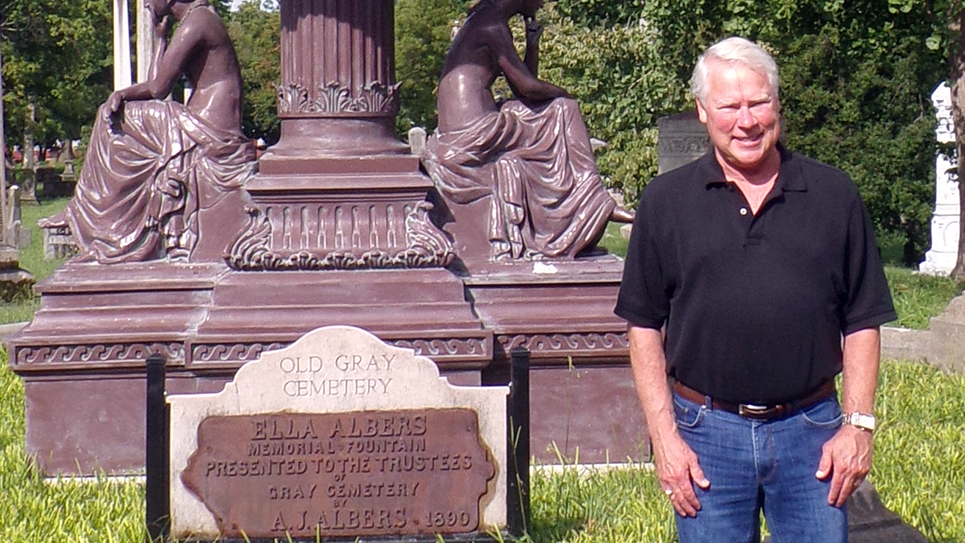
“I love it here,” said Russell Kuhlman, president of the board of trustees of Old Gray Education Historical Memorial Association. “I have a lot of family here.” In fact, five of his eight great-grandparents are buried there. Kuhlman related stories of the monuments and the lives of the people buried at Old Gray as he strolled over the cemetery’s 13 ½ acres.
“It is an outdoor art museum,” Kuhlman said, “Everything about this place is stunning; I see something new every day.” Victorian art and architecture are on display all around, with angels, crosses and other intricate designs carved in stone. Prominent throughout the cemetery is the obelisk, an Egyptian symbol of eternal life.
Old Gray was founded in 1850 and dedicated in 1852. It is the second oldest cemetery in Knoxville. It is properly called a cemetery because it is privately owned and not connected with a church. A graveyard is located on church property. It was named for English poet Thomas Gray, who wrote “Elegy in a Country Church Yard.” Old Gray is the first garden cemetery in the state. A garden cemetery is located on the outskirts of a city and is larger and more elaborate than a graveyard. When it was established, Old Gray was on farmland on the outskirts of the city. At first it was simply Gray Cemetery. It did not become Old Gray until New Gray Cemetery was opened on Western Avenue in 1892.
Old Gray is a certified arboretum by the Tennessee Urban Forestry Council with over 40 types of trees identified by marble stone markers supplied by the Akima Club and the Knoxville Garden Club.
Kuhlman said people used to come here for picnics and that weddings are sometimes held here.
The first grave is that of William Martin, who died July 14, 1851, as a result of injuries sustained in a 4th of July cannon explosion.
Knoxville’s divided loyalty during the Civil War can be seen in Old Gray, with the many graves of both Confederate and Union sympathizers.
Kuhlman pointed out the metal monument marking the grave of Emily T. Shepard, June 1, 1814 – September 17, 1882. He said that during Prohibition, the monument, which is hollow, had a door on the side. If a person wanted illegal alcohol, they would stroll by this monument and place the necessary amount of money in the door and would pass on by. A bootlegger would then retrieve the money and replace it with a bottle. The customer would come back later to retrieve the bottle.
In the center of the cemetery is a large metal fountain which was built in 2016 as a replica of the original, which was built in 1890 and later torn down.
Kuhlman pointed out the receiving vault, which was used for temporary storage of bodies when the weather did not allow for a burial or until it could be decided where to bury a person. He also pointed out the tombstone of a Confederate soldier known only as Horne. That one word is the only inscription on the tombstone, and that is all that is known about him. Beside the tombstone there is a statue of the soldier, which unfortunately has been decapitated by vandals.
Among the prominent people buried here is McGhee Tyson, for whom Knoxville’s airport is named. Another is Lizzie Crozier French, who was instrumental in the passage of the 19th Amendment to the U.S. Constitution, which gave women the right to vote. A large obelisk marks the grave of William G. “Parson” Brownlow, newspaper editor and governor of Tennessee. Large monuments mark the family plots of many prominent Knoxville families, including the Kern family of Kern’s Bakery, the McClungs and the Williams.
On special occasions, reenactors depict the lives of some of the prominent residents of Old Gray.
The cemetery is open to the public from 10 a.m. to 7 p.m. each day when people can freely walk the grounds. Guided tours can also be arranged through Knoxville Walking Tours by calling (865)309-4522. The cost is $20 per person.