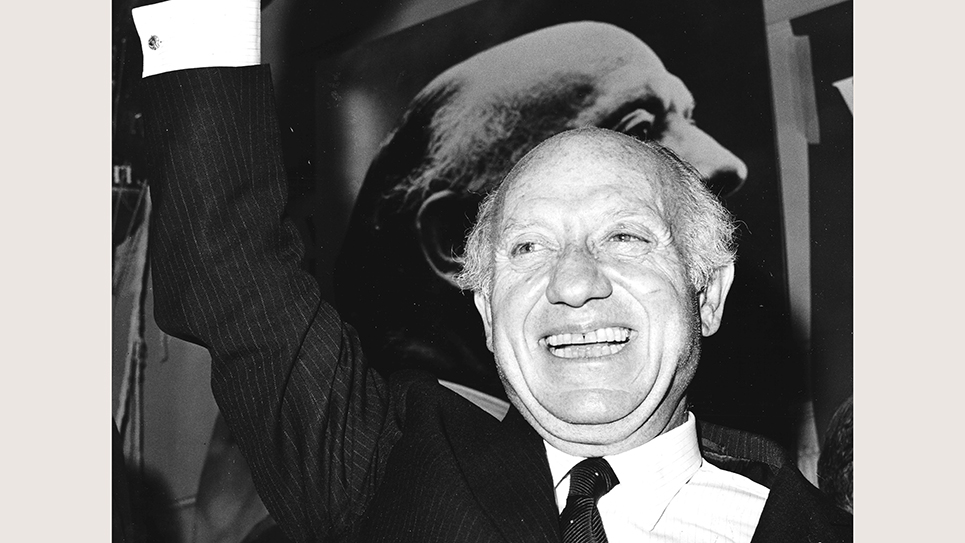
For decades, one of New York State’s most popular public officials was Jacob K. Javits. Rising from a tenement located on the Lower East Side, Javits worked his way through the New York University School of Law and began a law practice with his brother, Ben. The firm flourished and Javits, like most of his contemporaries, served in the armed forces during the Second World War. Jacob Javits was assigned to the Army’s Department of Chemical Warfare.
As a young man, Jacob Javits admired the fighting mayor of New York City, Fiorello LaGuardia, “the Little Flower,” a Republican who managed to be elected three times in a heavily Democratic bastion.
After every war, returning veterans come back, and many of them offered themselves as candidates for public office. Javits, who loathed the Tammany Hall political machine, became a Republican and was the GOP candidate for the U.S. House of Representatives in 1946 from New York’s Twenty-First District. The incumbent was a white-haired, jowly member of Tammany Hall, James H. Torrens, who had first won election to the House in a 1944 special election to fill the vacancy caused by the resignation of Congressman James A. Gavagan, who had been elected to a judgeship. Almost 71 years old, Torrens did not seek a second term. Tammany Hall instead offered up Daniel Flynn, a member of the New York State Assembly. One measure of just how Democratic the Twenty-First Congressional District was is the fact it had not elected a Republican since the Harding landslide of 1920. After Javits left office, the Twenty-First District went back to form and elected another Democrat.
1946 was a great year for Republican candidates as voters were weary after the long and bloody Second World War. Voters were also tired of the deprivations and sacrifices imposed to win the war. Republicans ran a clever national campaign exploiting the feelings of the voters with the blunt slogan: “Had Enough?” Javits easily beat Daniel Flynn, polling 46% of the vote in a three-way race. Eugene Connally siphoned off 14% of the vote as the nominee of the American Labor Party, which made it possible for Javits to win the general election, along with the Republican wave across the country.
Congressman Javits went to Washington, where he was no ordinary GOP foot soldier, realizing he needed to reflect the views of the people who had sent him to Congress; otherwise, he would be defeated. It did not take long for Javits to be recognized as one of the most liberal Republicans in the House. Javits was supportive of organized labor throughout his congressional career and was one of the very few Republicans to vote against the Taft – Hartley Bill in the House of Representatives. Jacob Javits also remained steadfastly internationalist in his outlook as far as foreign relations were concerned. Congressman Javits routinely supported the Truman White House in backing the Greek-Turkish loan, as well as the Marshall Plan for aid to a war-ravaged Europe.
Congressman Javits knew from the moment he was elected that the Democrats and Tammany Hall would move heaven and earth in a bid to reclaim New York’s Twenty-First Congressional District in the 1948 election. If 1946 had been a great year for Republicans, political prognosticators expected 1948 to be even better. At the top of the GOP ticket was Thomas E. Dewey, the formidable governor of New York and the Republican strongman in the Empire State. Javits faced an able and serious challenger in Paul O’Dwyer, who was as Irish as the Blarney Stone, having been born in County Mayo, Ireland.
As third-party candidate Henry Wallace pulled 422,000 votes in New York City, almost all of which came at the expense of Harry Truman, Governor Dewey managed to carry his home state, albeit by less than a percentage point. O’Dwyer had been an outspoken noninterventionist prior to the attack on Pearl Harbor by the Japanese Empire, serving as the chair of the American Friends of Irish Neutrality. Javits had helped to entrench himself by providing personal constituent service to the people of his district, and the congressman beat O’Dwyer by exactly 2,413 votes, winning less than 51% of the ballots cast.
Congressman Javits was reelected in 1950 in another three-way race with just under 50% of the vote. In the banner Republican year of 1952, Javits won more than 63% of the vote in a race against a Democrat and the nominee of the American Labor Party. As a popular and Jewish Republican who had amply demonstrated his appeal in a normally Democratic district, Javits was pushed by many Republican county leaders as a candidate for statewide office. In 1954, two New York congressmen gave up their offices to run for attorney general of New York; one was Jacob Javits, the other was Franklin D. Roosevelt Jr., son and namesake of the late four-term president. Roosevelt’s mother, former First Lady Eleanor Roosevelt, was a resident of and political force in New York. From the outset, Javits was viewed as the underdog.
Outgoing Governor Thomas E. Dewey engineered the nomination of Irving Ives to succeed him. Ives was the senior United States senator from New York and was highly popular and had been reelected to another six-year term in 1952 by more than 1.3 million votes and carried every county in the state except Kings County. Ives ran well in most of the state, carrying all but three counties, but Democrat Averell Harriman carried Kings County by almost 300,000 votes to eke out a narrow victory by 11,125 votes out of more than 5.1 million cast. Jacob Javits surprised political pundits when he upset Franklin Roosevelt Jr., winning by almost 173,000 votes as the rest of the Republican ticket was losing statewide.
Two years later, Senator Herbert Lehman announced he would not seek reelection to the United States Senate. Jacob Javits was acknowledged as the best vote-getter the Republican Party had in New York, and the attorney general had no difficulty in winning the nomination. Once again, Javits, the boy raised in the tenements and who had worked for everything he had gotten in the world, faced the scion of a famous father who also bore one of the most recognizable names in New York. Robert Wagner Jr. was the mayor of New York City and the only child of longtime U.S. Senator Robert F. Wagner, who had authored much of the New Deal’s signature legislation.
No longer an underdog and taken seriously by New York Democrats, running in tandem with the highly popular President Dwight D. Eisenhower, Javits scored an impressive victory, beating Wagner by 458,000 votes and polling more than 53% of the ballots cast. Eisenhower frequently had trouble from his own party in the Senate, but that usually came from his right flank. Jacob Javits was an exception who was oftentimes more liberal than Ike. Senator Javits boasted a formidable intellect, for which he was recognized, but he also had an oftentimes caustic personality as well, which irritated some of his colleagues. Yet the senator insisted his office be as highly responsive to the people of New York as was humanly possible. In addition, Javits was constantly hustling for votes, once introducing himself to a lady of the evening on a street in Manhattan and asking for her vote without realizing she was a prostitute.
Undeniably one who took his Senate responsibilities seriously, his hard work paid off when he was reelected in 1962, polling better than 57% of the vote, beating his Democratic challenger by 981,000 votes. Senator Javits even carried Kings County, albeit narrowly. The only county Javits lost in his reelection bid was Albany, a normally Democratic stronghold. In 1963, Republicans held both of New York’s seats in the U.S. Senate and the governorship was occupied by Nelson Rockefeller, who had been reelected to a second term in 1962.
A darling of much of the press who liked his liberal and internationalist viewpoint, Javits took himself seriously. TIME magazine, the most widely read news magazine in the world in its day, was published by Henry Luce, who was himself a moderate Republican and staunch internationalist, noted of Javits: “He loves his eminence and supports it with a sober-minded single-mindedness matched by few, if any, of his colleagues.”
Unlike many of his colleagues on the right, Javits was even more supportive of the Eisenhower administration than he had been of the Truman administration. Javits did dissent from regular Republican orthodoxy on labor legislation, which earned him far more support from organized labor than most Republicans could dream of when running for office. Senator Javits was highly informed of every constituency inside his state; he supported funding for the humanities and arts as New York City remained the locus of theatre in the United States. Javits also was an unapologetic supporter of civil rights for all and ran better in every ethnic group than any other GOP candidate in the Empire State.
None of New York’s establishment Republicans supported the presidential candidacy of Senator Barry Goldwater of Arizona. Goldwater was arguably the most conservative candidate ever nominated for the presidency up until that time. Senators Javits and Kenneth Keating announced they would not support Goldwater, who had defeated Governor Rockefeller to win the Republican presidential nomination. The landslide for Lyndon Johnson nationally was especially heavy in New York, which helped to defeat Senator Keating.
Senator Javits once again faced Paul O’Dwyer, who was the Democratic nominee for the Senate in 1968. O’Dwyer was an avid critic of the war in Vietnam and had the support of anti-war U.S. Senator Eugene McCarthy, who had nearly upset LBJ inside the New Hampshire primary. O’Dwyer had defeated a sitting congressman and a county executive to win the Democratic nomination in what most observers felt was an upset. Serious cracks were beginning to appear in the foundation of the Empire State’s Republican Party with the founding of the Conservative Party in 1962. In 1968, James L. Buckley, brother of William F. Buckley, was the Conservative nominee for the U.S. Senate and polled more than 1.1 million votes and 17% of the ballots cast. Even in a three-way race, Javits won every county in New York State and beat Paul O’Dwyer by 1,119,000 votes, although he polled under 50% of the total votes cast. James Buckley would win New York’s other Senate seat two years later as the Conservative Party’s nominee in yet another three-way race.
Up for another six-year term in 1974, the political independence of Senator Jacob Javits likely helped him more than it hurt, especially in a terrible year for GOP candidates who suffered politically with the resignation of President Richard Nixon. The Watergate scandal took a terrific toll on Republican incumbents, but Senator Javits won reelection against six other candidates. The Democrat running against Javits was Ramsay Clark, son of U.S. Supreme Court Justice Tom Clark, and both father and son had served as the attorney general of the United States. Clark was known for his opposition to the Vietnam War as well as being a liberal well to the left of most liberals in the country. Javits won just over 45% of the vote and beat Clark by 366,000 ballots.
1980 saw a revolution inside the Republican Party with Ronald Reagan winning the GOP presidential nomination and the party turning to the right. Javits was finally seriously challenged from the right, which was where he was probably the most vulnerable. Alphonse D’Amato challenged Javits in the GOP primary and surprised everyone by winning with 55% of the vote. Javits remained on the ballot as the candidate of New York’s Liberal Party, which ironically enabled D’Amato to win the general election.
Javits had been diagnosed with Lou Gehrig’s disease (ALS) in 1979 and was getting along in years. Unable to campaign with the same vigor as before, Javits was ripe for defeat, and Al D’Amato’s timing was impeccable; he won the election. Javits was named as a special advisor to Secretary of State Alexander Haig in 1981. Jacob Javits died in 1986.
© 2026 Ray Hill