By Pete Gawda
Located at 1917 Bethel Avenue is an unusual cemetery. Bethel Cemetery has over 1,600 graves, but only about 24 have tombstones. The vast majority of graves belong to Confederate soldiers. While some were killed in action, many more died of diseases. By the end of the war, over 1,000 Confederate and Union soldiers were buried here. Later, Confederate veterans and Confederate widows were buried at Bethel. One of the few marked graves belongs to a child and bears a lamb and a dove.
Patrick Hollis is executive director of the Hazen Mansion Historical Association, which owns both Bethel Cemetery and the Mabry-Hazen House. “We want to memorialize the dead and not glorify the Confederacy and ‘The Lost Cause,’” Hollis told The Focus. “One of the purposes of the foundation is to untangle myth from history.” He considers the cemetery a place for quiet reflection and went on to say, “Confederate memory has a place in Southern history. There are so many interesting ways to look at this site.” To create a sense of peace and tranquility, the growth of native plants is encouraged.
The cemetery belonged to the county at first. In 1868, the 2-acre plot was given to the Ladies Memorial Association, an action Hollis said exemplifies the political activism of Southern women.
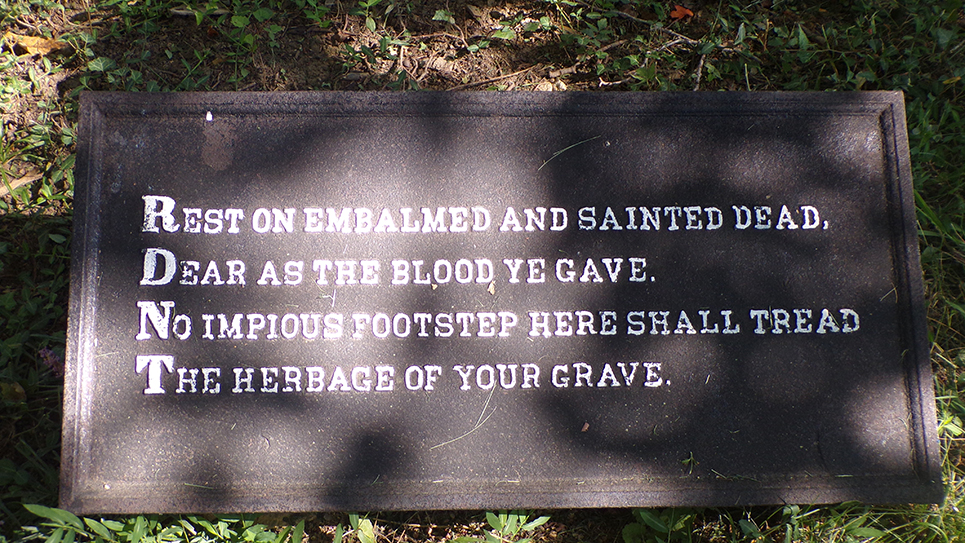
The Ladies Memorial Association erected a large monument in the center of the cemetery to honor those buried there. The statue atop the monument was designed by Lloyd Branson, a Knoxville artist, and the sculptor was George Whitaker, a veteran of the 143rd New York Infantry. The cost of the monument, $4,500, was paid in part by Confederate and Union veterans. The monument was unveiled on Memorial Day of 1892 with a parade through town led by General Edmond Kirby Smith, former Confederate Commander of the Confederate Department of East Tennessee. Senator William B. Bate, Confederate general and former governor of Tennessee, addressed a crowd of thousands. In his speech, Bate emphasized heroism, the common values held by both sides and brotherly forgiveness.
The names of many of those buried here have been identified by research and the help of relatives. In 1963, during the Civil War centennial, four bronze markers on stone stands were erected with over 1,500 names of the dead listed by state. Georgia has the longest list with five columns of names spread over two stones. The names of the Tennessee dead occupy one and a half columns. Hollis said there were minor inaccuracies in the list, such as the units to which some men were attached, and they were not all killed in the Battle of Knoxville as the tablets proclaim.
Of the few tombstones that were placed in the cemetery, Hollis said that some have fallen over and, in the course of time, their original positions were lost. They have been lined up along one fence. The foundation is contemplating the best way to put these tombstones on display.
The archaeology lab at UT used ground-penetrating radar to locate burial sites. This revealed a trench grave at one side of the cemetery. Hollis speculates that this could be the final resting place of Union prisoners.
Unlike the Mabry-Hazen House, the cemetery generates no revenue. Therefore, Hollis is grateful for the support of the Knoxville Civil War Roundtable, which helps with maintenance. The cemetery is open every day and receives five to 10 visitors a month.
In 1875, the first caretaker’s cottage was built. The present Queen Anne-style caretaker’s cottage was built in 1885. The first caretaker was William Winstead, a Confederate veteran who had lost his leg in the Civil War and worked as a shoemaker. After his death, his wife continued on as caretaker until her death in 1930. At that time, their youngest daughter, Mamie, became caretaker. In 1959, the Ladies Memorial Association deeded the caretaker’s cottage and the cemetery to Mamie. When Mamie died in 1989, she willed the cottage and the cemetery to the Hazen Historical Museum Foundation.