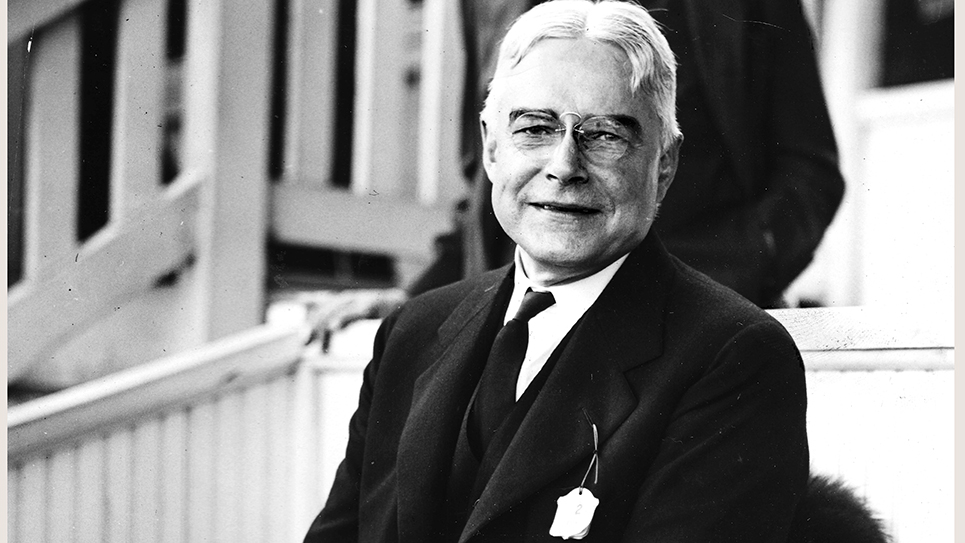
During his time in office, Albert Cabell Ritchie was one of the best-known chief executives in the country. Twice, Ritchie was a candidate for the Democratic nomination for the presidency. To this day, Albert C. Ritchie remains the longest-serving governor in Maryland’s history, remaining in the governor’s mansion for quite nearly 15 years. His hair was parted in the middle, giving him a somewhat severe look, and he was clean-shaven and possessed a distinguished appearance, which reinforced his image as a statesman as he aged. Oftentimes the governor wore pince-nez glasses perched on the bridge of his nose. While he might have looked like a stately professor, Albert C. Ritchie possessed a keen mind for organization, and he built a formidable political machine that kept him in office and made him the most powerful figure in the Free State for well over a decade. Ritchie was one of those who might well have won the Democratic presidential nomination in 1932 had there been a deadlock or Franklin Roosevelt’s candidacy had faltered.
Ritchie looked the part he was elected to and came from a distinguished family. His mother, Elizabeth Cabell, was the granddaughter of William H. Cabell, who served as a governor of Virginia. Ritchie’s father, for whom he was named, was at various times a professor of law at the University of Maryland, a justice of the court for Baltimore, the city attorney for Baltimore, president of the Maryland Historical Association and a duly elected member of the Maryland Constitutional Convention of 1867. His parents settled in Baltimore while young Albert was a toddler, and he lived there most of his life and followed in the footsteps of his father, earning a law degree after having been educated in private schools. Ritchie entered private practice but quickly accepted an appointment as an assistant in the office of the solicitor for Baltimore, the city attorney. That evidently gave Ritchie the impetus to form his own law firm, as his post with the City of Baltimore did not take up all of his time. Like his father, Albert C. Ritchie taught law at the University of Maryland’s law school and continued in his work for the City of Baltimore and private practice with his own firm.
Oddly, the future governor married Elizabeth Catherine Baker in 1907, but his wife filed for divorce in 1910, citing abandonment by her husband, who had left their home to live with his mother. That same year, Ritchie became the attorney for Maryland’s Public Service Commission, which regulated utility companies. Ritchie attracted much favorable attention from local newspapers in his efforts to lower utility costs for consumers. The publicity and his subsequent legal victories over the utility companies for the people helped to propel Ritchie into office as the attorney general for Maryland, which was an elected position. One of the first reforms Ritchie proposed was consolidating the legal services for virtually every department and agency of the state into the offices of the attorney general, which negated the need to hire outside counsel constantly.
Through his service as general counsel to the War Industries Board during the First World War, Ritchie became acquainted with financier Bernard Baruch. The two became friends, and Baruch helped to finance Ritchie’s political campaigns. In 1919, Attorney General Albert C. Ritchie became the consensus candidate for the Democratic nomination for governor. Without any opposition inside his own party, Ritchie entered the general election as the clear favorite, as Maryland was a reliably Democratic state. Yet Albert C. Ritchie faced Harry W. Nice, a Republican who had a pleasing personality and a knack for making friends out of both Republicans and Democrats. One of Nice’s friends was Frank Kelly, an infamous political boss who wielded enormous influence inside Baltimore, which was a heavily Democratic city and frequently returned the winning majorities for statewide candidates.
The American people had rejected a personal plea by President Woodrow Wilson to return a Democratic majority to Congress. The country was tiring of the aftermath of the World War, wanting to return to “normalcy,” as future GOP presidential nominee Warren Harding so aptly put it. The 1919 gubernatorial election in Maryland was a portent of things to come. Frank Kelly put out the word in his organization that he was backing Ritchie rather than his friend Harry W. Nice. That was enough to deliver the election to Albert C. Ritchie by the narrowest of margins, 165 votes out of almost 225,000 ballots cast by Marylanders. The closeness of the 1919 election and the widely suspected voter fraud by Frank Kelly’s political machine would come back to haunt Ritchie years later.
As governor, Albert Ritchie embarked on reforming state government and was a nationally recognized figure in his opposition to the prohibition of alcohol. Governor Ritchie streamlined services in state government and his efforts were appreciated by the people of Maryland as he became the first governor to be reelected to a second term since the Civil War. Ritchie won acclaim inside his own party when he was called to Washington by President Warren G. Harding for a conference of governors to urge compliance with the Eighteenth Amendment (prohibition) to the Constitution of the United States. Governor Ritchie, when it came his turn to speak, bluntly informed his listeners that the people of Maryland were against prohibition and the Eighteenth Amendment. Ritchie said Marylanders favored local option, meaning localities decided for themselves. “The Volstead Act changed all this,” Ritchie barked. “Our people in the main regard it as an unnecessary and drastic Federal infringement of their state and personal right, foreign to the spirit of the Federal union and resulting in a sectional tyranny that the people of my state will not brook.”
Ritchie’s remarks quite nearly blew up the White House conference. Not surprisingly, Governor Ritchie was one of the driving forces during the 1932 Democratic National Convention for inserting the plank urging repeal of the Eighteenth Amendment into the party platform. The governor was renominated and reelected in 1923, and once again in 1926, when Maryland changed its elections from the off year. Governor Albert Ritchie was reelected to a fourth consecutive term in 1930.
Ritchie was considered presidential timber by many inside his own political party, and while outdistanced by New York Governor Franklin Roosevelt, the Marylander was a contender until the convention nominated FDR. Although unsuccessful in his quest to win the presidential nomination, the governor was delighted when he was greeted by a gigantic throng of people when he returned from the 1932 convention. Ritchie said it was the happiest moment of his life to be greeted by so many of his fellow Marylanders even in defeat.
The Roosevelt forces at the 1932 Democratic National Convention bargained with the vice-presidential nomination in exchange for support. Some observers believed Ritchie could have had the vice-presidential spot on the ticket had he wanted it. The offer was supposedly made if the governor would lead the Maryland delegation into the Roosevelt campaign and help to bring around several other states which were either supporting favorite sons or undecided. The offer was allegedly declined by Governor Ritchie, who likely believed his own chances for the presidential nomination were as good as anyone else’s. The truth of the matter was that Ritchie did not think much of Roosevelt or the New Deal. That was later given as the real reason why Albert Ritchie refused to consider running for the US Senate in 1934. No one doubted the senatorial nomination was Ritchie’s, had he shown even the slightest interest in accepting it after 15 years as governor. It was the logical next move for one who wished to remain prominent in Maryland’s political life and it would have kept alive his aspirations for higher political office as well. Ritchie was relatively young at the time, 57 years old. Governor Ritchie had questioned the wholesale spending by Roosevelt’s New Deal and was highly critical of any effort by the federal government to usurp what he saw as the rights of the states to govern themselves. As a critic of the most popular Democrat in the country, Ritchie upset many inside his own party. While criticizing much of the New Deal, Governor Ritchie angered many recipients of Roosevelt’s administration’s largesse, which made many former supporters fall out with him.
Albert Ritchie refused to even consider running for the United States Senate in 1934. The governor did not wish to play a supporting role and have to pass on another’s political program in the Senate. By continuing to hold the governor’s office, Ritchie would continue to be the most politically powerful individual, at least in Maryland.
As a result, Governor Albert C. Ritchie, despite unrest and opposition, which had been building for some time in the last part of his administration, insisted upon being renominated to run again in 1934. Senator Millard Tydings had been backing George L. Radcliffe for the gubernatorial nomination; Mayor Howard Jackson of Baltimore had been ardently pursuing the Democratic nomination for governor himself. With Ritchie’s insistence upon running yet again, Tydings withdrew the candidacy of George Radcliffe, who became the Democratic nominee for the United States Senate; Jackson also withdrew as a candidate, allowing Ritchie to be nominated without any real opposition.
Ritchie confidently expected to defeat Harry W. Nice, who had beaten US Senator Phillips Lee Goldsborough to win the opportunity to face the governor once again. Ritchie was profoundly surprised when he was upset in the general election. Harry W. Nice had vindicated the loss of 1919. Whether it was covering his disappointment at the only defeat dealt him during his political career, or if it was a philosophical moment, Ritchie said his loss “probably was a blessing in disguise.” The governor had been “seriously ill,” according to press reports, before leaving for his first vacation since being chief executive of Maryland. Ritchie left for a European trip in the hopes of regaining his health for the general election.
Out of the governor’s mansion in 1935, Ritchie resumed the practice of law and adamantly clung tenaciously to his standing as a former governor and a leader of Maryland’s Democratic Party. There were many Democrats who fully expected Ritchie to compete once again in 1938 to win the fifth term he had failed to achieve in 1934. Once again, Albert Ritchie left for Europe, enjoying a vacation of several weeks in London.
Whatever his political intentions, fate has a way of overturning even the most carefully laid plans and prospects. On February 23, 1936, Albert Ritchie had addressed a club meeting at the Mount Vernon Episcopal Church, which was across the street from his Washington Apartment House home. The former governor lambasted the centralization of government for more than an hour. There had been no sign that Ritchie was ill as he had spoken over national radio on the previous Saturday evening and attended a banquet for the Johns Hopkins University Alumni Association.
Staff at the apartment house later related the former governor had been in good spirits and seemingly good health when he returned about 9:30 p.m. and entered the elevator to return to his rooms.
In the early morning hours of February 24, 1936, Albert Ritchie was stricken in his Baltimore apartment when he called his personal secretary, Mrs. Elizabeth Smith, to say that he was feeling quite ill. The former governor asked Mrs. Smith to come to his apartment as quickly as she could manage. Mrs. Smith found Ritchie unable to move and semiconscious while sitting in a chair when she arrived at his apartment. Mrs. Smith telephoned, desperately trying to locate a nearby physician. When doctors Cecil Bagley and Richard Coblentz arrived at the former governor’s apartment, Ritchie had apparently fallen out of his chair and was lying upon the floor of his study. The doctors sought oxygen tanks while one administered artificial respiration to Ritchie, who was unconscious. Firemen brought the requested oxygen tanks, and they tried eight times to resuscitate the former governor unsuccessfully. Ritchie was pronounced dead at 1:45 a.m.
© 2026 Ray Hill