By Pete Gawda
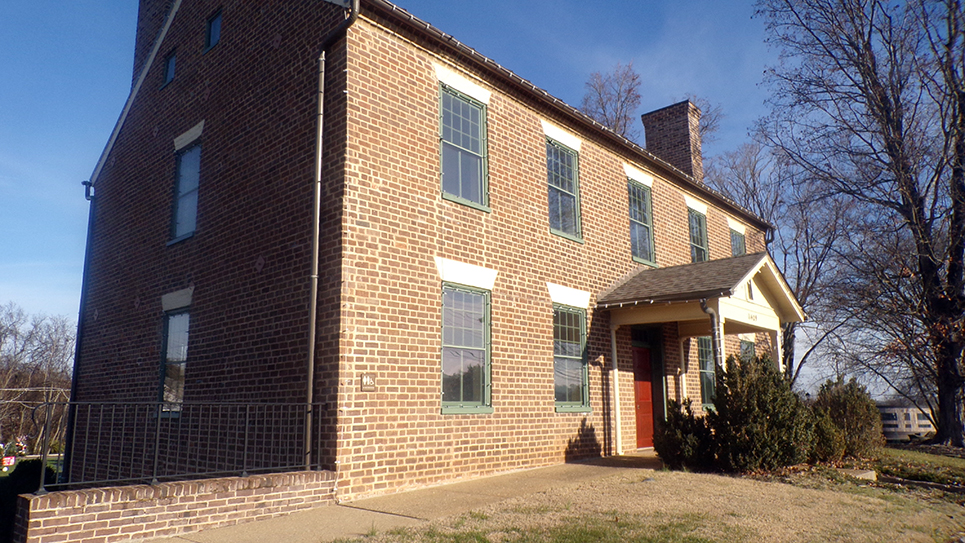
“The structure itself is not impressive,” said Wendy Smith, communications manager for The Town of Farragut, “but it has seen a lot of history.” She was referring to the newly renovated Campbell Station Inn.
Located at the intersection of Kingston Pike and Campbell Station Road in Farragut, the historic building has indeed seen a lot of history as it has been used as an inn, a stagecoach station, a hospital and a private dwelling house.
In 1787, David Campbell, who fought in the American Revolution in the regiment of Colonel John Sevier, acquired 640 acres on the east fork of Turkey Creek. The property was located about 15 miles east of White’s Fort, which grew to become the City of Knoxville.
The first structure on the property was a blockhouse. A blockhouse is a two-story log cabin with loopholes for firing at attacking Indians. The overhanging second floor allowed defenders to shoot down on the attackers. Surrounding settlers would gather at a blockhouse during times of peril. While no one was killed at Campbell Station, Indians did harass the settlers from time to time and steal their horses.
In the early days of the state, Knoxville was the capital, so the blockhouse, located on a major road to the capital, became one of the earliest inns in the state and a stagecoach station. The inn hosted various notables of the time, including Andrew Jackson.
Over time, a thriving community known as Campbell Station grew up around the blockhouse. The present brick inn was built in the early 1800s. There was a post office, tannery, wagon shop and general store at Campbell Station. It was said that Campbell Station did more business than Knoxville. When the railroad came through a few miles to the south, the community of Concord grew up along the railroad tracks, and Campbell Station began to decline.
In 1824, David Campbell sold the property to Samuel Martin, and the property remained in the Martin family for six generations and became known as the Avery Martin House.
During the November 16, 1863, Battle of Campbell Station, the inn served as a hospital for wounded troops. There are stories of blood-stained floorboards from that time. However, Smith said no such boards were found during the recent restoration by the Town of Farragut.
Old photographs of the building show a two-story porch across the front. That porch no longer exists.
The building is entered through a very wide front door, which opens into a wide central hallway. On each side of the hallway are two rooms, and each room has a fireplace. Upstairs, there are also two rooms on either side of the hall with fireplaces and a smaller room at the end of the hall, which does not have a fireplace. The basement has a dirt floor and a trough and was used as a stable.
In 2012, the Town of Farragut purchased the house and 2.26 acres. A restoration procession was recently completed so the building, which is on the Register of Historic Places, can be enjoyed by the public.
“I’m really glad we saved it,” Smith said. The restoration process included the preservation of much of the building’s character, including exposing some of the original bricks, plaster, wallpaper. decorative painting and flooring.
During the restoration process, a partition was removed between two of the downstairs rooms to make one larger room that will be rented for private gatherings. A dumbwaiter was installed in this room to allow a caterer to send food up from the basement. One of the other downstairs rooms will be used as a museum, and the other will be a gift shop. The upstairs will be used for office space and storage.
The Town of Farragut will cut the ribbon on a welcome center, a small event venue and office space at the historic Campbell Station Inn (11409 Kingston Pike) at 4:30 p.m. on Thursday, Jan. 8. After the ribbon cutting, tours of the furnished space and light refreshments will be available. The welcome center will be open to the public from 10 a.m. to 6 p.m. Tuesday through Saturday beginning Friday, Jan. 9. Details about the event venue, which will accommodate up to 30 guests, will be available at VisitFarragut.org by Feb. 1.