Hillary Clinton was not the first outsider to shop for a seat in the United States Senate from New York; that distinction belonged to Robert F. Kennedy, younger brother of President John F. Kennedy.
Robert Kennedy had been the assistant legal counsel to the committee chaired by Senator Joe McCarthy, the Wisconsin demagogue who had received funding from the Kennedy patriarch Joseph Kennedy. McCarthy had a significant following in Massachusetts, especially amongst Catholics, and Joe Kennedy had contributed generously to keep the Wisconsin senator from endorsing incumbent GOP Senator Henry Cabot Lodge Jr., who was being challenged by Congressman John F. Kennedy. Some attribute Kennedy’s victory to McCarthy staying out of the campaign.
Bobby Kennedy was acknowledged by many to be the toughest of the Kennedy brothers for being long on grudge and short on gratitude. Kennedy became counsel to the Senate committee looking into labor racketeering, headed by the fearless Senator John McClellan of Arkansas. That was the beginning of Bobby Kennedy’s blood feud with Teamsters president Jimmy Hoffa. Bobby worked frenetically for his brother Jack’s nomination for president in 1960. After edging out a win by a whisker over Vice President Richard Nixon, Joe Kennedy, who had provided much of the financing for his son’s presidential campaign, insisted the president-elect choose younger brother Bobby as his attorney general. Nepotism was hardly new in politics even then, yet it was perhaps the most breathtaking example, especially as Bobby Kennedy had never really practiced law before becoming attorney general of the United States.
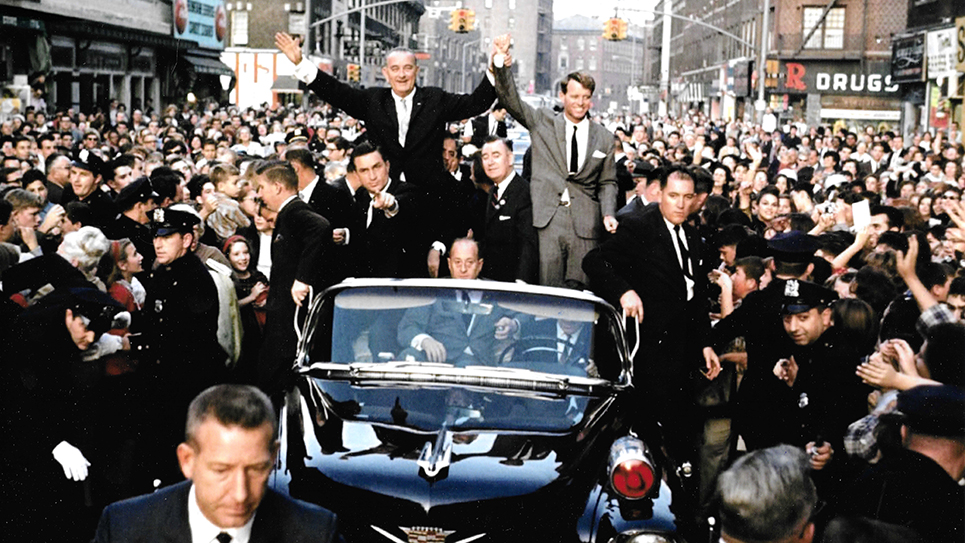
Following the assassination of his brother, Bobby experienced a wave of sympathy from much of the country, who watched sadly as his lean and sorrowful figure trailed behind the caisson pulled by six white horses bearing the late president’s coffin. There was a growing effort by Kennedy loyalists to place Bobby on the ticket with Lyndon Johnson in 1964. The problem was that LBJ and Bobby Kennedy loathed one another. Johnson, one of the most masterful politicians ever to occupy the White House, sidestepped a confrontation by announcing he would not choose anyone serving inside his Cabinet as his vice-presidential running mate. Kennedy later said he sent a note to other members of the Cabinet stating, “I’m sorry I took so many nice fellows over the side with me.”
Highly politically ambitious, Bobby Kennedy eyed a place to land outside of Lyndon Johnson’s Cabinet. His eyes fell on Kenneth B. Keating’s seat in the United States Senate.
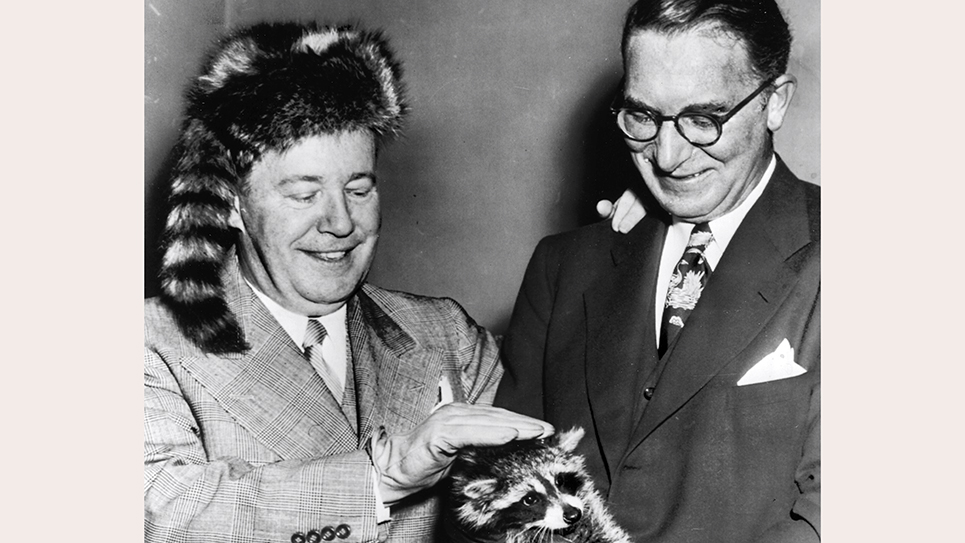
Ken Keating looked as if he came right out of Hollywood’s central casting office; white-haired, stocky, well-dressed and gregarious, Keating had been a highly popular congressman who had first been elected in the 1946 GOP wave. Keating, who had served in the armed forces during the Second World War, came home to run for the U.S. House of Representatives against Congressman George Rogers, who had unseated a Republican incumbent in 1944. Running inside New York’s Fortieth Congressional District, Keating proved to be a superlative campaigner, profoundly enjoying meeting people, shaking hands, kissing babies and trying on any kind of a hat, be it a fireman’s helmet or an American Indian war bonnet. Keating beat Rogers badly and won a rematch in 1948, which had been the closest election of his career. Deeply entrenched inside his congressional district, Keating grew in influence inside the House.
In 1958, Senator Irving Ives, who had been the choice of New York Governor Thomas E. Dewey, the GOP strongman inside the Empire State, was ailing and announced he would not seek a third term. Republicans in New York State pushed Congressman Ken Keating to run. Keating was not at all interested and seemed content to stay in the House of Representatives indefinitely. President Dwight D. Eisenhower, Vice President Richard Nixon, former Governor Dewey and others all urged and pressured Keating to make the race. Finally, “kicking and screaming,” Congressman Keating became the Republican nominee for the United States Senate.
Keating faced Frank Hogan, a storied and highly respected attorney who had served for years as the district attorney general of New York County. Hogan had begun his career in the district attorney’s office under no less than Thomas E. Dewey, who had been something of a boy wonder as the crime-fighting DA of New York. Hogan had been one of four assistant district attorneys Dewey had indicated would make a fine successor as he left office, as he was running for governor in 1942. Frank Hogan was a Democrat but ran in 1941 after having also been endorsed by the Republican Party and the American Labor Party.
Frank Hogan was in the headlines constantly, following the same crime-busting route Tom Dewey had blazed originally. Hogan prosecuted gangsters like Joe Adonis and crooked politicians, even those inside his own political party like Hulan Jack, the borough president of Manhattan and a stalwart member of Tammany Hall. Any number of Democrats coveted the nomination for Senator Ives’ seat, including James A. Farley, the postmaster general and dispenser of federal patronage under President Franklin D. Roosevelt. A former chairman of the Democratic National Committee throughout the first eight years of Roosevelt’s administration, the 74-year-old Farley announced his candidacy on June 3, 1958. Farley made a statement saying he would be “honored” to serve New York in the U.S. Senate during “this crucial period of the world’s history.”
Farley, once a political powerhouse, had habitually reached above himself and had broken with FDR over the president’s decision to seek a third term in 1940, less out of conviction than because he yearned to become the first Catholic to occupy the White House. Farley initially thought of running for president before promoting the idea of his running for the vice-presidency on a ticket with Secretary of State Cordell Hull. Farley seemed not to realize that whatever power he held was due to his association with Roosevelt, and he faded from the political scene as he entered the world of business and served as the chairman of the board of the Coca-Cola Export Board in New York. The last office Farley had held was that of state chairman of New York’s Democratic Party, an office he divested himself of in 1944. Despite friends in the news media who continually described the 70-year-old Farley as “vigorous and youthful,” he certainly did not look it. Such superlatives and descriptions of his energy did not stampede the delegates to New York’s state Democratic convention.
Senator Ives, then 62, opined Farley was too old at 70 to enter the Senate as a freshman legislator. The governor of New York was Averell Harriman, the scion of one of America’s wealthiest families. A veteran diplomat and foreign service officer, Harriman had been elected in 1954 when Tom Dewey refused to seek a fourth term. Governor Harriman was said to favor the senatorial candidacy of Thomas Finletter, a former secretary of the Air Force. The biggest roadblock to Farley or any other candidate for the Democratic nomination was Mayor Robert Wagner Jr. of New York City. The bearer of one of the most famous political names in New York history, Wagner’s father, had been one of the most prolific legislators inside the Senate during Franklin Roosevelt’s New Deal. Wagner himself had been the Democratic nominee for the United States Senate in 1956, but had lost to Jacob Javits, who was then the elected state attorney general.
Some Democrats hoped Wagner would run again, but he had been reelected as mayor in 1957, and after two campaigns in as many years, he was not anxious to engage in yet another. A recent poll had shown Wagner as the favorite among upstate party chairmen for the senatorial nomination.
There were those Republicans who hoped Nelson Rockefeller would run for the United States Senate. Like Harriman, Rockefeller was a scion of one of the country’s wealthiest families and had held positions inside the State Department. Rockefeller was interested in running for office although he had no interest in seeking a seat in the Senate, having his eye firmly fixed upon the governorship.
Through the summer months, James A. Farley found he was far from being considered a consensus candidate for the Senate seat. Finletter was an open candidate and the candidacy of Frank Hogan was showing over the horizon. Farley quickly issued a blast warning against the nomination of Hogan, whom he said had only experience in one county. Farley cautioned that by nominating Frank Hogan, Democrats risked bringing into the senatorial campaign the issues of crime and New York City’s own problems. Farley also took a few shots at Governor Harriman, who he believed was trying to dictate to the convention.
“It will horrify the governor to learn that there are old and respected Democratic leaders who wish to endorse me openly, yet fear political reprisal from some of the ambitious and unauthorized people who, apparently, have somehow wormed their way into the fringes of his usually vigilant outer-guard,” Farley complained loudly.
Farley was dismayed when Thomas E. Murray, whose only public office had been service as a member of the Atomic Energy Commission, became the fourth declared candidate for the Democratic nomination for the U.S. Senate. Farley called on the governor to help clarify some of the more “unusual candidacies” for the nomination. Farley knocked Murray’s candidacy, noting the newest candidate’s stands upon the issues of the day were completely unknown. Never having run for office before, Farley reasoned “therefore his ability as a campaigner must be unknown even to himself.”
“Yet, a man of his experience could scarcely have ventured forth without assurance of powerful support, not yet revealed,” Farley hinted darkly.
Farley’s campaign and that of other candidates proved to be little more than shadow boxing as Frank Hogan swept all before him to easily win the nomination. Likewise, Kenneth Keating had no difficulty in winning the GOP nomination for the U.S. Senate; indeed, the hardest part of the pre-nomination campaign had been to persuade Keating to run at all.
Once again, Ken Keating demonstrated his remarkable ability to engage and connect with voters as he ran in the general election. While some complained Keating did not always follow the imaginary dictates of dignified behavior, the congressman was a joyful human being who liked people. The same Republican state convention that nominated Ken Keating for the Senate also nominated Nelson A. Rockefeller as its candidate for governor.
In contrast to the patrician Harriman, Rockefeller proved to be a formidable mixer on the campaign trail, willing to sink his teeth into any ethnic food and flashing a toothy grin at every campaign stop. “Rocky” greeted voters with real relish while Harriman was stiff and more formal on the election trail. On Election Day, Rockefeller upset Harriman and Keating, yet again demonstrating his ability to draw the voters of Independents and some Democrats, and won the race to succeed Irving Ives.
Governor Rockefeller was reelected in 1962, as was Senator Jacob Javits. The stage was set for an epic contest in the senatorial race in 1964. Republicans in New York had given up any hope of carrying the Empire State for presidential nominee Barry Goldwater, who was not at all popular there, even though his running mate William Miller was from the state. Both Republicans and Democrats conceded Lyndon Johnson would easily carry New York.
Ken Keating, who had always had a knack for attracting publicity to himself, drew guffaws when he announced his reelection bid. Keating got laughter from his audience and momentarily caused reporters’ collective hearts to skip a beat when he said he wished to announce he would not run for the U.S. Senate, after a theatrical pause, “from Massachusetts.”
Congressman Samuel S. Stratton was a candidate for the Democratic nomination for the Senate but could not overcome the heavy spending by the Kennedy campaign and the support the former attorney general had garnered. Mayor Robert Wagner remained a powerful obstacle in the path of any Democrat for statewide office. Wagner was convinced no other Democrat could beat Senator Keating even with Barry Goldwater on the ballot, save for Robert F. Kennedy. That won Bobby Kennedy the Democratic nomination.
© 2026 Ray Hill