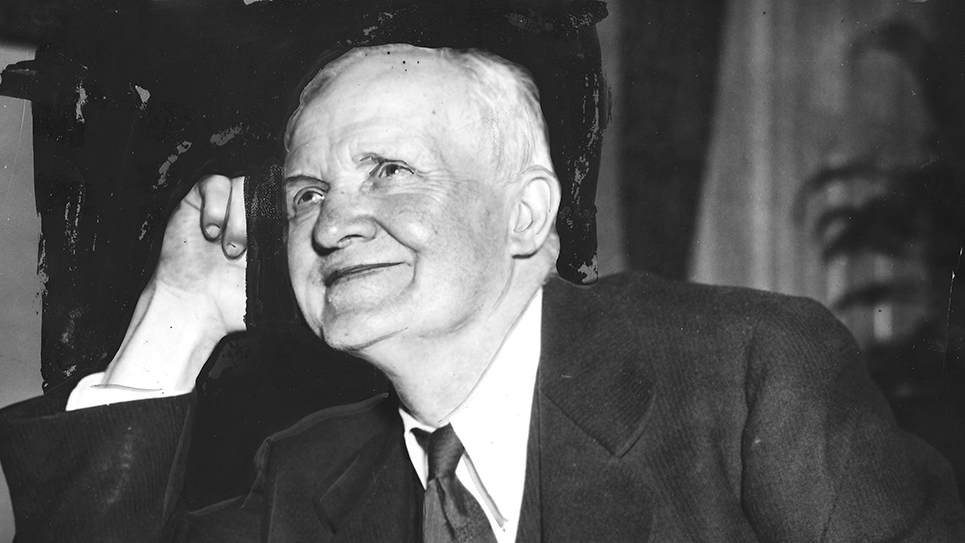
When I was a youngster, there were certain life stories which defined something unique about that individual’s climb from poverty to success, and it was almost invariably described as an “American success story.” That would certainly apply to the life of David John Lewis, who went to work in the coal mines at the tender age of nine and worked there until he was 23 years old. What lifted Davey Lewis out of the coal mines was his penchant for studying as hard as he worked. Illiterate for years, Lewis acquired the same eloquence his father had demonstrated as a Baptist preacher. Equally devout in his devotion to the cause of the working man and organized labor, 20-year-old Davey Lewis spoke at a labor meeting, and his grandiloquence caused one grizzled old reporter to marvel, “Boy, you ought to be a lawyer.” That caused Lewis to learn to read Latin, and he studied the law with the same fervor with which he mined coal out of the hard earth. By age 23, Lewis had earned his law degree.
As with many self-educated people, David J. Lewis’ love of learning continued throughout his lifetime. His hobby was physics, and Lewis was a member of the American Academy of Sciences. Lewis studied and read extensively on the topics of economics, history and sociology and was meticulous in his studies. Lewis learned French simply to verify a quote from de Tocqueville. The most widely read news magazine in the world, TIME, reported that one luxury Davey Lewis kept for himself was freedom from interruption when studying. Lewis would not publish his home address while in Washington, D.C., and had “a secret office in the old House Office Building with a door that cannot be opened from the outside.”
David J. Lewis commenced the practice of law in Cumberland, Maryland, and prospered. From the courtrooms, David Lewis, a man although diminutive in size, but in no way a small man, went from success in the courtrooms to the halls of the mighty, being elected to the Maryland State Senate in 1902. The more conservative members of Maryland’s General Assembly were appalled and horrified when Davey Lewis proposed a law to provide workers’ compensation.
An ambitious man, Lewis sought election to the US House of Representatives in 1908, running against GOP incumbent George A. Pearre, who had first been elected in 1898. It was a measure of Davey Lewis’s ability as a campaigner that the election was the closest of Congressman Pearre’s career. The incumbent eked out a narrow victory, winning by 546 votes and tallying 49% of the ballots cast. Perhaps because of the close election, George Pearre did not seek reelection in 1910, preferring to return to his law practice. Davey Lewis ran again and was elected, turning the tables on Republican Brainard Warner in another close election. Lewis edged Warner by 689 votes and went to Washington, D.C., as a congressman.
In 1912, Congressman Lewis proposed a law which later became the system under which the parcel post was organized by the Department of the Post Office. At the time, some companies were aghast at Lewis’ proposal, which would take the business from them and place it in the hands of the government. It might not have been a popular proposal with private business, but Congressman David Lewis was personally popular with the people he represented. Lewis won a smashing victory in his 1912 reelection campaign, winning by a majority almost ten times the size of his victory two years previously. Two years later, against a highly popular GOP candidate, Lewis won by only 742 votes.
Lewis yearned to serve in the United States Senate and won the Democratic nomination in 1916 to compete for an open seat. Lewis faced Dr. Joseph I. France, a Republican who had barely scraped by to upset Governor Phillips Lee Goldsborough in the primary. France ran a hard-hitting campaign, scourging Lewis for having been a socialist in his youth. While President Woodrow Wilson was running 21,000 votes ahead of the GOP presidential nominee in Maryland, Congressman Davey Lewis lost to Dr. Joseph I. France by a scant 3,922 votes out of more than 231,000 ballots cast. Dr. France had run far better in ordinarily Democratic Baltimore County than most Republicans, carrying it by less than 200 votes. Usually, Democratic candidates could count on a big majority out of the City of Baltimore and Baltimore County.
President Wilson appointed Lewis to serve on the Tariff Commission, which provided a nice salary, a post Lewis kept until 1925. Nor did his appointment keep him from being politically active at a time well before the Hatch Act. Lewis once again sought election to the United States Senate, being a candidate once again for the Democratic nomination in a three-way race in 1922. Lewis ran a distant third, although he carried his former Sixth Congressional District. The White House was once again in Republican hands, and when President Calvin Coolidge indicated he would reappoint Lewis if he would sign an undated letter of resignation, the former congressman refused and left the Tariff Commission.
Lewis looked to return to elective politics and began eyeing his old seat in Congress, which was occupied by a Republican, Frederick Zihlman. Davey Lewis had beaten Zihlman in 1914, albeit only just barely. Lewis reasoned he remained popular in Maryland’s Sixth Congressional District and was likely the only Democrat who could oust Zihlman. The former congressman campaigned energetically and spoke with his usual eloquence, but he had picked the wrong year to run, as 1928 proved to be a thoroughly Republican year. Popular former Governor Phillips Lee Goldsborough won election to the United States Senate while GOP presidential nominee Herbert Hoover was carrying the Free State. Congressman Zihlman thrashed Davey Lewis, winning by more than 10,000 votes and polling better than 56% of the ballots cast.
The only thing more fluid than politics is water, and things had changed drastically in two years. The stock market had crashed within a few months of Herbert Hoover having occupied the White House, and times were becoming harder for millions of Americans as the Great Depression loomed over the land. Lewis announced he was running for Congress once again to return to the House of Representatives. Lewis faced a serious candidate inside the primary and, perversely, lost his own home of Allegany County and carried the other four of the five-county Sixth Congressional District. Lewis demonstrated widespread support and won the Democratic nomination with more than 80% of the vote.
Once again, Lewis faced Congressman Frederick Zihlman in the general election. Lewis campaigned hard on the hard economic times and the failure of the Republican Party and President Hoover to stem the tide of the rising depression. Davey Lewis won decisively, once again losing his own home county, but carrying the others. White-haired and “wizened,” at least according to TIME magazine, David J. Lewis returned to the US House of Representatives after an absence of 14 years at age 62.
Congressman Lewis got right to work, sponsoring legislation that was oftentimes well ahead of its time. Lewis offered bills on old-age insurance and nationwide unemployment. Perhaps the legislation that Lewis is still best remembered for by scholars is his sponsorship of the legislation that created Social Security. Upon occasion, Lewis’s ideas were so popular during the New Deal that more senior and powerful legislators elbowed the Marylander out of the way to sponsor virtually identical bills. Robert L. Doughton, the cantankerous congressman from North Carolina, exercised considerable influence as the chairman of the House Ways and Means Committee, and his bill about old age and unemployment insurance was so closely written to that sponsored by Lewis that the printing plates used to print his bill were the same as those used for the version written by Lewis. Doughton used his power to leverage his bill ahead of that sponsored by Davey Lewis. A lesser man would likely have reacted differently. Some wondered if Lewis would oppose the Doughton bill out of spite. Standing in the well of the House, Davey Lewis began to speak.
“Gentlemen of the House, we are at a crossroads of history,” Lewis began. “We are developing a new class in America. It is those men and women who at 45 years of age have reached the limit of employability. They are turned away on the basis of their age. I christen them ‘America’s untouchables!’ Even under slavery, the slave owner did not fail to feed and clothe and doctor the slaves no matter what might happen to the crops or to markets … Fellow members of the American House of Commons … the world does not owe a man a living, I grant you, but as sure as God rules the heavens, it does owe him a chance to earn a living … This measure is only a small effort to give the disemployed equality before the law.”
The colleagues of Davey Lewis, realizing what had happened to his own bill, jumped up from their seats “shouting, clapping, cheering, as little Mr. Lewis gathered up his papers and scuttled to a seat near the door” TIME magazine reported. Colleagues sought him out to shake his hand and compliment him. David J. Lewis had made the valedictory of the debate to come. Members illustrated suffering by their own constituents from their personal experiences, what they had heard and seen. The shameless Robert Doughton proclaimed what had once been the Lewis Bill as “probably the most far-reaching piece of legislation ever considered by the American Congress.”
It was the beginning of helping those who had faltered through no fault of their own. The Great Depression was a time made for a politician like David J. Lewis, who was intensely interested in easing the difficulties and burdens borne by the less fortunate. Lewis was handsomely reelected in 1932, winning better than 58% of the vote. Two years later in the midterm election of 1934, Lewis faced a formidable challenge from the still popular former Congressman Frederick Zihlman. It was a close race, although Lewis won by 1,361 votes. Lewis won handily with Franklin Roosevelt at the top of the ticket in 1936.
David J. Lewis bears more than a footnote in one of the most famous elections in American history and in the history of President Franklin Roosevelt’s administration. For the first four years of his rule, Roosevelt got pretty much what he wanted from Congress. Peppery US Senator Carter Glass of Virginia once cracked that if FDR demanded that Congress commit suicide, they would obey. That supine obedience came to a halt when Roosevelt initiated his effort to pack the US Supreme Court. That caused a rebellion amongst Roosevelt’s fellow Democrats, both progressives and conservatives. One of the most vocal opponents of Roosevelt’s scheme was Senator Millard Tydings of Maryland. Outraged to be thwarted and humiliated by the Senate, FDR began what became known as his “purge” of political opponents. Roosevelt encouraged primary challenges to those Democratic senators he felt had not gone along with him, which included Tydings. Davey Lewis still wanted to go to the Senate, and Roosevelt convinced the aging congressman to challenge Senator Tydings inside the Democratic primary. President Roosevelt even traveled to Maryland to campaign for Lewis. Muckraking columnist Drew Pearson and his sisters, angry at what they perceived as Tydings’ treatment of their father, who had been the appointed governor of Puerto Rico, had lavished more than $17,000 in contributions to Lewis’s campaign. It was a huge sum for the time, but even FDR could not elect David J. Lewis to the Senate. Tydings won a thumping victory, polling just over 38% of the vote, although he did carry most of his congressional district.
Roosevelt rewarded Lewis with another federal job, appointing him to the National Mediation Board in 1939, where he served until his resignation in 1943. David J. Lewis died on 12, 1952, at the age of 83 in Cumberland, Maryland.
© 2026 Ray Hill