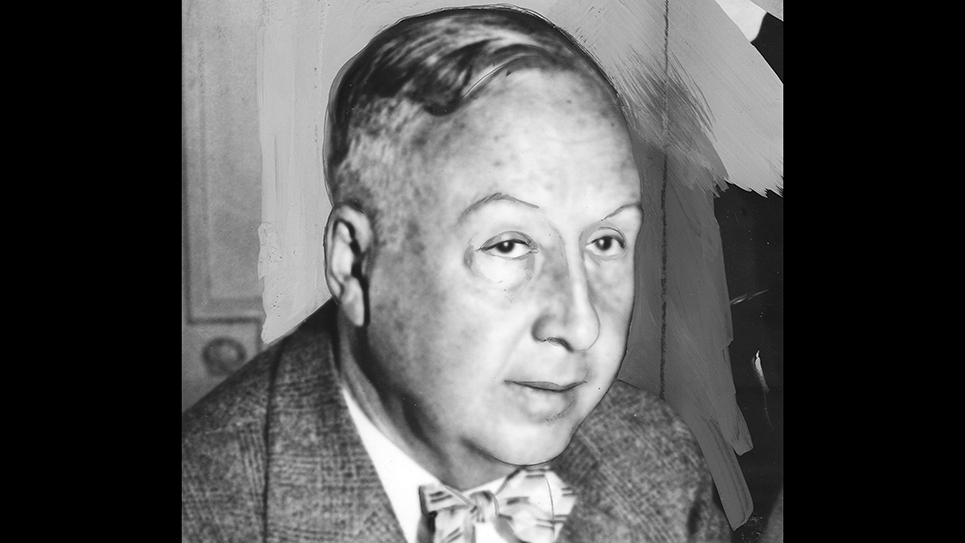
Joseph Irwin France was not at all a conventional politician, especially for his time. Depending upon one’s point of view, France could be seen as either a visionary or an eccentric. Senator France was adamantly against ratifying the Treaty of Versailles, the treaty that sealed the peace in Europe following the First World War, while sowing the seeds for the Second World War. One of the primary reasons Senator France opposed the Treaty of Versailles was precisely because he thought it imposed virtually impossible standards upon the defeated nations, most especially Germany. France viewed the treaty as being exceptionally harsh, and it is certainly true that the terms forced upon Germany by the victorious Allied powers both humiliated the German people and ruined the country’s once vibrant economy due to the heavy reparations it could not afford. That dissatisfaction and unrest brought about the rise of a former corporal in the German Army, Adolf Hitler, who promised to bring prosperity and prominence once again to the people of Germany.
Senator France was a strong advocate for the rights of minorities and civil liberties. The senator from Maryland was more orthodox in his views on government control over the economy, which he did not like. Still, the senator did support regulations while most of his GOP colleagues rigidly opposed them.
The New York Times dismissed Senator Joseph I. France as “flighty, fantastic, full of whims” as well as a man of “unstable temperament and shifting political fantasy.” The Times sniffed France had “won for himself and his State an unfortunate notoriety.” The most prominent journalist in Maryland certainly, as well as one with a formidable national reputation, H. L. Mencken, “the Sage of Baltimore,” had an entirely different opinion of Joseph I. France, writing, “Of all the 96 men in the upper body there is not one, during the great debates of the war and after, who has displayed a better temper, a shrewder understanding of the essential problems of the time, a more patient industry, or a cleaner and decenter independence.” Wildly divergent views indeed and Joseph I. France was a man who was not wedded to convention.
The son of a Presbyterian minister who had been forced to start earning his own living at the age of eleven as a messenger for a telegraph company, Joseph Irwin France had been awarded the Elihu Root Foreign Fellowship in physical science and received a scholarship to Cornell University. By profession, France was a physician, having attended Hamilton College in New York and the University of Leipzig in Germany. That same year, France began teaching at the Jacob Tome Institute, located in Port Deposit, Maryland. Tome was a fabulously wealthy businessman and philanthropist. France left the Tome Institute to study at the College of Physicians and Surgeons in Baltimore, graduating in 1903. Once he had his medical degree and license, Dr. France commenced the practice of medicine in Baltimore.
Three years later, France was prominent enough to win election to the Maryland State Senate. Leaving office in 1909, France was disappointed that he was not taken more seriously by either the Democrats or his own Republican Party. France concentrated on creating business opportunities and medicine.
In 1916, France offered himself as an alternative to Governor Phillips Lee Goldsborough, who was arguably the most popular Republican in a state dominated by Democrats. Goldsborough was only the second Republican to have won the governorship in the Free State. Much of the GOP leadership in the state preferred and promoted the candidacy of Joseph I. France. France’s chief asset politically was his fat purse, gained from marrying the widow of Jacob Tome, Evalyn Smith Tome. France only narrowly won the Republican senatorial nomination, and Maryland Republicans had to beg former Governor Goldsborough to campaign for his sometime rival.
France’s opponent in the general election was David J. “Davey” Lewis, who was a former socialist, having worked in the coal mines as a boy and young man. Lewis started the general election campaign at a disadvantage. He had not won the popular vote inside his own primary, but because of the convoluted process in determining the party nominees, he emerged as the Democratic nominee over his opponent. Joseph I. France campaigned against Lewis as a socialist, and Lewis never really got off the defensive. Davey Lewis would return to the House of Representatives later and become one of the leading authors of the Social Security Act. France won the election and became the first Republican to be popularly elected to the United States Senate from Maryland.
Senator France was the first member of the United States Senate to visit the Soviet Union following the murder of Tsar Nicholas and his family and the subsequent Communist revolution. France was an ardent advocate of better relations between the United States and the Soviet Union, a view that once again set the senator apart from virtually all of his colleagues. France met with the dictator of the Soviet Union, Lenin, who was less than impressed with his visitor.
France was never afraid of taking a position that might be unpopular, and he urged that those who had been imprisoned for dissenting during the First World War be granted pardons. Senator France tried to attach an amendment to the Sedition Act of 1918 that would have provided protections for free speech, although they would have been limited had his amendment not been defeated. Nor was Senator France one who thought small and declared that he was available to be nominated by the Republicans for the presidency in 1920. The senator’s pronouncement was widely ignored.
Senator France, because of some of his unorthodox views and the highly divergent opinions of his service in the United States Senate, was in trouble when he sought a second term in 1922. William Cabell Bruce was the Democratic nominee, and he carefully made France the issue in the campaign, trying to paint the incumbent as an eccentric buffoon who could accomplish little for the people of Maryland. Bruce won a convincing victory, beating Senator France by more than 21,000 votes and garnering almost 53% of the ballots cast.
Returning to his estate, Mount Ararat, in Maryland, France resumed the practice of medicine while simultaneously serving as president of the Republic International Corporation. France’s wife, Evalyn, died suddenly in 1927 following an operation. Evalyn was several years older than the former senator, and apparently, France did not spend too long mourning his late wife, as a few months later, he married Tatiana Vladimirovna Dechtereva, a Russian, in Paris. Ms. Dechtereva was referred to as a “princess” during the reign of the tsar before the revolution toppled the aristocracy and nobility.
France was still deeply interested in politics and sought to take advantage of the disintegrating personal popularity of President Herbert Hoover. The former senator announced that he was a candidate for the 1932 GOP presidential nomination in 1931. France lambasted the Eighteenth Amendment to the Constitution, which forced the prohibition of alcoholic beverages, and made the tart observation “any one of 50 outstanding Republicans is better fitted to be President than Hoover.” It was an opinion shared by the large majority of the country, but GOP leaders in Maryland were horrified. France called for the elimination of war debts that most European countries could not pay in any event, especially as the depression had spread across the globe. The former senator demanded that the United States recognize the Soviet government and drop all trade barriers to help restore prosperity.
It was, at best, a quixotic quest by the former senator who tried to offer himself as an alternative to the incumbent president. France filed in the Republican primaries in several states at a time when the primary elections were largely ceremonial and nonbinding upon the delegates. Dr. France was wealthy enough to self-finance his campaign and earned a footnote in history as the person who received the most votes in the 1932 Republican primaries, outpolling President Hoover 1,137,948 to 861,602 in a combined total of all the votes cast.
Once Hoover was renominated, France returned to the home that had belonged to his late wife, Evalyn, where he resumed his life as a gentleman farmer and sometime doctor.
France’s one-time competitor, Phillips Lee Goldsborough, had won the seat the doctor had once occupied when he had handily beaten Senator Bruce in 1928. Goldsborough did not seek reelection to the U.S. Senate in 1934, instead running for governor as a “harmony” candidate. The former senator won the GOP primary to claim the nomination of his party, beating former Congressman John Phillip Hill, who had previously lost a primary for the U.S. Senate and for his old seat in the House of Representatives in 1928. In a three-way race, Joseph I. France beat Hill by 6,612 votes, winning the primary with a plurality of just under 39% of the vote.
In the general election, France faced George L. Radcliffe, who was himself a wealthy country squire and attorney, who had long been active inside the Democratic Party. Unlike Joseph France, Radcliffe was the consensus candidate of his party and ran as a strong supporter of President Roosevelt and the New Deal. France campaigned gamely, joining a contingent of Republicans at the Harford County Fair. Harry W. Nice had been the Republican nominee for governor of Maryland in 1919, losing to Albert Ritchie in a close election. Ritchie was still governor in 1934 and running for yet another term. Nice was picking up steam, and former Senator France, once derided as a “radical,” campaigned by calling for a “return to the old principles of the Republic and of the Constitution of the United States.” France took a slap at the New Deal “brain trust,” saying there was “too much brains” in Washington, D.C., and sneered that too many of President Roosevelt’s advisers had been “educated away from the problems of the people.” “We are suffering from stand-still statesmanship,” France cried. “There are too many ‘rubber-stamp’ Senators and Congressmen who sit around with their feet on their desks until they are told what to do, and then, blindly, go to the great arena and vote as they are told.”
As Harry W. Nice was upsetting Governor Ritchie, Joseph I. France was losing to George L. Radcliffe by a wide margin. Radcliffe won better than 56% of the vote while beating France by 66,636 votes. Marylanders had demonstrated they knew how to split their tickets as Nice polled 66,000 more votes than France to beat Governor Ritchie by 6,147 votes.
At the time of his death, Joseph I. France was involved in complicated litigation involving his divorce from his Russian wife, who was considerably younger than he; both had filed two appeals in a running divorce and alimony battle being fought in the Cecil County courts. Before they were wed, France had insisted that Ms. Dechtereva sign a prenuptial agreement in which both parties waived any rights to the other’s property. That agreement was signed by both former Senator France and Ms. Dechtereva before the American vice-consul in Paris on June 17, 1927, and became a point of contention in the subsequent divorce proceedings. Apparently, it was a wise move on the former senator’s part as the judge who granted the couple’s divorce observed “a large part” of the marriage between the princess and Dr. France had been “more or less in a state of turbulence and discord.” As the case was pending in the court of appeals in Annapolis, Dr. France was paying his former Russian bride $300 per month.
Mrs. France insisted her former husband was worth $2 million (more than $46 million today) while seeking alimony. Dr. France insisted his estate was valued at $200,000 and had insurance in the sum of $260,000.
Evidently, the stress of the divorce was too much for the former senator. Servants found Dr. France dead in his bed, the victim of a heart attack while sleeping. Joseph I. France was only 66 years old at the time of his death.
© 2026 Ray Hill