
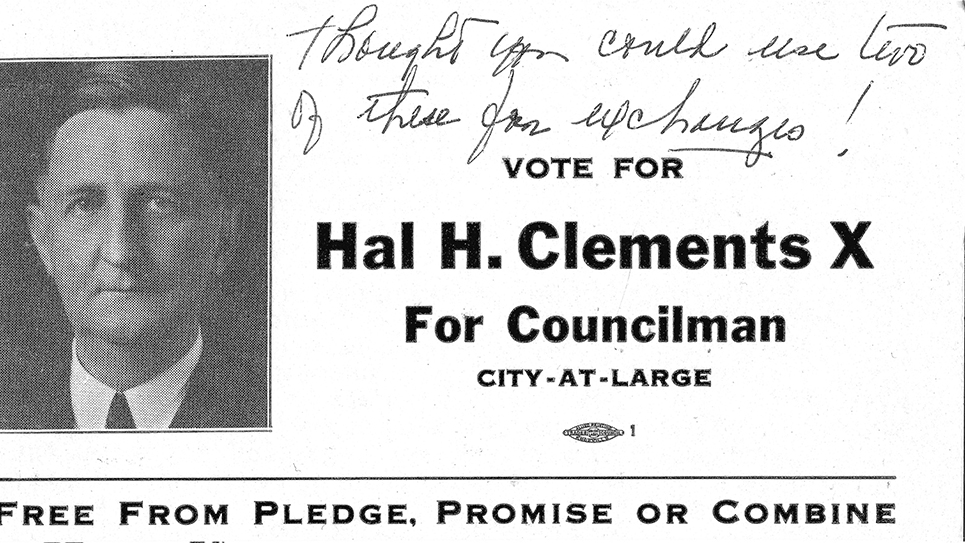
For decades, one of the constants of Knox County’s political life was Hal Harrison Clements, an attorney who dabbled in politics, although it is likely more accurate to say that he was an attorney whose true vocation was politics and he dabbled in the law as time permitted. Clean-shaven with a full head of thick hair, Clements was a fixture in Tennessee’s Republican Party, which he once chaired. In profile, Hal Clements had a beak of a nose and a weak chin, but there was nothing frail about the Knoxville lawyer. Voluble, opinionated, and ever ready to join the battle, Hal Clements was, win or lose, a force to be reckoned with during his lifetime. The firm of Clements and Ailor did a tidy business in Knox County and East Tennessee. Clements’ law partner was former Court of Appeals Judge Thurman Ailor, a Democrat. Clements spoke with a vocal “twang” signifying him as an East Tennessean and was masterful in the give-and-take of both the courtroom and the campaign trail. Hal Clements had a commanding presence and could sway juries with his oratory, carrying his listeners along with him and wringing laughter and tears from them “in the space of a few minutes,” according to one reporter who had observed the attorney ply his trade in the courtroom.
Hal H. Clements built up a large legal practice over time, which caused him to travel in numerous counties in East Tennessee. At the same time, Clements built up a name for himself, which further helped his legal practice as well as his political ambitions.
J. Fred Bibb, longtime district attorney general for Knox County who had moved up to sit on the bench as a judge of the criminal court, remembered Clements fondly. “He was smooth, and adroit in cross examination, and had the ability to transport his personality to a jury,” Bibb told a newsman.
Hal H. Clements had been born in Prescott, Wisconsin, but had come to Knoxville early, where he received the bulk of his education, including at the University of Tennessee. For 41 years, Clements practiced in Tennessee and Knox County courts. During his long political career, he served as the chairman of Tennessee’s Republican Party, Collector of Internal Revenue for Tennessee, was twice elected to the Tennessee State Senate, and was an assistant district attorney general for Knox County. The importance of Hal Clements as a Republican was signified by the fact that he served as a delegate to the 1928 Republican National Convention, where he served on the Platform Committee. Hal Clements had been appointed to serve on the Knox County Election Commission as one of its Republican members. Clements had also been elected to the Knoxville City School Board (the city had a school system at the time) and had once run in the GOP primary for his party’s gubernatorial nomination.
A highly ambitious man, Hal Clements was never idle and seldom quiet. Clements was an East Tennessee mountain Republican who was friendly to labor and even in his later years retained ties to the United Mine Workers of America at a time when mining was an important occupation inside Tennessee’s Second Congressional District. Hal Clements was one of the leading members of Knoxville’s Bar, trying both criminal and civil cases. Clements was involved in some of Knox County’s most notable legal cases.
When Tennessee lost virtually all of its funds with the collapse of the House of Caldwell, state Senator Hal Clements scalded Governor Henry Horton and his administration. Clements had been a vocal critic before the fall of Rogers Caldwell’s financial empire but became even more caustic, if possible, in his fiery denunciation of Horton and his supporters.
Tennessee’s Second Congressional District, in which Knoxville is the largest city, has been the most Republican in the nation inasmuch as it has never elected anything but a member of the Grand Old Party to the US House of Representatives since it has been on the ballot. In 1918, the sitting congressman from the Second Congressional District was Richard W. Austin, a lean man with a firm handshake and a bald top. Austin had been in the U.S. House of Representatives for a decade when he was challenged inside the Republican primary by James Willis Taylor, the mayor of LaFollette. Known as “J. Will,” Taylor sought out to topple Congressman Austin and picked Hal Clements as his campaign manager. It was a hard-fought campaign, and Taylor was born and bred inside the Second District, unlike Austin, who had first run for Congress from Alabama. J. Will Taylor not only upset “Dick” Austin but beat him decisively.
J. Will Taylor, or “Hillbilly Bill” as he would become known throughout his congressional district, would remain in office for the rest of his life and become a national power inside the Republican Party. During the decade of the 1920s, the Republican held the White House through three administrations – – – Warren Harding, Calvin Coolidge and Herbert Hoover – – – and enjoyed majorities in both houses of Congress. J. Will Taylor became the Republican National Committeeman for the Volunteer State and exercised an outsized influence upon the distribution of federal jobs throughout Tennessee during the apex of Republicanism. After eight years of Woodrow Wilson, Republicans were eager and hungry for the federal jobs that came with holding the presidency. J. Will Taylor consolidated his power and helped to entrench himself by making shrewd appointments and even though he was one of two GOP congressmen after the 1922 election, he held considerable sway over federal jobs in all three of Tennessee’s Grand Divisions. I. C. King, for whom the local park in South Knoxville is named, was appointed as U.S. Marshal, a post he held throughout the twelve years of Republican rule. Perhaps the choicest piece of the political pie at the time was the appointment of Collector of Internal Revenue for Tennessee. Naturally, it was a post that attracted a host of applicants and even more aspirants. Yet it was one post which managed to elude J. Will Taylor.
When Warren Harding was elected in 1920, Tennessee went Republican for only the second time in its history; the first having been in 1868 when then-Governor William “Parson” Brownlow had federal troops “monitor” the election and Ulysses S. Grant won the Volunteer State’s electoral votes. Many women resented the opposition of many Tennessee Democrats to giving them the right to vote, even though the Volunteer State had been the final state to ratify the Nineteenth Amendment to the Constitution after a bitter battle in the legislature. Along with Harding came Alf Taylor, a 72-year-old veteran of Tennessee politics, who defeated the hapless Governor A. H. Roberts for a two-year term. Republicans also won five out of Tennessee’s ten seats in the U.S. House of Representatives. Even the previously unbeatable Cordell Hull fell victim to the GOP tidal wave by a few hundred votes. Joe Brown won the Third Congressional District (Chattanooga), Wynne F. Clouse the Fourth Congressional District, and Lon A. Scott won the Seventh Congressional District in West Tennessee. Carroll Reece, a young veteran of the First World War, had defeated incumbent Republican Congressman Sam Sells in the First Congressional District and easily won the general election.
To the victors belong the spoils, but, unfortunately, the Republican congressmen began to bicker, frequently over the same bone. Eventually the post of Collector of Internal Revenue fell to Lee Brock, who was not especially friendly to Congressman J. Will Taylor. Wynne Clouse and Lon Scott would be defeated in the 1922 election and Joe Brown opted not to run again, and all three districts returned to being represented by Democrats. Carroll Reece and J. Will Taylor would jockey for position for the remainder of the decade, with “Hillbilly Bill” usually maintaining the upper hand. Throughout much of the 1920s, J. Will Taylor made repeated efforts to dislodge Lee Brock from his perch as Collector of Internal Revenue for Tennessee. Taylor had to tangle extensively with wealthy Chattanooga financier Claudius Huston, who had been named as chairman of the Republican National Committee by Herbert Hoover. Finally victorious in his bid to remove Brock, J. Will Taylor appointed his friend Hal Clements to become the Collector of Internal Revenue, a post he held until 1933. Clements continued to serve in the Tennessee State Senate while he was also serving as Collector.
J. Will Taylor was, until John and “Jimmy” Duncan, the Second District’s longest-serving congressman, serving for twenty years. During those twenty years, the friendship between the congressman and Hal Clements see-sawed back and forth. More than once, Clements fell out with “Hillbilly Bill” and made noises about running for Congress. It was during one of Clements’ periodic pouts that J. Will Taylor maneuvered Clements into the IRS plum. It surprised no one at all that the friendship between the congressman and Hal Clements was restored once the collectorship appointment was made.
Nor did Clements feel the need to be merely a follower. While Congressman J. Will Taylor aligned himself with those favoring prohibition, Hal Clements, who described himself as a “liberal Republican,” was an ardent “wet.” As any candidate who runs often enough comes to realize, politics has its peaks and valleys and that was certainly true for Hal H. Clements. Clements lost one race for the Tennessee State Senate due to the fraudulent votes counted by the notorious courthouse machine of Burch Biggs in Polk County. Clements also waged and lost a campaign to be elected to the Knoxville City Council.
1944 was to be a year of triumphs and loss for the veteran Republican warrior. As his son Hal Jr. was elected Knox County District Attorney General, Hal Sr. was winning the GOP nomination for the state Senate. The seat Clements Sr. was running for was the entire county of Knox and Clements defeated a young, formidable candidate in state Representative George P. Chandler, who gave up what most believed was a safe seat in the House to seek election to the Senate. August 3, 1944, had to be a great day for Hal Clements as his son was elected attorney general while he was making his own political comeback by winning a hotly contested nomination for the state Senate. The long and frequently stormy political career of Hal Clements ended on a high note.
During late September of 1944, Clements was suffering from a cold which seemed to linger, and it slowly graduated to a persistent case of bronchitis. Nobody thought Hal Clements was seriously ill until his heart simply gave out on October 7, 1944, at 9:15 p.m. at his home on White Avenue. Clements had been ailing enough to have remained at home for the two weeks before his death, although his family had not been worried about his condition. At the time, Clements was making another race for the Tennessee State Senate. For the past several years, most of Clements’ attention politically had been devoted to promoting his son and namesake, who was successfully elected Knox County District Attorney General in 1944. Hal Clements Jr. promptly took a leave of absence as attorney general as he was serving on active duty in the American armed forces during the Second World War.
The passing of Hal Clements was overshadowed by the death of one-time Republican presidential nominee Wendell Willkie, who died in the early morning hours of October 8, 1944. Willkie’s death from a heart attack pushed Clements’ own passing out of the headlines. Hal H. Clements was only 61 years old.
© RAY HILL
If you enjoy this column, order Ray Hill’s biography of Tennessee’s longest-serving U.S. senator and Member of Congress, Kenneth McKellar. You can order “Senator Kenneth McKellar: Feudin’ Son of Tennessee” from Amazon.com and other booksellers. It is the definitive biography of McKellar, who wielded enormous influence in Washington. Order your copy today!