Where Did the Portrait Go?
I am a BIG believer in preservation of historical artifacts, documents, photos and memorabilia, and I think it all should be preserved for future generations. I am invariably appalled to discover items that have been discarded carelessly by descendants who care little or nothing about such artifacts, but I understand that with the passage of time they have less meaning to family members who have neither a memory of nor a connection to the deceased.
There had been a painting of Senator Kenneth McKellar hanging in the Appropriations Committee offices in the Capitol, painted by a Frenchman named Boris Bernhard Gordon. The painting, however, had not been bought by either the U.S. Senate or Senator McKellar and was legally still the property of the painter. No one seems to know where that particular painting went.
Six of McKellar’s friends in Memphis wanted to pay tribute to the senator and gathered a fund together to hire Ms. K. Doyle Ford, a noted artist and gifted portraitist, to paint a portrait of McKellar. The only name revealed publicly was that of McKellar’s friend and political partner, E. H. Crump. Almost certainly one of the six was Lew Barringer, a very successful businessman. Congressman Cliff Davis later explained that so many people were interested in helping to pay for the portrait that it was decided the names of the six individuals would never be divulged, save for that of Ed Crump.
Ms. Ford liked to paint from life and rarely ever painted from photographs, but she had to make do in the case of the McKellar portrait. Kitty Doyle Ford had managed to observe McKellar closely on a few occasions, but he never sat for her, nor was he even aware she was painting a portrait of him.
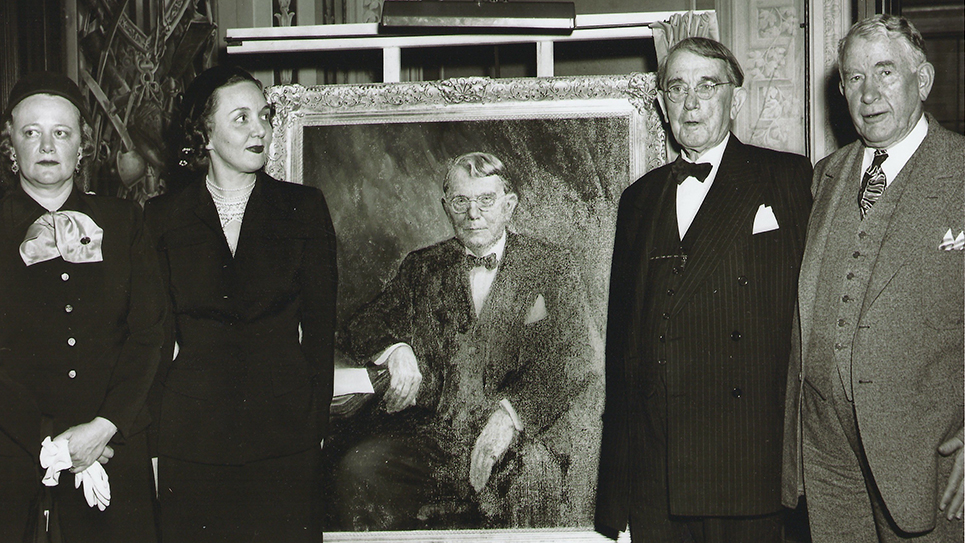
A delegation of Memphians, including cotton broker L. T. “Lew” Barringer, Mrs. Charles Crabtree and the artist, Ms. Ford, was on hand when folks started gathering in the hearing room of the Senate Appropriations Committee. Every member of Tennessee’s congressional delegation was present, as were a host of senators of both parties. The day of the presentation had been a busy one as well for the United States Senate, whose members were debating a repeal of the tax on margarine. Three times the Senate had failed to produce a quorum, yet minutes after one of the quorum calls, more than half the Senate, both Republicans and Democrats, crowded into the Appropriations Committee hearing room to honor Senator Kenneth McKellar. “Maybe we should have moved the debate down here,” J. W. Fulbright of Arkansas laughed.
Chief Justice Fred Vinson of Kentucky was waiting, as was Associate Justice and former Attorney General of the United States Tom Clark of Texas, along with Secretary of the Air Force Stuart Symington and Postmaster General Jesse M. Donaldson. Several members of McKellar’s family and staff were present, including his sister-in-law Janice McKellar, the widow of his youngest brother Don who had worked for him long before the two had married. Several of the senator’s nieces and nephews were also present for the ceremony.
McKellar may well have been the only person in Washington, D.C., who did not know about the presentation ceremony. The senator was called by the clerk of the Senate Appropriations Committee from his office in the Russell Senate Office Building on the pretext of needing to meet with the staff. The senator entered the hearing room through a side door and was stunned by the crowd awaiting his arrival.
Congressman Clifford Davis of Memphis made some brief remarks and presented the portrait to the senator on behalf of McKellar’s friends in Memphis. As Vice President Alben Barkley stood by beaming with pleasure, the portrait was unveiled to much applause by Ms. Ford herself. Congressman Davis brought down the house when he said all of McKellar’s friends very much wanted to see the bachelor senator get married. Vice President Barkley loudly intoned, “Amen!” while the senator grinned and applauded vigorously.
McKellar was so surprised by the gathering and the presentation that it took him some time before he could speak. Senator McKellar was overcome with emotion and repeatedly expressed his gratitude to the people of Tennessee who had “kept me in office longer than any other man from the state.” McKellar said it was “the nicest thing that had ever happened to him except” the people of Tennessee having elected him to Congress and keeping him there for 39 years.
“Tennessee has been more than partial to me,” McKellar told the audience of friends, family and colleagues, “in electing me so many times and in honoring me with this portrait and I appreciate it more than I can say.”
In a town where secrets are usually impossible to keep, the celebration and presentation of Ms. Ford’s portrait to Senator McKellar was kept quiet. The 81-year-old McKellar had no idea and, despite his age, was as busy as ever. McKellar had attended a meeting of the Democratic Policy Committee of the Senate, sorted out the assignments to the Appropriations Committee’s various subcommittees, worked on the coal crisis then afflicting Nashville, and was delighted to hear his friend Henry “Peg” Bell had been named as U.S. Marshal for the Eastern District of Tennessee by President Harry Truman. McKellar was the last to arrive at the Appropriations Committee hearing room and was the most surprised man in Washington when he saw the crowd gathered together.
“It looks like I am going to have to buy a house after all these years so I can have a place to hang the portrait,” McKellar told members of his office force.
The senator’s only regret about the ceremony presenting Kitty Doyle Ford’s portrait to him was the fact his brother Clint was unable to be present in Washington.
The press in Tennessee used the occasion of the gifting of the oil painting of the senator to praise McKellar’s long career in both houses of Congress. Editorials appeared in Tennessee newspapers, like the one in the Jackson Sun, which reminded readers of the senator’s long and faithful service. “Senator McKellar is a man of powerful influence in Washington and has never failed Tennessee when its interests were at stake,” the editorial stated.
Naturally, I became interested in what became of the McKellar portrait painted by Kitty Doyle Ford. An inquiry to the Senate Art Curator’s office brought back a frosty reply that there was no oil painting of Senator Kenneth McKellar. So, then I telephoned Millicent Ford Creech, the daughter of Kitty Doyle Ford. Mrs. Creech, a sprightly and delightful 87-year-old artist, was as intrigued as I was about the portrait of McKellar painted by her mother. I sent her a copy of the photograph above, which she enjoyed and shared with her equally charming and delightful daughter, Norwood, who is also an artist. Evidently, the women in Ms. Ford’s bloodline are all supremely talented, artistic and industrious. Millicent, Norwood and I have been poring through information and the sources available to us to determine whatever became of Kitty Doyle Ford’s magnificent portrait of Senator Kenneth McKellar.
Kathleen “Kitty” Doyle Ford had also painted the official portraits of Governors Ben Laney and Sid McMath of Arkansas. Mentored by the renowned Howard Chandler Christy, who suggested she sign her artwork “K. Doyle Ford,” an idea she adopted. A remarkable artist, Mrs. Ford became much sought after to paint portraits of notable personages and did an excellent job with Senator McKellar’s portrait.
1950 was an especially trying time for many Members of Congress, and the session was an arduous one for the youngest among them. McKellar, an oftentimes peppery personality, still retained a lively sense of humor. While visiting the Colemere Club in Nashville, the senator was asked to sign the register. McKellar took the pen and started to write, and then looked at the club’s president and said, “I may be getting old, but I’m still young enough to know there’s no ink in this fountain pen.”
McKellar was also still able to banter with reporters. Coming home to Memphis, a newspaper reporter quizzed the senator. Asked if he would run again in 1952, McKellar retorted, “I’ll reach that point in my career when I have to.” Asked about the Korean War, the senator replied, “It looks very hopeful and we are going to win, of course.” What about Russia, the reporter wanted to know. “Our attitude should be to get along with Russia just so far as Russia is willing to get along with us.” What about price controls, the reporter queried. “I’ll bet your next question is going to be interesting,” McKellar drawled. The reporter pivoted to asking about wage controls. “I’m sure your next question is going to be even more interesting,” McKellar shot back. What about Secretary of State Dean Acheson? “I don’t serve on the Foreign Relations Committee and am not an expert on the subject, but I certainly feel our foreign affairs are in splendid condition.” The reporter impishly asked the senator about marriage. “I’m not on that committee either,” McKellar laughed.
That same year saw McKellar put in a remarkable performance shepherding the Appropriations Bill through the Senate. Marshall McNeil, the Washington correspondent for the Knoxville News-Sentinel, watched as the senator “walked haltingly into the Senate, supporting himself on a heavy cane, and appearing sometimes to be in pain.” The senator suffered from poor circulation in his lower legs, which did indeed cause him considerable pain sometimes. McKellar was accompanied by a member of his staff who sat in a chair beside the senator’s desk on the front row of the Senate Chamber. Majority Leader Scott Lucas of Illinois referred to McKellar’s ill health as an excuse to recess, which finally brought a roar of displeasure from the Tennessean. During a night session of the Senate, the majority leader noted McKellar seemed “very tired” and suggested “in deference to the senator from Tennessee. . .” McKellar interrupted Lucas before the majority leader could finish his sentence. “I am not so tired as I am lame,” McKellar corrected his colleague. “Especially so after all the attacks which have been made up the bill.”
When the Senate was still droning on around 9:30 p.m. on a Thursday night, Lucas again tried to use McKellar as an excuse to recess and the senator once again interrupted the majority leader. “Oh,” McKellar growled, “let the senator put it on his own account.”
A startled Lucas said, “On my own account … I think the Senate ought to recess until 12 o’clock tomorrow. I so move.”
For five torturous weeks, the U.S. Senate gnawed on the Appropriations Bill, causing Senator McKellar to have to repulse attacks upon it and attempts to alter it significantly, and explain oftentimes minute details about it. Finally, Senator Dennis Chavez of New Mexico got up, a member of the Senate Appropriations Committee, to list notable Tennesseans including John Sevier, Andrew Jackson and James K. Polk. Chavez went on to praise Senator McKellar’s performance as the chairman of the Senate’s Appropriations Committee. That brought the other members of the Senate to their feet, and they gave the old man a standing ovation.
To this time, we have not located the portrait of Senator Kenneth McKellar painted by Kitty Doyle Ford. Hopefully, it is not lost. All too often, things of historical import and value are lost to history, which is a real tragedy. Abraham Lincoln once said, “I don’t think much of a man who is not wiser today than he was yesterday.” History makes us all wiser, and I hope we can locate Kitty Doyle Ford’s portrait of Senator McKellar, and I truly hope it may yet be enjoyed by all Tennesseans.
© 2025 Ray Hill