By Ray Hill
Kentucky was not quite so solidly a Democratic state as many of its sister border and southern states; Republicans could periodically win statewide elections, but Democrats held a strong advantage in most state, local and federal elections in the Bluegrass State. One big exception was John Marshall Robsion, who served as both a congressman and United States senator from Kentucky.
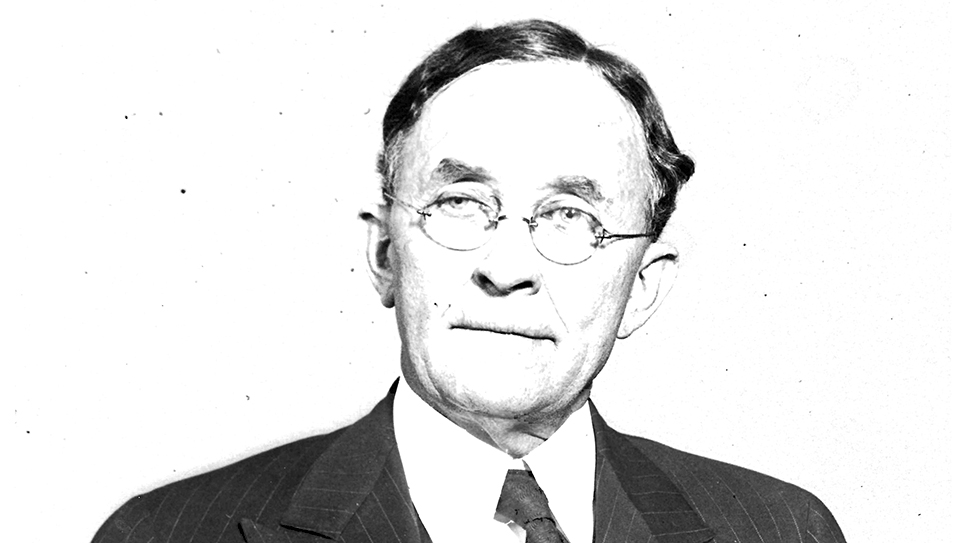
John M. Robsion was no stranger to Tennessee, having attended Holbrook College, which was located in Knoxville. Robsion worked as a teacher, earned a law degree, practiced law and became a banker as well. Governor Flem D. Sampson, a fellow Republican, slapped a nickname on Robsion that stuck, referring to him as “that mountain congressman.” Others referred to Congressman John M. Robsion as “The Tall Sycamore of the Cumberlands.” Six feet, three inches tall, with a craggy face, Robsion looked very much like his fellow hill countrymen. Orphaned as a boy, Robsion worked to put himself through school, eventually earning a law degree. A mountaineer to his core, Robsion once advised a friend that it was a “sight easier not to go out in the first place, than to go out and have to come back.”
The secret of Robsion’s longevity in public office was quite simple; he carefully tended to the needs of the people who elected him and paid close attention to their letters and requests.
First elected to the House of Representatives in 1918 from Kentucky’s Eleventh District, John M. Robsion proved to be impossible to dislodge, so popular was he with the people he represented. Even during those times when Republicans became scarce as hen’s teeth in the Bluegrass State, Congressman Robsion was routinely reelected. Congressman W. Voris Gregory, a Democrat, once described his GOP colleague as a man of “courage and integrity” and thought him “a genuine and typical Kentuckian.” Congressman Thruston Morton, who later served in the United States Senate, said Robsion “had more friends through Kentucky than anyone I have ever known.”
The incumbent congressman from the Eleventh District was Caleb Powers, and John M. Robsion had decided to run against him. Powers sent conflicting signals as to whether or not he would run again, which confused his supporters, while others fell away to back another candidate. Likewise, Congressman Powers seemed unable to decide whether or not he would support American entry into the First World War. One newspaper opined that Powers managed to alienate just about everyone as he would blow hot and cold. At the same time, Robsion was actively moving throughout the district and managed to arouse considerable hostility to the incumbent while at the same time winning support from Republicans. Seeing the handwriting on the wall, Congressman Powers announced he would not seek reelection. John M. Robsion became the GOP nominee and won the general election with better than 76% of the vote.
Robsion proved to be highly popular with his people, and the congressman never dipped below 74% in a general election and only once was someone foolhardy enough to challenge him inside a primary. The congressman won quite nearly 80% of the vote in the 1924 primary. When Senator Frederic M. Sackett resigned his seat to become President Herbert Hoover’s ambassador to Germany, Governor Flem Sampson appointed Congressman Robsion to fill the vacancy on January 9, 1930. Robsion had managed Sampson’s campaign for the governorship in 1927. As one measure of John M. Robsion’s popularity inside his congressional district, the congressman ran ahead of Herbert Hoover during the 1928 GOP landslide. Robsion had been elected six times by the time he accepted appointment to the United States Senate.
Robsion was led down the aisle of the Senate by Senator Simeon Fess of Ohio, who had been one of Robsion’s professors at the Northern University of Ohio years earlier. As Robsion took his seat in the Senate, the Lexington Herald thought him “a typical small town politician,” and for better or worse, his twelve years in Washington, D.C., had not changed him at all.
Senator Sackett and many of his supporters had been factionally opposed to John M. Robsion and those who supported the congressman. Sackett’s appointment as an ambassador helped to ensure there had been no collision of their ambitions. Once appointed, Robsion realized he could not afford a rupture inside his own party, which was already the minority party in Kentucky. Senator Robsion set out to immediately assure those supporters of Frederic Sackett that he did not intend to displace any federal appointees or officeholders. Formerly bitter political enemies united in support of Robsion, who was duly nominated by his party to contend for the full six-year term.
Robsion faced former justice of the Kentucky State Supreme Court, Marvel M. Logan, in the 1930 general election. Logan was an experienced and able campaigner and immediately chastised Senator Robsion for having put his son and namesake into a $6,000 job at the Veterans’ Bureau in Washington, D.C. Logan piously said the job should have gone to an ex-serviceman.
Logan chortled, “Flem Sampson and John Robsion have meddled in every Republican primary race for six years and the men they defeated are sharpening their axes now.” Logan swept aside Senator Robsion’s assertion it had been President Hoover who had reached down from the White House and plucked up John M. Robsion Jr. for the well-paying job in the Veterans’ Bureau. “If I wanted to tell the people of Kentucky a lie, I would tell something more reasonable to believe,” Logan barked. “Can you imagine the President stopping all business while he searched through the United States and finally picked out this beardless youth to appoint to an important post that pays $4,000 more than 99 out of 100 men in Kentucky make?”
Senator Robsion campaigned on pocketbook issues and pointed to defects in the administration of those agencies in Kentucky under the supervision of Democrats. Robsion told an audience in Hyden, “The ripper crowd ripped you out of free textbooks, and if you vote for them, they’ll rip you out of roads.”
Each tried to blame the other for the burden of economic suffering inflicted by the Great Depression. Robsion ran a strong race, but fell short, losing to Logan by just over 27,000 votes. Robsion polled almost 48% of the ballots cast.
The legislature had failed to redistrict, causing every congressman from Kentucky to have to run statewide in 1932. Fortunately, the legislature finally did its job, and the new Ninth Congressional District favored a Republican. The incumbent was Finley Hamilton, by virtue of the at-large election two years earlier. Much of Robsion’s old Eleventh District comprised the new Ninth District. It was immediately apparent that John Robsion was interested in going back to the House of Representatives, but there was a potentially formidable obstacle in his path in the form of former governor Edwin Morrow. Morrow was a remarkably brilliant speaker, and Democrats and Republicans both flocked to hear him whenever he spoke. Ed Morrow had been elected governor in 1919 as a Republican and had been thinking of making another gubernatorial bid. With the creation of a new congressional district that might very well elect a Republican, Morrow turned his sights on the U.S. House of Representatives. Morrow had few peers in public speaking and was already making the rounds in anticipation of running, and some county organizations had already endorsed him for Congress. Robsion, while not as able a speaker as the former governor, was a superb organizer. Congressman Finley Hamilton, calculating the long odds, withdrew as a candidate for the Democratic nomination.
While campaigning for the GOP nomination, Robsion claimed he had the support of all miners, but it was former Governor Morrow who garnered the backing of the United Mine Workers. Yet it was the former senator who won the Republican nomination for Kentucky’s Ninth Congressional District, piling up a majority of more than 8,000 votes over former governor Edwin P. Morrow. It was an indication of Robsion’s continued popularity with the people of his old congressional district during a year when many former officeholders were trying to go to Congress. Former Congresswoman Katherine Langley lost a Republican primary, while former Governor William J. Fields lost the Democratic primary to Congressman Fred Vinson. One factor that contributed to the victory of Robsion was his strong stand against liquor and alcohol. Edwin P. Morrow proved to be gracious in defeat, sending Robsion a telegram noting that the former congressman, in “perhaps the gravest hour of our nation’s need” had won the nomination of their party to go to Congress. Morrow offered his congratulations.
John M. Robsion won the general election with just over 77% of the vote. After a hiatus of almost five years, the 60-year-old former congressman and U.S. senator was returning to Washington, D.C., and the House of Representatives.
Robsion returned to the House in 1935, a time when Republican ranks were thinning due to the popularity of Franklin Roosevelt and the New Deal. The ranks would grow thinner still following the 1936 elections when the GOP lost another fifteen seats, and its total number in the House was only eighty-eight. Even then, the Ninth Congressional District remained solidly Republican, giving Congressman Robsion over 61% of the vote as Franklin Roosevelt carried the Bluegrass State easily. Robsion was reelected in 1938, 1940, 1942 and 1946, showing no inclination to retire. Upon his return to Congress, Robsion was usually addressed by his former title of “senator” rather than his elected title of “congressman.”
There were periodic attempts to dislodge John M. Robsion from his perch in Congress. Eugene Siler, a 42-year-old attorney, challenged Congressman Robsion inside the 1942 GOP primary. Despite a strong effort, Siler only managed to poll around 32% of the vote. Siler later got himself elected to Congress, where he served for 14 years before losing a senatorial primary. Pleaz Mobley and another candidate tried to defeat Robsion in the 1946 Republican primary, but the congressman still polled 63% of the vote.
Outside of his own district, Robsion remained a highly influential figure inside Kentucky’s Republican Party. One sticking point with rival Republicans was the congressman’s promotion of his son, John Jr. A “harmony” meeting had been held by Jefferson County (Louisville) Republican leaders and Robsion. Some outspoken Republicans condemned what they described as a deal between the congressman and Jefferson County leaders to provide the younger Robsion with a lucrative appointive post.
The aging congressman gamely campaigned for the GOP nominee for governor of Kentucky in the 1947 election. Despite his years, Robsion remained quick on his feet. When Congress upped its pay from $7,500 to $10,000 annually, one outraged constituent berated the congressman in a long rant about how much it cost the taxpayers. After listening for a while, Robsion interrupted to say, “I’ve figured this out. My increase will cost my constituents one-fifth of a cent apiece. In five years, that will be a penny.” The congressman reached into his pocket and pulled out a shiny penny and handed it to his somewhat deflated critic. “Here’s yours,” Robsion said cheerfully, “and I’ve got plenty more.”
Traveling from Washington, D.C., to Louisville, where he attended a Lincoln Day Dinner celebration, Congressman Robsion decided not to return to the Capitol immediately, but instead chose to visit with some local friends. Although 75 years old, the congressman seemed to have a sturdy constitution and appeared to be in excellent health, aside from suffering from a cold. The longtime congressman went to bed on the night of Tuesday, February 17, 1948, in Barbourville, Kentucky, the guest of a friend, Circuit Court Clerk John Pickard. Sometime during the night, Congressman Robsion suffered a heart attack in his sleep and died.
The congressman’s son and namesake, John Jr., was elected to the House of Representatives in 1952 and served three terms. The son did not have the common touch that had made his father so popular for so long. John Robsion Jr., unlike his father, was ousted from office during a Democratic sweep in 1958.
© 2026 Ray Hill