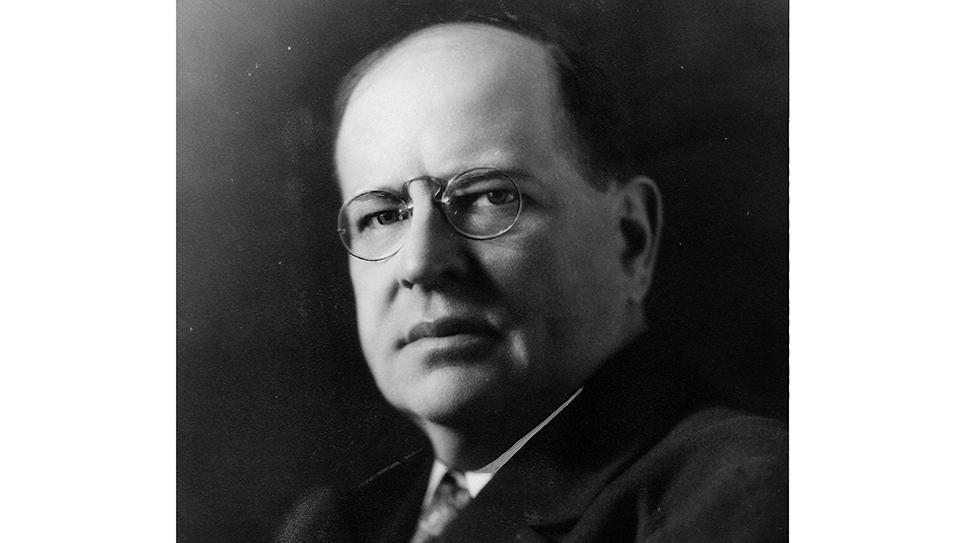
Just about everyone is familiar with the infamous feud between the Hatfields and the McCoys, which may have cost the lives of as many as 100 men and women. Henry Drury Hatfield was a nephew of William A. “Devil Anse” Hatfield. The future governor and U.S. senator hated talk of the legendary feud. “He would actually, physically, throw you out of that hospital if you’d ask him about that feud,” the governor’s great-nephew recalled.
Henry Hatfield’s entire life was one of service. Hatfield was a doctor, and no matter what office he received from the people of West Virginia, it was never as important to him as his occupation. For Henry D. Hatfield, politics and government were his avocation rather than his vocation.
Young Henry was something of a prodigy, having graduated from Franklin College at the remarkably young age of 14. By the time he was 18, he had earned his degree in medicine. Hatfield continued his studies at the University of New York, New York Post Graduate School & Hospital, the New York Polyclinic School & Hospital, and Cornell Medical College. Returning to his home in West Virginia, Henry D. Hatfield became the Mingo County Commissioner of Health at age 20. Dr. Hatfield also began a practice as a surgeon for the Norfolk and Western Railroad. It was not long before the young physician became politically active, not by running for office, but rather by pushing for reforms. Dr. Hatfield lobbied the state legislature intensely to create three new state hospitals. Successful, Hatfield became the chief surgeon of the first state hospital.
As a young doctor, Henry Hatfield traveled to the backwoods and hollows of West Virginia by horseback, where he visited patients, sometimes performing surgeries on kitchen tables and “sterilizing his surgical instruments in kettles bubbling over log fires.” At the time of his death, one newspaper noted it was not unusual for Hatfield to visit the nearest country store to buy groceries for the families he treated. Many of the reforms he sought as governor came from his own experience as a young physician, where he had ridden over the rough trails visiting cabins tucked away in the hills and hollows of West Virginia.
Henry D. Hatfield was as talented a doctor as he was busy, completing 18,000 operations in 14 years. Hatfield evidently had a special knack for setting bones. Most of his patients were “feudists, miners and railroad men.” Dr. Hatfield won a national reputation as a bone specialist.
In 1904, Hatfield ran for a seat in West Virginia’s State Senate and won. It was the beginning of his own electoral career and was something of an accident. Hatfield had become the GOP nominee only after the candidate who had originally been nominated withdrew. Dr. Hatfield was substituted and won the election and was reelected to the West Virginia state Senate. Eventually, Hatfield served as the president of the state Senate.
As with most everything in his life, great success came early to Henry Drury Hatfield. In 1912, Hatfield was the GOP nominee for governor and won a narrow victory over Democrat W. R. Thompson by just over 8,000 votes. At the time, Dr. Hatfield was the youngest man to occupy the governor’s office in the Mountain State. Many of the reforms proposed by Governor Hatfield, not surprisingly, concerned the health and welfare of West Virginians. The governor demanded and got a state health code, created a medical department for the University of West Virginia, reorganized the state insane asylums, and passed a workers’ compensation law that became a model for other states to emulate. The workers’ compensation act passed during his administration as governor had been based upon a similar law in Germany. At the time, it was considered quite a progressive law.
Henry D. Hatfield was fearless in taking a position and was never one to compromise a principle or conviction. Hatfield was a stickler for party discipline and was devout in his belief in rewarding the party faithful.
As his term as governor came to a close, America was entering the First World War, and Henry D. Hatfield left one field of service for another, serving as a major in the Medical Corps.
In 1928, several Republicans wanted their party’s nomination to face U.S. Senator Matthew M. Neely, who had won the seat in an upset six years earlier. Neely had served in the U.S. House of Representatives and was an old-fashioned orator who could quote with equal ease from the Bible or the classics.
Hatfield faced incumbent Governor Howard M. Gore and former Congressman Benjamin Rosenbloom in the Republican primary. It was a measure of Hatfield’s personal popularity that he won 55% of the votes cast.
The campaign against Senator Neely in the fall was hard-fought and bitter. The former governor’s campaign was financed by businessmen, railroads and the mine owners. Neely had strong support from mine workers and organized labor. As an orator, Hatfield was no match for Neely on the stump. Hatfield spoke in a “sing-song voice,” and while earnest, he read his speeches while Senator Neely memorized his, giving them the appearance of being extemporaneous.
As Herbert Hoover was polling more than 58% of the votes in West Virginia, former Governor Henry D. Hatfield only narrowly nudged Senator Matthew Neely out of office, winning by 9,646 votes or 50.68%
Henry D. Hatfield looked like both a country doctor and a senator from West Virginia. Bespectacled, serious, always arrayed in dark, conservative suits, Hatfield was tall and broad and walked with his head slightly bowed, as if always in a state of deep contemplation. Hatfield also always carried a Bible in his hip pocket.
While Congress was in session, Senator Hatfield lived in the Hotel Continental at 420 North Capitol Street, a modest and unpretentious hostelry. Married with a daughter, Senator Hatfield was described by TIME magazine as “socially inactive.” Quite nearly every weekend, Hatfield left Washington, D.C., to return to his home in Huntington, West Virginia. Usually, Dr. Hatfield spent those weekends performing surgeries free of charge for poor patients. Hatfield derived a nice income from an interest in two hospitals in his home state.
When in Washington, Senator Hatfield was prominent amongst those senators sought out by President Hoover. Hatfield often visited Hoover’s summer retreat from Washington’s heat and humidity along the Rapidan, which eventually became Camp David.
During his time in the United States Senate, Henry D. Hatfield became a stalwart member of the old guard of his party. Senator Hatfield loyally backed President Herbert Hoover during the first four years of his time in the Senate. Hoover lost to the Democratic nominee for president in a landslide in 1932, largely due to his inability to grapple with the Great Depression. A man of great energy, after Hoover’s defeat, Senator Hatfield became a caustic critic of the New Deal and the burgeoning bureaucracy. Ever the individualist, Dr. Henry Hatfield was horrified by Franklin Roosevelt and the New Deal. One reporter recalled the senator “neither forgot nor forgave those who embraced” the New Deal.
Matthew M. Neely was very hard to kill politically. Out of office, Neely set his sights on West Virginia’s other seat in the United States Senate. Incumbent Guy Goff was in failing health and declined to run again, and Neely came roaring back, winning by the greatest majority that any candidate received for the U.S. Senate in West Virginia’s history. Henry Hatfield had the uncomfortable experience of having his former opponent as his Senate colleague for the next four years.
Senator Neely was as enthusiastic a supporter of FDR and the New Deal as Henry Hatfield was an opponent. Neely consolidated his power in West Virginia and headed the politically potent “federal faction” of his state’s Democratic Party. Neely backed 29-year-old state legislator Rush Dew Holt for the U.S. Senate to challenge Henry Hatfield, who was seeking a second term.
Holt enjoyed the powerful backing of not only Senator Neely and his federal faction, but also that of the politically potent United Mine Workers’ union. Senator Hatfield did not shy away from the contest, making a determined stand on behalf of both the Republican Party and his dislike for the New Deal. Senator Hatfield toured West Virginia, speaking to audiences in cities and hamlets. Hatfield excoriated Van Bittner of the United Mine Workers of America in a letter addressed to the labor leader, accusing Bittner of having “shown ingratitude, insincerity and political indecency.” Hatfield was replying to a letter sent by Bitter, and the senator flatly stated, “Your intense desire to control the election of a senator who could be subservient to your wishes precludes you from being fair.”
Hatfield continued to flay the New Deal in his speeches to the voters of West Virginia. Senator Hatfield roared that “the stubborn refusal of the New Deal technicians to give assurances asked by business, finance and labor can only serve to prolong the present period of unemployment, destitution and undernourishment of millions of citizens.”
Senator Hatfield did not hesitate to criticize the most popular member of President Roosevelt’s Cabinet, Cordell Hull of Tennessee. Hatfield declaimed Hull “supported by the arbitrary powers that he possesses under the new tariff law, constitutes an amazing chapter of political duplicity and are a distinct menace, not only to recovery from the depression, but to the long range policy of the whole nation.”
Senator Hatfield campaigned as a statesman while attempting to portray Rush Holt as an inexperienced, immature and callow youth who had accomplished very little. Unfortunately, the suffering all across the United States inflicted by the harshness of the Great Depression was acutely felt by many millions of people and the suffering in West Virginia was especially terrible. The majority of voters didn’t care if Rush Holt was young; they wanted someone to back Franklin Roosevelt and help to end their misery. Holt beat Senator Hatfield by more than 68,000 votes, winning with 55% of the ballots cast.
Holt had to wait six months to be sworn into the U.S. Senate, as he did not reach the constitutionally required age of 30 before that time. Senator Holt would have a spectacular falling out with his mentor, Matt Neely, and would become one of the most outspoken noninterventionists in the Senate.
Henry D. Hatfield had run his reelection campaign on his beliefs and record and recognized the tide of the times had been against him. Hatfield had pitched his campaign on “sane government,” a plea that had been rejected by the majority of the people he represented.
Hatfield would never be tempted again to seek public office.
There was most certainly life after the Senate for Henry Drury Hatfield. The former senator returned to his home in Huntington and resumed the practice of medicine. The former governor and senator remained a prominent figure in both his own political party and state. So, too, was Dr. Hatfield sought out by patients; he continued to attend well past his own 80th birthday. H. D. Hatfield kept regular office hours as an octogenarian, long past the time when most men had already retired.
Hatfield had been the head of the corporation that ran Huntington’s Memorial Hospital for nearly half a century. A facility with 140 beds, the hospital had been closed in 1958 after the federal government filed liens of almost $350,000 against the corporation. Evidently, the company running the hospital owed corporation and Social Security taxes for almost a decade, a period when Henry Hatfield was ill and thought to be near death. The former governor recovered, but the corporation apparently did not. The furnishings, equipment and everything else were auctioned off, but brought only a small sum.
After a long and very productive life, Henry Hatfield died in his own home, aged 87, on October 23, 1962. The former governor left an estate of some $3.6 million, which today would be the equivalent of almost $38 million.
© 2026 Ray Hill