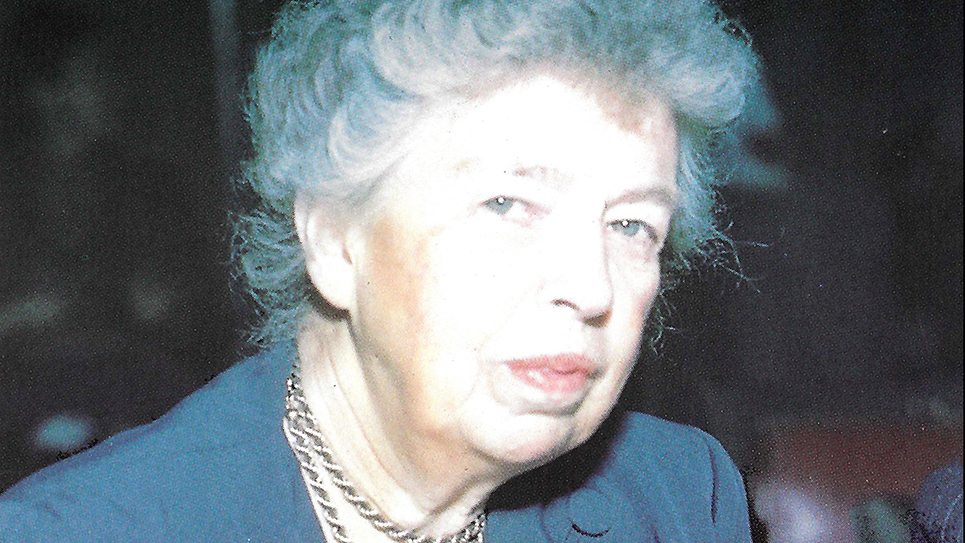
Eleanor Roosevelt was no ordinary First Lady. Separated from her husband, at least emotionally if not literally, by past mistakes, Mrs. Roosevelt set out to recreate herself while living in the White House. If her husband was known worldwide, then quite probably Eleanor Roosevelt was the best-known woman in the world. In the past, most First Ladies were content to preside over teas and stand beside the husband at the appropriate time. Eleanor Roosevelt, due to her husband’s inability to walk after having been stricken with polio, became the eyes and ears of FDR outside the White House. Mrs. Roosevelt also managed to keep her own identity, beginning one of the most popular columns at a time when virtually every American got his or her news from the pages of the newspaper. Eleanor Roosevelt wrote “My Day” six days a week from December 31, 1935, until September 26, 1962, when she became too ill to continue.
On April 30, 1940, Eleanor Roosevelt began broadcasting her own radio show over the NBC network. The radio was the prime media outlet, aside from newspapers, at the time, as television was several years away from dominating the airwaves. Prior to the launch of her own show, Mrs. Roosevelt had appeared on the radio as a guest on numerous other programs as well as having been broadcast as a speaker during events carried live for listeners. Mrs. Roosevelt’s radio show aired every Tuesday and Thursday, irrespective of where she might be in the country. During its first run, Eleanor Roosevelt’s radio program was sponsored by the Manhattan Soap Company, which manufactured Sweetheart Soap. Mrs. Roosevelt’s program was quite simple in nature; she talked about her day, a reflection of her daily newspaper column, or those issues that either concerned or interested her. Broadcasting her initial show from station WRC in Washington, D.C., the First Lady was a hit with audiences and critics alike. Mrs. Roosevelt always preferred sitting down while broadcasting rather than standing. The First Lady was also well-versed in the various hand signals used by radio technicians of the day. The length of Mrs. Roosevelt’s radio show was fifteen minutes and it aired at 1:15 p.m. Eastern Standard Time. While her own show did not last long, Eleanor Roosevelt made some 300 appearances over the radio, oftentimes being handsomely compensated. So, too, was the First Lady well paid for her weekly column. It was a different day and age and would now certainly be considered a conflict of interest, but at the time Mrs. Roosevelt earned her own money, oftentimes more than her husband made as president of the United States.
When FDR died, his widow had announced somberly, “The story is over.” She could not have been more wrong. On December 21, 1945, President Harry Truman wrote Eleanor Roosevelt to inform her that he had appointed her as a delegate to the United Nations. “You, as a representative of the United States, will bear the grave responsibility of demonstrating the wholehearted support which this government is pledged to give to the United Nations organization, to the end that the organization can become the means of preserving the international peace and of creating conditions of mutual trust and economic and social well-being among all peoples of the world,” Truman wrote in his letter to Mrs. Roosevelt.
A woman of many firsts, Eleanor Roosevelt also became the first woman to represent the United States at the United Nations. When President Truman initially wanted to appoint Mrs. Roosevelt to the U.S. delegation to the UN, she had turned down the offer, feeling that she was too inexperienced for such a role. Truman continued to press her, and eventually, Eleanor Roosevelt changed her mind. “I believed the United Nations to be the one hope for a peaceful world,” Mrs. Roosevelt later explained. “I knew that my husband had placed great importance on the establishment of this world organization. So I felt a great sense of responsibility.”
President Harry Truman had wisely peppered the American delegation to the first session of the United Nations, which was held in January 1946 in London, with both Republicans and Democrats. Among Mrs. Roosevelt’s colleagues were Secretary of State Edward Stettinius and Senators Tom Connally of Texas and Arthur Vandenberg of Michigan. The alternates were as distinguished as the delegates. Truman had named Sol Bloom, chairman of the House Foreign Affairs Committee, along with his GOP counterpart, Congressman Charles A. Eaton of New Jersey; Frank Walker, a Democratic politico who had served as postmaster general under FDR; and John G. Townsend Jr., a former Republican senator from Delaware who was also the chief fundraiser for the senatorial campaign committee. Lastly, Truman appointed John Foster Dulles, a prominent Wall Street attorney and GOP foreign policy expert, who would later become secretary of state under President Dwight D. Eisenhower.
Following the death of her husband, Eleanor Roosevelt faced a new life altogether. Mrs. Roosevelt had turned down various entreaties, including running for the United States Senate or becoming the head of a university. Yet Eleanor Roosevelt had no intention of remaining silent. With Franklin Roosevelt dead, she would have to speak for herself, and she proved more than able to raise her voice in support of those things in which she believed so deeply.
Eleanor Roosevelt’s appointment, as one of the best-known women in the world, as well as a former First Lady of the United States, gave the delegation to the United Nations an even greater standing as representatives of the American government. Still, Mrs. Roosevelt was given an assignment perhaps less meaningful than that given to most of her male colleagues. In truth, some of her male colleagues were less than thrilled by her appointment.
The former First Lady was assigned to a committee which occupied itself with those questions concerning economic, cultural and humanitarian issues. The menfolk were left to wrestle with the more political, legal and financial matters and the atomic bomb, all of which were facing the United Nations. Yet through that assignment where some of her male colleagues thought she could do little or no harm, Eleanor Roosevelt would rise head and shoulders above those same men.
During the years she served as a member of the American delegation to the United Nations, that organization considered the most pressing issues facing mankind. Control of atomic weapons, a proposed armed force for the UN to keep the peace, the creation of the State of Israel, and the rights of women were all considered by the United Nations during the time that Mrs. Roosevelt represented the United States.
Eleanor Roosevelt made the assignment her own and quickly demonstrated she was not to be underestimated because of her lack of diplomatic experience, much less her gender. To the surprise of some, Mrs. Roosevelt proved to be an effective spokesperson for the American point of view, as well as quite diplomatic in her dealings with those delegates from other countries whose support was needed by the United States. So, too, was Eleanor Roosevelt highly articulate in voicing America’s positions on those issues involving human rights and freedoms. Mrs. Roosevelt stoutly argued for the right of self-determination for those all too numerous refugees who had been displaced from their homes during the Second World War. The former First Lady was profoundly opposed to the notion of forced repatriation for refugees, meaning those who did not wish to return to their home countries, many of which had been gobbled up and come under the domination of the Communist dictatorship of the Soviet Union.
Because of her ability and standing, Eleanor Roosevelt was named as the United States’ representative on the newly created Human Rights Committee of the United Nations. Throughout her years of service as a member of the American delegation to the UN, Mrs. Roosevelt always maintained that her assignment to the Human Rights Committee remained her “most important task.” The diplomatic skill, hard work and talent of Eleanor Roosevelt were recognized by her colleagues, who promptly named her as chair of the Human Rights Committee.
Mrs. Roosevelt took her work as a member of the Human Rights Committee very seriously, and the woman who came from a sheltered and patrician background found herself frequently debating with the usually outraged Soviet representative, especially where the matter of rights for human beings was concerned. The United Nations was tussling with defining just what liberties should be established for human rights. Mrs. Roosevelt wanted the human rights declaration to echo those contained in the American Bill of Rights. The former First Lady also insisted that the document and statement contain language that was both simple and to the point, so that it could be easily understood by everybody who read it. The end result of Eleanor Roosevelt’s hard work was the Universal Declaration of Human Rights, which became the hope of the world in how each country should treat its own citizens.
Eleanor Roosevelt had to first convince the United States Department of State to embrace a statement of human rights, which included economic, social and cultural rights instead of solely being focused on civil rights. The state department was, at least in the beginning, if not resistant, it was highly reluctant. After finally dragging along the recalcitrant state department behind her, Mrs. Roosevelt had to use every ounce of her diplomatic skill in order to convince the Soviet Union not to object to and kill the provisions of the declaration dealing with civil and political rights and liberties. Then the former First Lady had to get the declaration approved by the full United Nations. It was a long and difficult path to success.
Among those rights were the freedom of opinion and the right to express those opinions. The freedom of thought and the practice of one’s own religion. It was a document full of hope for the world, through which the United Nations had been born, but of course, many of those nations comprising the UN, especially those ruled by Communists, fell far short of the goals stated in the Declaration and still do to this day.
Eleanor Roosevelt spoke before the assembled nations of the world at the UN meeting to urge the adoption of the declaration, saying it might well become “the international Magna Carta” that would lift the people of the earth “to a higher standard of life and to greater enjoyment of freedom.”
Forty-eight nations voted to affirm the Universal Declaration of Human Rights. While no nation voted against it, eight nations abstained. Once the vote was concluded, the delegates got to their feet to give Eleanor Roosevelt a standing ovation.
Some years later, Mrs. Roosevelt put words to her beliefs about the declaration. “Where, after all, do universal human rights begin?” she wondered before answering her own question. “In small places, close to home – – – so close and so small that they cannot be seen on any map of the world. Yet they are the world of the individual person. The neighborhood he lives in; the school or college he attends; the factory, farm or office where he works. Such are the places where every man, woman and child seeks equal justice, equal opportunity, equal dignity without discrimination. Unless these rights have meaning there, they have little meaning anywhere. Without concerted citizen action to uphold them close to home, we shall look in vain for progress in the larger world.”
No one can always please everyone and that included Eleanor Roosevelt, who was criticized by a wide spectrum of groups ranging from feminists to the Ku Klux Klan. Mrs. Roosevelt’s kind exterior hid a determined woman with a resolve of iron. Eleanor Roosevelt left the United Nations in 1953 after being replaced by the incoming administration of President Eisenhower. Mrs. Roosevelt continued to speak out until her death on November 7, 1962, when she died from a mysterious blood disorder. It was later discovered after her death that the former First Lady had been suffering from tuberculosis.
© 2026 Ray Hill