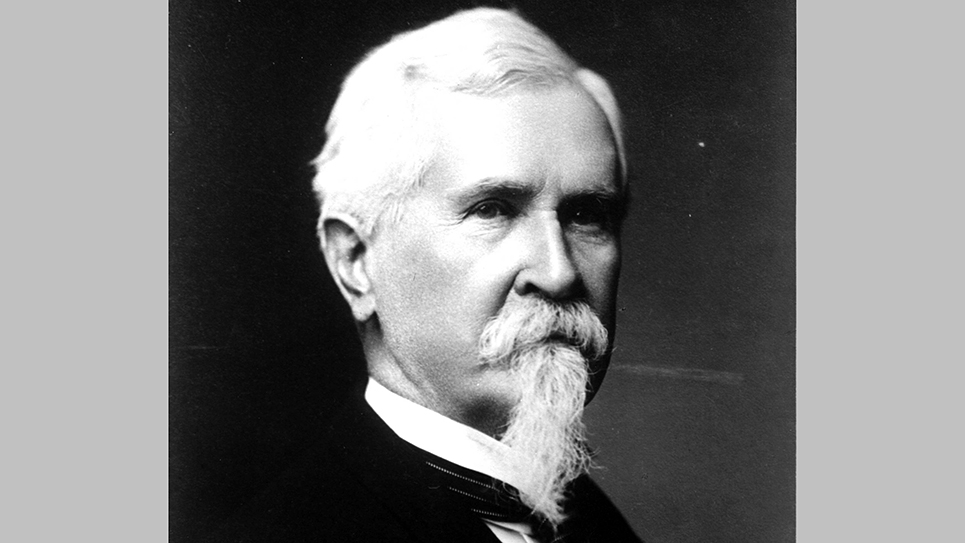
James Davis Porter served two terms as governor of Tennessee and remained one of the most notable of the Volunteer State’s citizens. Lawmaker, judge, chief executive, highly successful businessman and college president, James D. Porter lived a full and remarkable life. A distinguished-looking man, today James D. Porter would embody the stereotypical “Southern colonel” with his white hair, sweeping moustache and Van Dyke beard. Like many people of his time and far less true today, James D. Porter was born and died in the same town in which he lived the most of his life: Paris, Tennessee. By the time he died, Porter had been in the public eye longer than any other person in the State of Tennessee. Throughout his life, Porter was also profoundly interested in the history of Tennessee and was considered an expert on the subject. The former governor frequently wrote articles about incidents from the Volunteer State’s history and remained an avid and active member of the Tennessee Historical Society for the bigger part of his adult life. Porter personally wrote an extensive military history of the Confederacy in Tennessee. Although Tennessee’s twenty-fifth governor, he was the first person to be born and raised in West Tennessee to be elected as the Volunteer State’s chief executive.
A man of striking appearance, Porter’s demeanor matched his rather majestic exterior. James D. Porter was one of the few men who could be recognized at a glance. Porter possessed a probing intellect and a very strong character. Governor Porter was the quintessential Southern gentleman come to life. Indeed, James D. Porter looked as if he could have walked out of the pages of “Gone With the Wind.” Governor James D. Porter was a man who commanded attention.
Born on December 7, 1828, Porter was the third son of Thomas Kennedy and Geraldine Porter. David Cochrane, an Irishman from Belfast, Ireland, helped to educate James Porter as the principal of an academy in Paris, Tennessee. Porter was 16 years old when he entered the University of Nashville. After he graduated from the University of Nashville in 1846, he promptly enrolled in the Cumberland Law School. Porter had been tutored in the law, or in the vernacular of the time, “read law” with General John H. Dunlap. While studying with Dunlap, young Porter fell in love with the general’s daughter, Susannah, and the two were married. Mrs. Porter and her father, General Dunlap, were distinctly against her husband entering public life, but were supportive when he chose to do so anyway. The couple had two sons and a daughter together.
The future governor began practicing law in 1851 in his native Paris. Almost immediately, Porter took an interest in politics and was elected to the Tennessee House of Representatives in 1858 as a Whig. Porter attended the state convention, which nominated John Bell for president in the highly contentious election of 1860, which was a multicandidate race. Abraham Lincoln, the second nominee of the new Republican Party, defeated Bell, a former Whig, as well as Democrat Stephen Douglas, who, like Lincoln, was from Illinois, and John Breckinridge of Kentucky, who was the candidate of Southern Democrats.
James D. Porter was a member of the state legislature that sundered Tennessee’s ties with the Union and had played a significant role in the proceedings. Porter was the author of the resolution, which stated Tennessee would join her sister states from the South should war break out. Known as the “Porter Resolution,” it was adopted by several other Southern states. Once secession became a fact, Porter helped General Gideon J. Pillow to organize what later became known as the Army of Tennessee for the Confederacy. The future governor was released from the Confederate Army when the Army of Tennessee surrendered in May of 1865. When Porter returned home, the state was under Republican rule and three-fourths of all White voters had been disenfranchised, unable to vote in elections.
When Tennessee seceded from the Union, Porter joined the Confederate Army, where he was an adjutant general on the staff of General Benjamin Franklin Cheatham. Following the Civil War, James D. Porter remained active in civic affairs and was a delegate to the Constitutional Convention of 1870, which drafted a new constitution for the Volunteer State. That same year, Porter was elected judge of Tennessee’s Twelfth Judicial Circuit. Just four years later, Porter was nominated by the Democratic Party as its candidate for governor while still serving as a judge of the Circuit Court. Porter’s opponent in the 1874 election was perhaps the most personally popular Republican in the state, Horace Maynard, who had been elected statewide in 1872 as congressman-at-large over a divided Democratic Party, beating Benjamin F. Cheatham and former President Andrew Johnson.
Only the second man to become governor following Reconstruction, James D. Porter was reelected in 1876. Following his leaving the governor’s office, Porter became the president of the Nashville, Chattanooga and St. Louis Railroad in 1880. Porter remained in that post until the election of President Grover Cleveland in 1884. Cleveland was the first Democrat to be elected to the White House since the Civil War (Andrew Johnson was indeed a Democrat, but he succeeded to the presidency following the assassination of Abraham Lincoln) and Porter was named as Assistant Secretary of State under Thomas F. Bayard of Delaware. Cleveland was defeated in 1888, although he narrowly won the popular vote, by Benjamin Harrison, only to run for a third time and win in 1892, a feat which has only happened twice in American history.
Porter had been frequently mentioned as a possible candidate for the United States Senate during a time when senators were elected by state legislatures rather than the people. The years of the Civil War had taken a terrible toll on Tennessee and her people. The administration of the state’s affairs suffered accordingly. Andrew Johnson served as the military governor of the state, appointed by President Lincoln, from 1862 until March 4, 1865, when he assumed the office of vice president of the United States. Edward H. East served for a month as governor before surrendering the office to William Brownlow. With former Confederates disenfranchised and unable to vote, “Parson” Brownlow reigned supreme for four years, and his parting gift to himself upon leaving the governorship was a seat in the United States Senate. Brownlow’s successor was also a Republican, DeWitt Senter, who served for two years. Senter had alienated enough Republicans by being lenient to former Confederates that he did not bother to run for reelection. John C. Brown easily defeated the GOP nominee. President Andrew Johnson had pardoned the former Confederates, restoring their voting rights and that made the Democrats the majority party in the Volunteer State for the next one hundred years. Only four Republicans would be elected as governor from 1871 until 1971. Tennessee never elected a Republican to the United States Senate until 1966, when Howard Baker defeated Governor Frank Clement.
Brown served for two consecutive two-year terms before James D. Porter was nominated and elected in 1874. Porter had not been the leading candidate for the nomination of his party when it met in convention in 1874. Josiah Patterson, father of future governor Malcolm Rice Patterson, and Jere Baxter fought a bitter battle for the nomination, only to see the delegates turn to Judge James D. Porter.
The biggest issue confronting both Governors Brown and Porter was Tennessee’s sorry financial condition as the Treasury had been emptied under the administration of Parson Brownlow. Governor John C. Brown had been burdened with the task of cleaning up the state’s finances and putting it back on the path to financial solvency. Public education had begun in Tennessee, and it was James D. Porter who helped it to its feet and nudged it on its way forward. Perhaps Porter’s greatest accomplishment as governor was bringing order out of chaos.
Following his departure from the governor’s office, Porter engaged in what several former governors of Tennessee did for work: assume the presidency of a railroad. James “Lean Jimmy” Jones had assumed the presidency of the Memphis & Charleston Railroad in 1858, and Porter’s predecessor, John C. Brown, moved to Texas for a period of time, where he became the president of the Texas and Pacific Railroad. Porter remained as the head of the Nashville, Chattanooga and St. Louis Railroad until he briefly returned home to Paris before accepting the office of Assistant Secretary of State under President Grover Cleveland. Both former Governor Porter and former President Cleveland remained personal friends following the election loss of 1888. Porter went home to Tennessee, where he was active on behalf of Cleveland when the former chief executive sought the Democratic presidential nomination for a third time in 1892. James D. Porter was the chairman of the Tennessee delegation to the 1892 Democratic National Convention. Reelected to a second nonconsecutive term, Grover Cleveland did not forget his friend in Tennessee. The president nominated James Davis Porter to be America’s Envoy Extraordinary and Minister Plenipotentiary to Chile. Porter’s nomination was approved by the United States Senate and Porter and his wife, Susannah, served the entire four years of Cleveland’s second administration in Chile. The couple returned home to Paris, Tennessee, at the expiration of Cleveland’s term in 1897. Porter was 70 years old, but as one reporter wrote, like Moses, “his eye was not dim nor his natural force abated,” and the former governor became chancellor of Peabody College. George Peabody had left millions of dollars, which the late millionaire wished to be left to educate Southerners. In the beginning, Peabody College was supposed to be merely an adjunct of Vanderbilt University, a notion James Porter disliked. As a member of the board of directors for the late George Peabody’s legacy, the former governor fought the idea of Peabody Normal College being an attachment to Vanderbilt. That battle raged for two or three years before it was lost.
Such was James D. Porter’s stature in Tennessee that he remained above the frequently bitter and tumultuous battles and faction fights inside the Volunteer State’s Democratic Party. Porter was a friend of then-embattled Governor Malcolm Patterson in 1908, when the incumbent was facing a strong challenge inside the Democratic primary from former United States Senator Edward Ward Carmack. Even the warmest supporters of Carmack, who would curse out the governor’s supporters when reminded that former Governor Porter was supporting Patterson, would meekly murmur that it was simply “unfortunate.”
Governor Porter was acknowledged to be a good judge of character of his fellow man. It was Porter who launched the judicial career of Horace H. Lurton who eventually sat on the Tennessee Supreme Court as a justice. Porter was a contemporary of some of the towering figures of Tennessee’s politics, both before and following the Civil War, including Andrew Johnson, Isham G. Harris, Emerson Ethridge, Horace Maynard, William G. Brownlow, and the colorful John H. Savage.
By the time James D. Porter settled into retirement, he had become “the grand old man” of Tennessee. Porter saw eleven other men inaugurated as governor of Tennessee to succeed him in office.
Following his death, only two men of the one hundred who had drafted the new state constitution in 1870 remained living. Porter’s death left five men living who had served as governor of Tennessee: John Buchanan, Benton McMillin, James B. Frazier, John I. Cox and Malcolm Patterson.
Eighty-four years old, the former governor began ailing. The Chattanooga Times reported Porter had been suffering from “a complication of diseases incident to old age.”
James Davis Porter died peacefully at his home in Paris, Tennessee, on May 18, 1912, surrounded by the immediate members of his family. Governor Porter was mourned by all of Tennessee.
James D. Porter’s life was useful to his fellow citizens, state and nation. Porter’s was the very definition of a life well lived. There were few men in Tennessee who were as highly esteemed as was former Governor James Davis Porter.
© 2026 Ray Hill