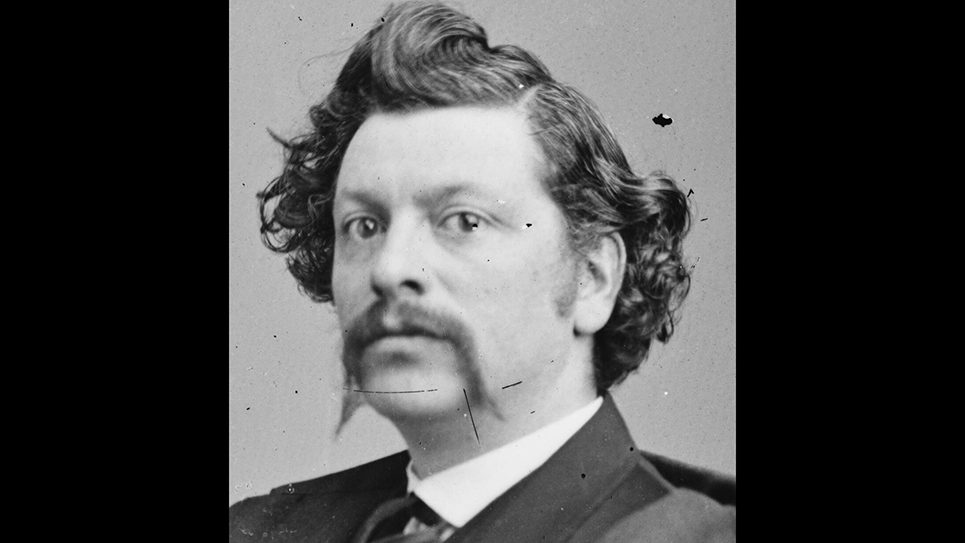
There was a time when John H. Savage was one of the most prominent men in Tennessee. With his long, wavy locks of hair and a moustache that drooped below his chin, Savage resembled a mix between an outlaw and a Chinese Mandarin, especially with his dark, piercing eyes. At age 87, the former congressman published his memoirs, “The Life of John H. Savage.” One newspaperman later wrote that Savage “was one of the most remarkable men this State has ever produced.” A man of firm and unshakable convictions, Savage tended to see things in the darkest shades of black and the purest of whites. The preface of his memoirs reveals much about Savage’s nature. “John H. Savage has been misrepresented, ridiculed, abused, vilified and slandered in more ways and to a greater extent than any other citizen in the State of Tennessee,” it read.
Those were not merely the musings of someone with a serious victim complex, nor that of one who just couldn’t accept criticism. The former congressman recounted the various times he had been denounced by newspaper editors as having lost his mind, denounced as quite literally crazy, a demagogue, a perennial office seeker, a “champion repudiator,” and even a chimpanzee monkey. Savage wrote his memoirs to give his side of the story and, hopefully, convince readers that what had been written about him previously was not at all true. Certainly, John H. Savage had his own say in his memoirs, and one review noted: “a number of passages in the book are too warm to handle without tongs.”
It was certainly true that John H. Savage came along during difficult and unusually perilous times. Whatever might be said of John Houston Savage, he was a man of conviction and never lacked courage, either physical or moral. Savage attended public schools, which were then referred to as the “common schools.” Savage volunteered to serve as a private and fought in the war against the Seminoles. Once back home in Tennessee, Savage studied law, passed the Bar exam and began the practice of his profession in Smithville, Tennessee. Savage continued to be active in Tennessee’s militia, rising to the rank of colonel, while practicing law. John Savage’s entry into public office was when he won a special election as the district attorney general for his judicial district in 1841, a post he occupied through 1847. John Savage was named as an elector for James K. Polk in 1844 and the suggestion that he run as a presidential elector came from Polk himself. Ironically, it was Henry Clay who carried Tennessee, although he lost the election.
At the same time, Savage was commissioned as a major in the United States Army and quickly promoted to lieutenant colonel, a title he kept his entire life. Savage fought in the Mexican War during the administration of his fellow Tennessean, James K. Polk. In 1848, John Houston Savage was elected as a Democrat to the US House of Representatives. Savage was reelected in 1850 and could likely have won another term in 1852, but he refused to be a candidate because he was tired of Congress. Savage returned to Tennessee and resumed his law practice.
It was while he was serving his first two terms in the House that Savage broke with Andrew Johnson, who was serving as the congressman from the First District in upper East Tennessee. The two remained political enemies.
Democrats were horrified when Savage’s successor in the House was William Cullom, a former congressman from the Eighth District who had moved and won election from the Fourth District as a Whig. Democrats were anxious to recapture the seat and they sought out John H. Savage, believing he would beat Congressman Cullom. Grudgingly, Savage finally consented to run and the campaign for the House in Tennessee’s Fourth Congressional District by all accounts was a spectacular one.
The canvass for the congressional campaign was a hot one, and Savage and Cullom agreed to a joint debate. Whether true or not, it was said that before the debate began, both candidates placed their pistols and Bowie knives on a table before the speaking began. Savage always denied that it was true, yet never failed to acknowledge the fact that he never campaigned without being armed. At one joint debate, things became so heated that the two candidates began to tussle before Savage drew and cocked his pistol. Congressman Cullom quickly threw up his hands and reminded his opponent he was unarmed.
Savage did indeed win the election of 1854 and returned to Washington, D.C. Colonel Savage had the dubious honor of being considered an expert on “the code of honor,” meaning dueling. While serving his third term in Congress, Savage went to a shooting gallery with Congressman Charles J. Faulkner of Virginia, who was astonished to see his colleague from Tennessee demonstrate remarkable accuracy with both pistol and rifle. Savage earned such a reputation as a marksman; he never again fired a gun while in Washington, D.C.
John H. Savage did serve notice to several men in preparation for a duel, one being Preston Brooks of South Carolina, who is remembered today for having nearly beaten Senator Charles Sumner of Massachusetts to death with his cane. Another, John Woodruff of Connecticut, was so rattled by Savage’s challenge that he humiliated himself. Congressman Savage withdrew the challenge, telling Woodruff that he was “too low on the scale of humanity to give satisfaction to any gentleman.”
Once again, after two terms, Savage refused to run for a third term. When Tennessee seceded from the Union, Savage joined the Confederate Army and was twice wounded. Although he served as a colonel, Savage resigned his commission because of his belief that he was being discriminated against in being promoted. The slaughter of his men at Perryville, where Savage was himself wounded, saw 199 men out of 250 killed, causing the colonel to drop beneath a tree and cry like a child.
The former congressman was especially bitter at the rapid advancement of Isham Green Harris, who had been governor of Tennessee when the Volunteer State joined the Confederacy. What he saw as favoritism with the rapid promotion of Harris, who became a general, rankled John Savage and stoked an intense dislike of the former governor, which lasted even after Harris was dead. In his memoirs, Savage recalls being urged by the comptroller of Tennessee to try and become friends with Isham G. Harris. “I consider Harris as a man without truth or honor,” Savage snapped. “I should dread his pretended friendship much more than his open enmity. You know as well as I that he has acted the rascal with me and done me all the injury he could. I want nothing to do with him.”
Isham G. Harris returned to public life following the Civil War and won election to the United States Senate three times, always over the public and fierce opposition of John H. Savage. The two did meet, but the atmosphere was frosty, albeit it polite. The two men shook hands while Savage informed the senator, “Nothing that you could say would alter my opinion of your conduct in the past.” After that, Savage coldly bade Senator Harris “good morning” and departed.
Two of Tennessee’s towering political figures during John Savage’s time were Andrew Johnson, who served as congressman, US senator, military governor, vice president and president of the United States, and Horace Maynard. Johnson, like Savage, was a Democrat, while Maynard was one of Tennessee’s leading Republicans. Maynard was elected to the US House of Representatives from the Second Congressional District several times, defeated Johnson and another Democrat in 1872 to win a statewide election as congressman-at-large, and held several important posts during GOP presidential administrations. Both Andrew Johnson and Horace Maynard were able speakers, and Savage recalled in his memoirs meeting both of them in a joint debate in Sparta, Tennessee. Savage proceeded to “indict” Maynard and Johnson with 23 counts of high political crimes and misdemeanors. Savage said Johnson was the “chief criminal,” while Maynard was the “high accessory before and after the fact.” John Savage was ready for anything, ready for any challenge, especially with his provocative speeches and intemperate tongue, as he always was armed when campaigning or on the stump. Friends and foes both repeated what was often said of the former congressman: “Savage by name and savage by nature.”
Although he had chosen not to seek reelection to Congress, John H. Savage was not done with public office. Savage offered himself as a candidate for the Tennessee House of Representatives to represent Warren County and was elected in 1878. Two years later, Savage was elected to the Tennessee State Senate. Savage spent his time in the state legislature working and speaking out on the problems created by Tennessee’s ruinous debt, which had become a catastrophe following the Civil War. Savage made an unsuccessful race for the governorship, losing to Albert S. Marks as the choice of Tennessee Democrats.
John H. Savage was named as a member of the first incarnation of Tennessee’s Railroad Commission, which was mostly without any real authority. Savage was appointed to the body by Governor William B. Bate. The old fire-eater was widely admired by many in Tennessee and especially so in his own Warren County and McMinnville. Largely because of Savage, Warren County Democrats announced their opposition to giving the Democratic nomination to former President Grover Cleveland, who was making his third run for the White House in 1892.
Without a wife and children and being a man of considerable industry, John Houston Savage managed to accumulate substantial wealth, especially for a largely rural community. Just six months before his death, the former congressman sold off land in White County to the Clift Creek Coal Company for $40,000 (more than $1.4 million in today). Savage owned other property including a building on the public square in McMinnville which served as both his office and home.
Never marrying, in his later years, John H. Savage was referred to as “the Old Man of the Mountain” in his native McMinnville. Yet there is quite likely a good reason why John Savage chose to remain a bachelor. His closest scrape with matrimony came in the person of Miss Narcissa P. Saunders, a woman whose beauty earned her national attention. At the time of their association, Savage was truly a dashing and compelling figure, but their affair ended in a scandalous lawsuit, which one newspaper described as being as bizarre as it was sensational. The love life and affairs of some of Washington’s most distinguished men provided grist for the legal mill and it ground it very fine indeed. The names of congressmen, a member of the Supreme Court, several generals and the president of a railroad, were all mentioned, much to their chagrin and embarrassment.
In his dotage, John Houston Savage was no longer the dashing young man he had once been, but that is likely true of all old men. The long and wavy locks had been shorn and had turned white. The drooping moustache was gone and replaced by a snow-white full beard. The dark eyes had dimmed over the decades, but the spirit remained exactly the same, as fierce as ever.
Knowing his days were truly numbered, John H. Savage wrote a prayer. “To the Great Spirit, ruler of a boundless universe, mysterious, incomprehensible, self-existing, omnipotent and omniscient, of whom men can know nothing except as revealed by the light of the sun, moon and stars, to thee I address this, my humble prayer,” it read. “I pray thee to look in mercy on the little good I have tried to do, and pardon the many wrongs I may have committed on the earth, and when this life shall end, I pray thee, accept my spirit, and although it be but an atom in thy boundless universe, let it live immortal and not perish in endless night.”
John Houston Savage’s untamed spirit went to his Maker on April 5, 1905, at age 88. No epitaph could outdo that prayer which Savage himself wrote just before his own death.
© 2026 Ray Hill