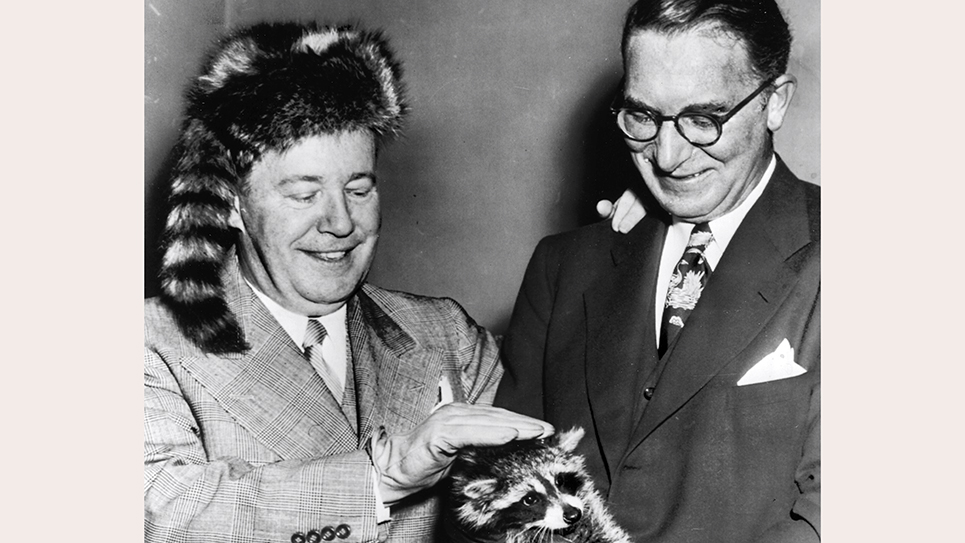
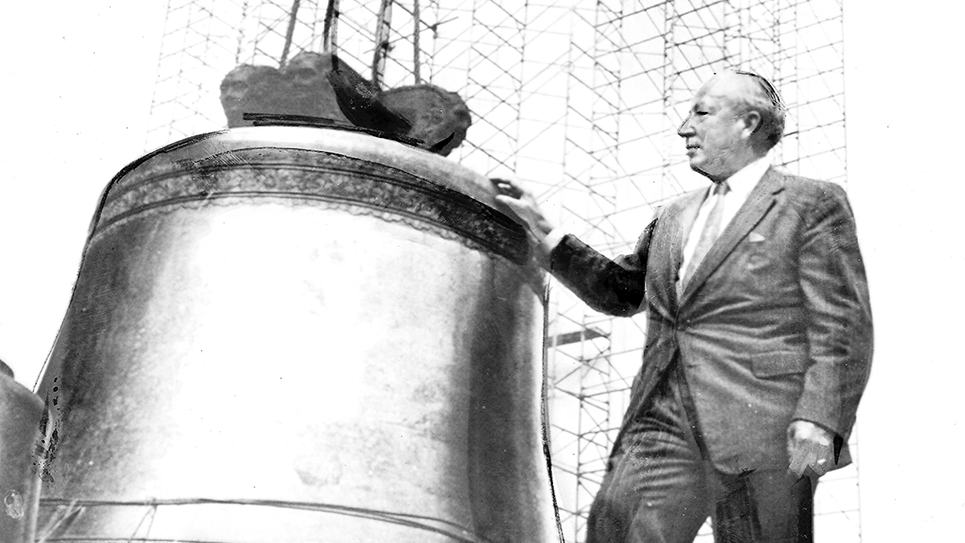
Carroll Reece, congressman from Tennessee’s First Congressional District, a 30-year veteran of the U.S. House of Representatives and the Republican National Committeeman for the Volunteer State, headed a special select committee. Originally, the committee had been headed by E. E. “Gene” Cox of Georgia. Cox had died on December 24, 1952, of a heart attack, and the Select Committee to Investigate Tax-Exempt Foundations and Comparable Organizations released a report which found nothing amiss and concluded, “So far as we can ascertain, there is little basis for the belief expressed in some quarters that foundation funds are being diverted from their intended use.”
While Carroll Reece rarely spoke on the floor of the House of Representatives, nor did he seek to pass much in the way of legislation, he was one of the prototypes who pioneered and stressed prompt service to constituents like his successors Jimmy Quillen and John and Jimmy Duncan in the neighboring Second Congressional District. That same stressing of service to the people back home made him highly popular with the people of upper East Tennessee, where he built an effective political organization. Reece was also a nationally recognized figure and the most prominent Republican in the South.
Congressman Reece was dissatisfied with the final report and felt the investigation had not been as thorough as it ought to have been and had been hurriedly concluded due to Cox’s final illness and death. In 1952, the Republicans won both houses of Congress and the White House. Reece continued to push for the investigation to be completed, and the select committee was revived under the Tennessean.
In seeking to reauthorize the committee, Congressman Reece flatly said that “some of these institutions support efforts to overthrow our government and to undermine our American way of life.” Pressing the need for further investigation, Reece insisted, “Some officers of large and supposedly legitimate foundations were Communists.” The Tennessee congressman also stated others who were Communists had received grants from foundations. Reece pointed to some organizations which had been identified by the office of the U.S. Attorney General or Congressional committees as being “pro-Communist.”
The House of Representatives agreed to revive the committee, installing Carroll Reece as chairman. The GOP members of the special committee were Reece, Jesse P. Wolcott of Michigan and Angier Goodwin of Massachusetts. Two Democrats were also members of the special committee, Gracie Pfost of Idaho and Wayne Hays of Ohio. Mrs. Pfost was a highly popular congresswoman who had been a local official, having served as recorder of deeds and the treasurer for her county before beating GOP incumbent John T. Wood in the 1952 election.
The House appropriated $50,000 in 1953, followed by an additional $65,000 a year later for the committee to hire staff and do its work. Norman Dodd, who had enjoyed a long career as a banker, was hired as the chief of staff for the special committee. The committee was sharply divided along partisan lines, and Wayne Hays particularly enjoyed picking at people. Hays was quite likely the biggest bully in the House of Representatives, who seemed to delight in torturing those over whom he held some power. Years later, William “Fishbait” Miller, the longtime Doorkeeper of the U.S. House of Representatives, recalled Hays having no peer at “bitching and name-calling.” Miller wrote that when Hays was forced out of Congress by a sex scandal, there was not enough sympathy collectively to form a single teardrop.
Amongst Hays’s name-calling was his accusation that Carroll Reece was a coward. Yet Reece was a decorated veteran of the First World War, noted for his bravery by both the governments of the United States and France. Wayne Hays, as pointed out by news columnist Westbrook Pegler, was “30 ½” years old when the Japanese attacked Pearl Harbor. Hays claimed that he had entered the armed forces on the day after, yet was released without explanation in August 1942.
A typical exchange between the two was Hays snarling, “Out where I come from, we have a saying that if a man double-crosses you once that is his fault; if he double-crosses you twice, that is your fault. You won’t get a second chance.”
“Even that statement is not going to provoke the chairman,” Reece replied serenely. “But no man can justifiably say that this chairman has ever double-crossed anybody or failed to keep his word.”
“I am saying both,” Hays spat back.
“That does not disturb me a particle,” Reece said.
“Thought they had more guts in Tennessee,” Hays sneered.
The Tennessean with a sunny disposition shrugged off the bullying of Wayne Hays, dismissing the Ohioan as having a marked inferiority complex. Reece said the abusive attitude of Hays was less pugnacity than empty bluster. “He is a big fellow,” Reece cheerfully acknowledged, “but not above the neck.”
When asked by friends why Reece didn’t bring up his war record and medals for bravery when accused of cowardice by Hays, the Tennessean had a simple explanation. “It was all there for anyone to read who wanted to look it up. It wasn’t up to me to prove I wasn’t a coward.”
As the committee continued hearing testimony, Hays was at his querulous best, constantly harassing both witnesses whose testimony he did not like, as well as his Republican counterparts on the committee. Hays also continuously heckled Reece as the chairman of the committee. Carroll Reece was no orator, but he was one of the best-liked members of the House and usually managed to charm the people back home with his broad grin and willingness to do all he could to help folks. Reece was especially interested in the welfare of his fellow veterans. At a time before Social Security and when no pensions were being paid to those who had served in the armed forces, disabled veterans had to seek their congressmen and senators to pass private bills providing them with a pension. During his first fifteen years in office, Carroll Reece was said to have introduced more bills for the benefit of veterans and their widows and orphans than any other single member of the House of Representatives.
The committee heard from Ken Earl, a former staff member of the Senate’s Internal Security subcommittee on June 15, 1954. Earl told the committee members that he had concluded from his study of the League for Industrial Democracy, which was tax-exempt, it was “an adjunct of the Socialist Party.”
The president of the Social Science Research Council, Pendleton Herring, sought out an opportunity to testify before the Reece Committee to try and respond to criticisms made by committee staffers of his organization. Herring told committee members the Social Science Research Council was “not engaged in developing or in advancing public policies or political programs, or in directing or shaping educational objectives and policies.”
Herring was providing testimony when the flamboyant Wayne Hays erupted and charged the committee with being nothing more than an “Alice-in-Wonderland” inquest “in which a verdict against foundations was rendered before the evidence was heard.” Reece banged the gavel and recessed the hearing. The Tennessean said the recess was necessitated in order to “protect the Committee staff and witnesses” while trying to “maintain the dignity of the Committee.”
The president of the American Council on Education, Arthur S. Adams, provided a statement to the Reece Committee saying educational organizations had, of course, received financial support from foundations as a means of keeping the federal government from controlling education in the United States. That financial support was a form of protection, Adams insisted. Adams said removing the tax-exempt status of foundations was one means of asserting the control of the federal government over education. Adams asked the Reece Committee to state “the extent to which it believes federal control of tax-exempt institutions is justifiable” by the government.
David N. Rowe, a professor at Yale University, had been a trustee of the Institute of Pacific Relations during the period of 1947 – 1950. Rowe testified that foundation grants to the Institute had benefitted “people who did not have the best interests of this country at heart.” Rowe stated some foundations continued to provide funding for the Institute even after disclosures of “pro-Communist influences” at the Institute of Pacific Relations.
Another witness, Kenneth W. Colegrove, a retired professor at Northwestern who continued teaching at Queens College, testified the Rockefeller Foundation should have conducted a thorough investigation of the Institute of Pacific Relations “when the situation was brought energetically to its attention by Alfred Kohlberg,” in 1945. Kohlberg was the head of the American China Policy Association, while detractors referred to him as head of the “China lobby” for the Nationalist government of Chiang Kai-shek.
Wayne Hays lived up to his reputation as a bully throughout the hearings. William “Fishbait” Miller recalled in his “Memoirs of the House Doorkeeper,” “When it came to bitching and name-calling. . .” Hays had no peers in the House. Wayne Hays continued his bullying tactics and would later leave the House of Representatives following the revelation he had hired a secretary who could not type. Elizabeth Ray claimed Hays had not hired her for her typing skills, but rather her personal charms. “Fishbait” Miller chortled, “there was not enough sympathy to put into a teardrop in the corner of an eye” from congressmen and staff on Capitol Hill when the tale of Hays and his “sexploitation” occurred.
On July 2, 1954, the Reece Committee was done with hearings and voted, yet again along party lines, to end its hearings and ask for statements from the foundations rather than having representatives give oral testimony. The committee set a deadline of fifteen days for the foundations to submit written statements to be included in the committee’s final report. Both Gracie Pfost and Wayne Hays objected, saying the foundations should be provided the opportunity to appear before the committee and give testimony. Reece snapped that the constant harassment and generally “obstructionist tactics” used by Wayne Hays made further hearings useless.
Several leaders of various foundations and organizations, including Charles Dollard, the president of the Carnegie Corporation, Harry W. Laidler, executive director of the League for Industrial Democracy, Paul Hoffman, chairman of the Fund for the Republic, sent statements for the Reece Committee’s records. Hoffman used the opportunity to attempt to rebut charges made against the Fund for the Republic and himself by Carroll Reece from a speech made by the Tennessee congressman in 1953. Reece had described the Fund for the Republic as a “king-sized Civil Rights Congress . . . given liberal respectability” through the appointment of Paul Hoffman as its head. In his own statement, Hoffman huffed that Reece’s remarks would have been slanderous and the Tennessean legally liable were it not for congressional immunity. Congressmen and senators were protected from legal liability for such statements spoken on the floor of their respective houses. Hoffman decried Reece’s accusation that the Fund for the Republic had been established to diminish and attack Congress for trying to get to the root of the Communist conspiracy in the country.
The 432-page report of the Reece Committee was released eight days after the U.S. Senate censured Joe McCarthy after his sometimes-baseless charges and erratic behavior in his hunt for headlines, which undermined any serious effort to discuss Communists in high places.
While the report stated with but few exceptions “foundations have not directly supported organizations which, in turn, operated to support communism,” it did reach the conclusion “some of the larger foundations have directly supported ‘subversion’ in the true meaning of that term – – – namely, the process of undermining some of our vitally protective concepts and principles.” “They have actively supported attacks upon our social and governmental system and financed the promotion of socialism and collectivist ideas,” the report stated.
The fury and contempt of the left-leaning in the country was palpable. Robert Hutchins, former president of the University of Chicago, complained, “The Reece Committee achieved some of its gaudiest effects by the simple process of giving old words new definitions and then pinning the old words on the foundations.”
The fun had just begun.
© 2026 Ray Hill