By Pete Gawda
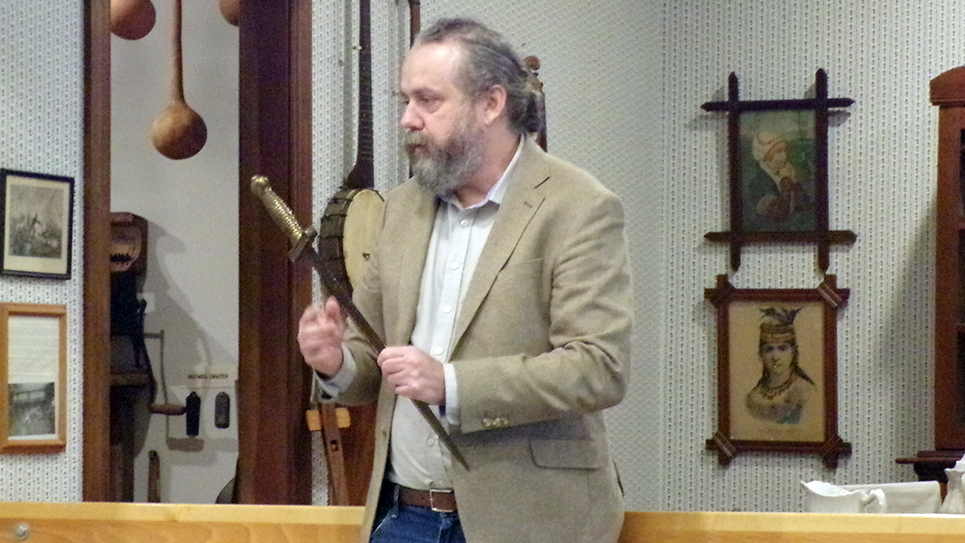
On Thursday evening, August 6, historian Josh Anderson gave a talk on East Tennessee in the Civil War at the Lenoir Museum at Norris Dam State Park. The talk was part of a series of talks celebrating the 250th birthday of our country and was illustrated with slides and artifacts.
Anderson noted that East Tennessee was not too keen on secession from the Union. On Feb 9, 1861, Tennessee voted against secession. Soon after that, groups from other Southern states visited Tennessee to persuade the state to secede. Finally, on June 8, 1861, Tennessee became the last state to secede. However, in East Tennessee the vote was 2 to 1 against secession. In Anderson County, only 7 out of a total of 98 votes cast were for secession. The division of loyalty was evident in the number of troops from Tennessee serving on each side. While 120,000 Tennessee troops fought for the Confederacy, 31,000 Tennessee men enlisted in the Union Army. Even though every Confederate state had some men join the Union Army, Tennessee’s total was the highest.
Anderson told the story of Julia Marcum of Scott County. Her father, Hiram Marcum, was loyal to the Union and was harassed for that stand. On September 7, 1861, while her father was hiding in the woods, a group of Confederate soldiers raided the house looking for him. They attacked the women of the household trying to learn his whereabouts. Julia fought off their attack, hitting one soldier with an ax. However, she lost an eye from a bayonet and a finger from a gunshot. Her father burst in in time to save his family. Julia’s wounds were treated by a Confederate Army doctor. As a result of these activities, Julia was the only woman to receive a pension for combat in the Civil War.
Anderson also told the story of William Blount Carter, an abolitionist and Presbyterian minister who planned a guerrilla raid in November 1861 to destroy nine bridges on the East Tennessee and Virginia Railroad to disrupt communications and supply lines and to hinder the transport of troops. This action was supposed to be done in connection with a raid conducted by Union forces in the area. However, that raid was called off, and only five bridges were damaged or destroyed. The bridges were quickly rebuilt, having little military impact. However, as a result of the bridge attacks, the Confederate government declared martial law in East Tennessee and about 150 Union sympathizers were arrested. Several suspected bridge burners were tried and hanged.
There was also a skirmish at Wallace’s Crossroads, now known as Andersonville. On July 15, 1862, four companies of Confederate cavalry stationed at Andersonville were surprised by two regiments of Union infantry. The Confederates were put to flight, and the Union forces withdrew. Anderson displayed several cannonballs found in the area and showed a slide of a receipt from the store at Wallace’s Crossroad where Confederate soldiers bought hay, bacon and corn. He also had a photograph of J.K.P. Wallace of Andersonville who provided an eyewitness account of the skirmish.
Anderson detailed the November 29, 1863 Battle of Fort Sanders, displaying a slide of the earthwork defenses and a drawing of the battle showing telegraph wires strung low to the ground between tree stumps. This foreshadowed the barbed wire strung between the trenches in World War II. Anderson also noted that this was one of the most lopsided battles of the war with 800 Confederate casualties and few Union casualties and resulted in a Union victory
Anderson related the story of E. C. Camp, a Northerner who came to Knoxville as a Union soldier and remained after the war to become U.S. Attorney for Eastern Tennessee and found the Coal Creek Coal Company. He built the large stone house on Broadway which now houses the offices and studios of WATE television.
There is an interesting reminder of the Civil War in downtown Clinton; about a block apart are two Methodist Churches. Members of St. Mark’s were Southern sympathizers while members of Memorial were loyal to the Union.
During the course of the Civil War, Greenville changed hands between the Union and the Confederates about 50 times.
Anderson stated that Tennessee was second only to Virginia in the number Civil War battles fought in the state.
At the conclusion of the Civil War, Tennessee was the first state to be readmitted to the Union.