By Ray Hill
Throughout his life, Herbert Romulus O’Conor earned a reputation as a man of industry, capability and capacity. O’Conor also possessed an impeccable sense of timing, which, in politics, is a gift from God. As with catching the trapeze bar, timing is everything in politics. That timing likely explains why Herbert R. O’Conor never lost an election. O’Conor set out to be a lawyer and was recognized at Loyola College as a gifted orator, an excellent baseball player and a good scholar. While attending the University of Maryland School of Law, O’Conor worked as a reporter for the Baltimore Evening Sun, covering the police beat. Musing upon his time as a cub reporter, his editors later remembered Herbert O’Conor as “reliable, energetic and imaginative.” If his beat was slow, O’Conor was prone to pull out his law books and study.
Herbert R. O’Conor was a man of principle, neither smoking nor drinking but an avowed opponent of prohibition. O’Conor preferred celebrating his repeated victories at the polls with a double chocolate malted rather than an alcoholic beverage. The fourth of four sons, Herbert R. O’Conor and his wife were the parents of four sons and one daughter. O’Conor was a man of faith and a devout Catholic.
O’Conor never regretted leaving behind his time as a newspaper reporter, preferring the law and politics. Herbert O’Conor was one of those rare people who seemed to succeed at everything he did; he was admitted to the bar even before he graduated from law school. Almost immediately after passing the bar, O’Conor accepted an appointment as an assistant to the state’s attorney. At a time well before the advent of television, O’Conor found his name plastered across the pages of the newspapers during several high-profile and lurid murder cases in Baltimore. O’Conor won more headlines when he was sent to New York to retrieve Walter Socolow, a 19-year-old involved in the killing of William B. Norris, a local businessman. Socolow’s attorneys were appearing in a New York courtroom seeking an order of habeas corpus when O’Conor ordered the Baltimore detectives accompanying him, “Take him, boys!” Walter Socolow gave no resistance, and five hours later, O’Conor and his prisoner were back in Baltimore. When Herbert R. O’Conor died, one reporter recalled that the opinions written by the young attorney at the time he served as a deputy in the state’s attorney’s office were “cited as among the clearest expositions of points of Maryland law available.” O’Conor prosecuted several other murder cases which captured the attention of Baltimore residents, won the young prosecutor praise from Maryland’s Supreme Court, and rolled up a majority of some 100,000 votes in being elected state’s attorney in his own right. O’Conor’s courtroom exploits won him not only headlines but also devoted support from his fellow residents inside Baltimore and Baltimore County. Throughout his career, O’Conor could count on solid support from his hometown folks.
Demonstrating his sense of political timing, Herbert O’Conor declared his candidacy for attorney general of Maryland, winning both the Democratic nomination and the general election. O’Conor thrashed his GOP opponent, winning better than 60% of the vote in a state that was largely Democratic. In 1938, O’Conor marched toward the governor’s mansion in a crowded field of contenders, including Howard Jackson, the popular and powerful mayor of Baltimore. Yet again, O’Conor proved his personal popularity, winning more than 50% of the vote against three serious opponents for the Democratic nomination. O’Conor even carried both the City of Baltimore and Baltimore County, beating Howard Jackson on his home ground. In the general election, Herbert R. O’Conor faced that rarest of creatures: a Republican governor. Since 1777, Maryland has only had ten governors who were Republicans. Harry W. Nice had upset incumbent Democrat Albert Ritchie, who many had thought to be governor-for-life, in the 1934 election. By 1938, Nice had disillusioned many inside his own party, and O’Conor beat Governor Nice and five minor candidates with 54% of the ballots cast. Herbert O’Conor was the first member of his Catholic faith to be elected as governor of Maryland.
As governor, Herbert R. O’Conor’s actions were marked by both “caution and circumspection,” according to one reporter who covered him during the eight years he served as Maryland’s chief executive.
Governor O’Conor served as the Free State’s chief executive officer as the country was emerging from the end of the Great Depression and through the Second World War. When he entered the governor’s office, O’Conor discovered to his dismay that the state’s debt was $48 million, a hefty sum for the time. By the time he left office in 1947, O’Conor departed, leaving a surplus of $8 million. With America engaged in winning the bloodiest war in the history of mankind, Governor O’Conor was able to cut taxes, as there was no way states could extend road construction with men and resources all devoted to the war effort. Cutting taxes and still enjoying a surplus in the treasury made Herbert R. O’Conor a great many friends in Maryland.
Governor O’Conor ran for a second term in 1942 and crushed three challengers inside the Democratic primary. The general election proved to be a surprise to Democrats in general and Herbert R. O’Conor in particular. O’Conor faced Theodore McKeldin, perhaps the most popular Republican ever to arise in the Free State’s history. O’Conor saw his usual vast majorities inside the City of Baltimore whittled down to 3,800 votes. On the strength of that performance, Theodore McKeldin was elected mayor of Baltimore.
For quite some time, O’Conor had been eyeing a seat in the United States Senate. One was occupied by the venerable Millard Tydings, who had easily survived an assault from the most popular Democrat in the country, Franklin D. Roosevelt. Tydings had been reelected in 1944 and Maryland’s other Senate seat just happened to come up for election at the same time O’Conor would be leaving the governor’s chair, in 1946. The incumbent was a Democrat, George L. Radcliffe, an attorney and country squire who had been elected in 1934, near the peak of FDR’s popularity. Senator Radcliffe was an amiable sort, but all things considered was something of a colorless politician who had not managed to entrench himself after 12 years in office.
Governor O’Conor made his candidacy for the U.S. Senate official on Wednesday, January 9, 1946, pointing to his record as Maryland’s chief executive for the past eight years. Noting he had eliminated the state’s debt and provided a surplus, the governor said now he felt his work was done in Annapolis and he could look forward to a broader field of service. O’Conor swatted away the notion that his challenging an incumbent Democrat for the nomination was an “unfortunate” thing. “On the contrary, it will prove healthy, I believe, to have an open primary so that the rank and file of our party may determine who shall be their candidate,” O’Conor said in his declaration of candidacy statement.
Senator Radcliffe fought as hard as he could, but Governor O’Conor emerged as the victor of the Democratic primary, beating the incumbent by more than 22,000 votes and winning quite nearly 53% of the ballots cast. Once again, the general election proved to be the big surprise. 1946 was the best year Republicans had enjoyed since the banner year of 1928. Millions of Americans were weary from the war and the deprivations it had wrought. Americans were tired of the rationing of goods, shortages and many other things. Carroll Reece, the Tennessean running the Republican campaign as chairman of the Republican National Committee, pounced upon the slogan, “Had Enough?” They had, and they voted Republican. Even as a Democratic state, Maryland saw Democrats lose seats in Congress, and Governor Herbert R. O’Conor quite nearly lost to General David John Markey; the difference was O’Conor’s majority of almost 12,000 votes inside the City of Baltimore. O’Conor beat Markey by exactly 2,232 votes out of almost 500,000 cast.
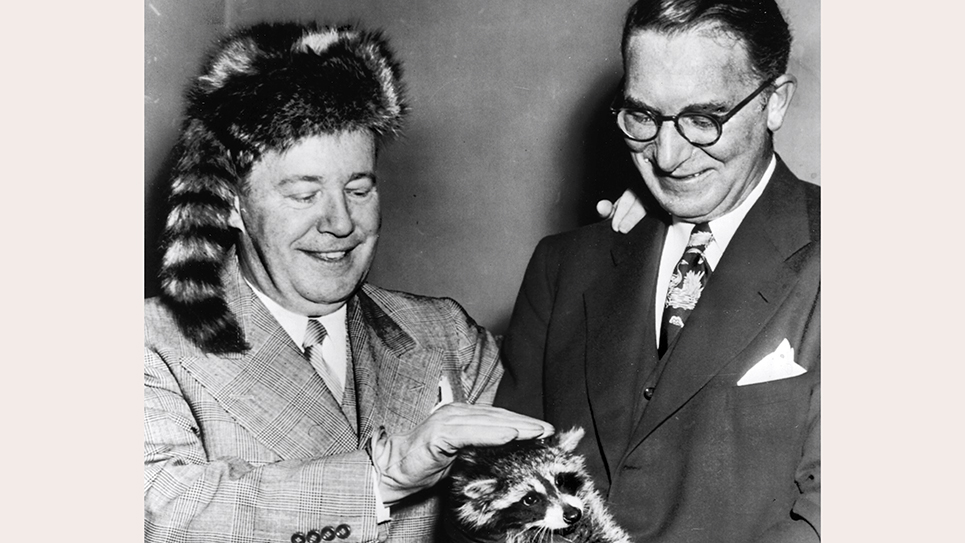
Senator Herbert O’Conor became one of the better-known members of the Senate rather quickly, almost unheard of for a freshman legislator, through the relatively new medium of television. O’Conor was a member of the “Kefauver Committee,” which was a special committee charged with investigating organized crime and corruption named for its chair, Senator Estes Kefauver of Tennessee. The subject matter and the committee’s deliberations caught the imagination of the public, who avidly watched the daily hearings for weeks on end, listening to the senators and especially the testimony of witnesses, such as Dan Gilbert, who was quickly labeled by the news media as “The World’s Richest Cop” due to his surprising, not to mention highly questionable, net worth. Gilbert, who was the Democratic nominee for sheriff of Cook County (Chicago) in Illinois, passed it off as having won far more than he ever lost in gambling.
In 1952, Senator O’Conor announced he would not seek a second term in the US Senate. His nose seemed infallible where politics was concerned. O’Conor whiffed an aroma of an approaching Republican victory. Millard Tydings had been upset two years earlier by Republican John Marshall Butler. GOP Congressman J. Glenn Beall (pronounced “Bell”) was already running hard for the Senate. There was also growing discontent inside his own party.
Having experienced very close calls during his last two elections, Herbert R. O’Conor announced his retirement. The senator said he also wanted to be able to openly voice his dissent and disagreement on some of the policies of the Truman administration.
A former elected attorney general, governor, and United States senator, Herbert R. O’Conor reestablished himself in the practice of law once again in Baltimore. The former senator was conspicuous in his regular attendance at his church and was an avid participant in the lay activities of his religion. Just a few months before his death, Herbert R. O’Conor was seen marching in procession for the dedication of the new Cathedral of Mary Our Queen Church, the insignia of a Papal knight on his lapel.
Out of office, O’Conor accepted clients and was a consultant on labor issues to the City of Baltimore. Another client was the American Merchant Marine Institute, where O’Conor served as general counsel, which gave him reason to visit Washington, D.C.
The former governor’s last trip to Maryland’s state capitol of Annapolis had been a proud moment. O’Conor watched as his son and namesake, Herbert Jr., filed his papers to run for the Democratic nomination for the US House of Representatives. O’Conor counted his friends in the thousands, but was a man who had no true close friends; Herbert O’Conor spent virtually all his free time in the company of his family.
To the very end of his life, even as his health became questionable, Herbert R. O’Conor continued to make public appearances and play his part in the activities of his community. The former senator attended a banquet held for alumni of Loyola College and the next day went to church to receive the traditional Ash Wednesday blessing. Later that same night, Herbert O’Conor suffered a cerebral hemorrhage. Two days later, Herbert R. O’Conor was dead. Only 63 years old, O’Conor’s death came as a distinct shock to the people of Maryland and many of those in public life. Perhaps most shocked of all was O’Conor’s wife, who suffered what appeared to be a heart attack after her husband died at Mercy Hospital. Mrs. O’Conor was moved to a room to receive care.
The Salisbury Times noted the passing of one of Maryland’s great men, who had held office without ever having been a politician. The Times stated in an editorial lauding the late former governor that Herbert O’Conor had developed a huge personal following because of his own innate personal kindness and raw ability, having achieved remarkable success in all he undertook throughout his lifetime. “Mr. O’Conor was a man of action, capable of making his own decisions and giving out his own answers,” the editorial noted. The Salisbury Times lamented the loss of “its best known and most capable elder statesman.”
© RAY HILL