By Ray Hill
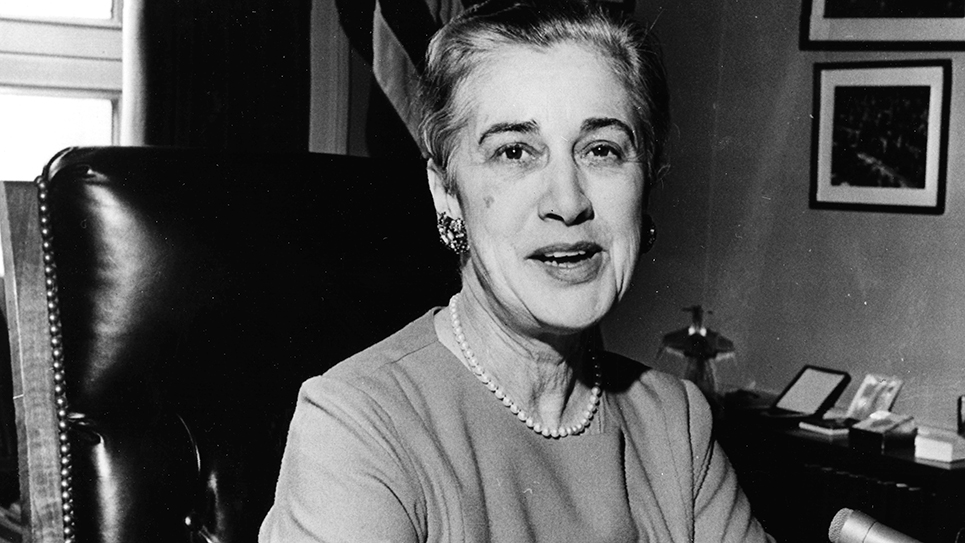
Edna Flannery Kelly spent 20 years in the U.S. House of Representatives, where she represented Brooklyn. Mrs. Kelly was the first woman to be elected to Congress from New York City and made her presence felt in the House.
Things might have been very different for Edna Kelly had it not been for an accident. The youngest of five daughters, Edna Flannery attended and graduated from Hunter College in New York, where she earned a Bachelor of Arts degree in history and economics at a time when it was not common for women to go past high school. Edna Flannery married Edward L. Kelly, a lawyer, and they had two children together. Governor Herbert Lehman appointed Ed Kelly as a justice of the New York City Court in January 1942. Just a few months later, Kelly was fatally injured in an automobile accident. Edna Flannery Kelly might well have been content to raise her children had it not been for her husband’s death. Mrs. Kelly found a mentor and ally in Irwin Steingut, who was the political boss of Brooklyn as well as the minority leader in the New York General Assembly.Steingut urged Mrs. Kelly to join as many organizations as she could participate in, one of which was the Madison Democratic Club, which had enjoyed far better days. Needing to support her children, Mrs. Kelly was hired, likely through the influence of Irwin Steingut, as a research director for the New York State Assembly in 1943. In 1944, Edna Kelly ran for and was elected to the executive committee of Kings County’s Democratic Party, becoming a leader alongside Steingut.
The congressman from New York’s Tenth Congressional District was Andrew L. Somers, who was first elected in 1924 at the age of 29, which earned him the nickname of “the boy congressman.” Somers entered St. Alban’s Naval Hospital in Queens on March 1, 1949, complaining of stomach pains. Somers’s office did not disclose the precise ailment but issued a press release insisting he was “recuperating nicely,” although the statement indicated the congressman would need “two or three weeks more treatment.” On April 6, 1949, came the startling news that the 54-year-old congressman had died. According to doctors at the Naval Hospital, Somers had died from cirrhosis of the liver and additional “complications.” More than 1,000 people paid their respects to the fallen congressman at his funeral.
Vacancies in the U.S. House of Representatives are different from those in the United States Senate. When a senator dies or resigns from office, the governor of his or her state appoints someone who fills the vacancy until the next regular election. When a congressman dies or resigns, a special election is called by the governor of that state and the people elect his or her replacement. Edna F. Kelly was selected by her party as their nominee to succeed the late Andrew L. Somers on July 15, 1949. Years later, Mrs. Kelly said her selection had been due to Democratic leaders recognizing the need to promote female candidates. “They felt this was the time to recognize the work of women,” Edna Kelly recalled. “I had been a long time working in the Democratic Party.” New York’s Tenth Congressional District was safely Democratic and had large Jewish and Catholic populations.
Mrs. Kelly proved to be an attractive candidate and was easily elected to succeed Andrew Somers. As a new member of Congress, Edna Kelly backed the administration of President Harry Truman, both in his foreign and domestic policies. As a candidate, Mrs. Kelly had pledged her support for Truman and said she would vote to continue funding for the Marshall Plan and enthusiastically backed the participation of the United States in the United Nations. Mrs. Kelly proclaimed she was for aid to the new state of Israel and supported NATO. Edna Kelly also talked about issues that resonated with women and spoke with authority when she said the federal government ought to help develop centers for childcare. Mrs. Kelly decried that there needed to be a congressional investigation as to why the price of milk had skyrocketed. Edna Kelly also said she was opposed to excise taxes on cosmetics.
After winning the special election, Edna F. Kelly became the first woman to represent New York City in Congress. Mrs. Kelly quickly introduced herself to the other women in both the House and the Senate (Margaret Chase Smith of Maine was the lone woman in the Senate) and encouraged dinners where the women could discuss legislative matters. Success in serving on legislative bodies can be traced to interpersonal relationships, and Mrs. Kelly became warm personal friends with two of her colleagues, Congresswoman Leonor Sullivan of Missouri and Congresswoman Martha Griffiths of Michigan. Sullivan and Kelly shared the sad experience of widowhood.
A comely woman when first elected, Edna F. Kelly chastised some reporters for noticing her appearance. “Please don’t describe me as attractive,” she said. “Just say I have common sense!”
As a freshman legislator, Edna Kelly sought an assignment to the House Foreign Affairs Committee and promptly received the backing of the other 44 members of New York’s House delegation who urged her to be appointed to a vacancy on the committee. Kelly was asked by President Truman and Speaker of the House Sam Rayburn to defer to newly elected Congressman Franklin D. Roosevelt Jr. So did Roosevelt’s mother, former First Lady Eleanor Roosevelt. Edna Kelly flatly refused.
Political pressure was applied to Kelly’s political patron, Irwin Steingut, who told Mrs. Kelly, “I just got a call from Sam Rayburn. I understand you want to be on the Foreign Affairs Committee.” “Yes, Irwin, I do,” Kelly replied. Steingut told Rayburn, “Well, give Edna what she wants.” The speaker, powerful though he was, noted the New York House delegation was solidly behind Edna Kelly rather than Franklin Roosevelt Jr. The speaker also had to take measure of the support Mrs. Kelly had inside the Democratic Caucus as well as the highly influential Ways and Means Committee. More than a few fellow congressmen did not view the younger Roosevelt’s ambitions with much favor, viewing him as a playboy and a dilettante. FDR Jr. did eventually get a seat on the Foreign Affairs Committee after the House leadership expanded the committee’s membership. As many of his colleagues had suspected, the House was merely a stop on Roosevelt’s way to follow in his famous father’s footsteps. Franklin Roosevelt Jr. left the House in 1954 to run for attorney general of New York and lost to Republican Jacob Javits. Edna Kelly served on the House Foreign Affairs Committee throughout the entirety of her 20 years in the House of Representatives.
Congresswoman Edna Kelly worked hard and had earned her committee assignment, and she relished the opportunity to play an important role in the House. Mrs. Kelly voted to increase foreign aid to the Republic of South Korea, a measure which failed by a single vote. John McCormack of Massachusetts, the tall and lanky House Majority Leader, said presciently, “We’re going to resent this vote.” Indeed, they did, as later that same year North Korea invaded the South, triggering the Korean War, which involved American armed forces.
Congresswoman Kelly was vehemently anti-Communist and proceeded to lecture Secretary of State John Foster Dulles about the huge shipments of arms to Middle Eastern countries by the Soviet Union. Kelly pressed Dulles to “tell the world what the Russians are doing.” Dulles, a Republican, snapped, “Edna, you want war?” “You’re going to get war if you don’t do it,” Kelly shot back.
Kelly also earned the respect of most of her colleagues. As the House considered a $7.9 billion foreign aid package offered by President Truman, Congresswoman Edna F. Kelly introduced an amendment which would cut out the flow of U.S. dollars to Yugoslavia, which was a Communist-dominated country. Kelly’s amendment was adopted by the House of Representatives. Likewise, Congresswoman Kelly was successful in attaching another amendment to the Agricultural Trade Development and Assistance Act in 1954, the effect of which made it illegal to sell surplus commodities to the Soviet Union or its satellite countries.
Edna Kelly’s hardline attitude against Communism was highly popular with the people of her working-class district as well as many of those in the upper middle class. In 1954, Kelly faced a challenge from GOP candidate Abraham Sher, who ran on the odd platform of having the government of the United States officially recognize Communist China, something the congresswoman adamantly opposed.
Kelly had entrenched herself inside New York’s Tenth Congressional District through her close attention to the casework generated in her House office. That same high level of service to her constituents made her unbeatable at the polls. Back home in her district, Kelly held office hours at the Democratic Madison Club headquarters where she visited with those constituents who needed help. Kelly was careful to kindly turn away small gifts offered by constituents, gently reminding them, “This is my job.”
Being easily reelected led to increased seniority, and that brought Kelly the chairmanship of a subcommittee of the Foreign Affairs Committee. As the chair of the Foreign Affairs Subcommittee on Europe, Edna Kelly set out to do her homework. Over a period of time, Kelly visited Europe five times on fact-finding tours. President John F. Kennedy named Congresswoman Kelly to the American delegation to the United Nations in 1963, where she worked hand in glove with America’s Ambassador to the UN, two-time presidential nominee Adlai Stevenson. One fellow House member later recalled traveling with Edna Kelly and marveled at the number of people the congresswoman knew. The congressman said it was “like going abroad with Mata Hari,” noting, “She had innumerable contacts … that were not available at all to the State Department.”
Mrs. Kelly’s charm also served her well and enabled her to worm out nuggets not readily known by the State Department. While in Yugoslavia, Congresswoman Kelly attended an official dinner with high-ranking Communist officials who were her hosts. One of the Communist hosts mentioned having visited North Vietnam and casually said he had seen its leader, Ho Chi Minh, who had disappeared from public view for months. “Oh, you mean my old friend, Ho? How is he?” Kelly wondered. That brought forth a statement from her delighted host that Ho had been seriously ill for quite some time, information the State Department had not been able to confirm.
Throughout her time in the House, Congresswoman Kelly was an unwavering supporter of the war in Vietnam both during the Kennedy and Johnson administrations. The Vietnam War became increasingly unpopular in the United States and especially inside the Democratic Party outside the South. One such measure of the war’s unpopularity was the fact that Congresswoman Kelly had demolished a challenger inside the Democratic primary in 1964 by winning nearly 75% of the vote. An anti-war challenger inside the 1966 primary, Eugene Victor, held her to 52% of the vote, a very close call for a longtime incumbent.
What ended Edna Kelly’s congressional career was redistricting, which has helped to end many careers inside the House of Representatives. Mrs. Kelly’s district was combined with two other House districts, which dramatically changed the composition of her constituency. The greater part of her district had a majority of Black voters, and the Democratic leader for the area had endorsed the candidacy of Shirley Chisholm, who was also Black. The other district had been carved out for the Dean of New York’s delegation in the House, Emanuel Celler, who had first been elected to Congress in 1922. Kelly ran against the venerable Celler, who was chairman of the House Judiciary Committee and lost badly, winning less than a third of the vote. Kelly went home to Brooklyn, where she lived until a stroke forced her to move in with her daughter. Edna Kelly died in Alexandria, Virginia, on December 14, 1997, at the age of 91.
© 2026 Ray Hill