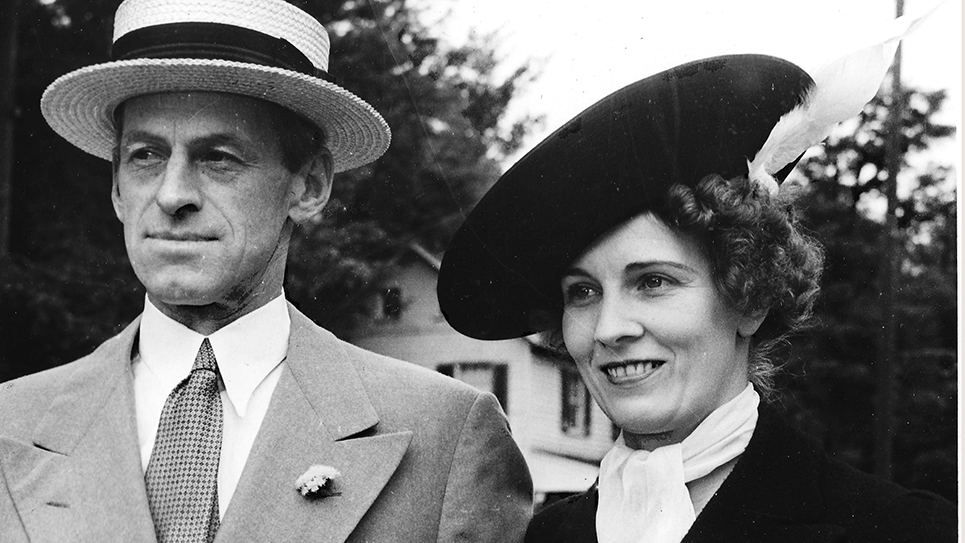
For decades, Millard Tydings was one of the most widely known members of the United States Senate and a powerful voice in and for Maryland. Lean with a cultivated aristocratic bearing despite having been born to modest circumstances, Millard Tydings was frequently a force to be reckoned with in Maryland politics. A genuine hero of the First World War, Tydings had been awarded the Distinguished Service Medal and the Distinguished Service Cross for his heroism. As a veteran, Tydings could become both equally eloquent and angry upon occasion, as he did when the Senate was considering the manpower problem as the Second World War was grinding to a halt.
“Think of the men standing on the battlefronts in the dark,” Tydings cried from the Senate floor, “learning that back home the great Congress of the U.S. has said that the people at home are doing a good enough job, nobody is to be bothered, a man can loaf if he wants to and there will be no penalty … I think we are cowardly in this Congress, when we read that up to this time 1,000,000 men have been killed, wounded or are missing, and permit unlawful strikes to take place. . .”
After returning home from the First World War, Tydings began eyeing a seat in Congress. Albert A. Blakeney had first been elected to the U.S. House of Representatives in 1900. Apparently, he cared little for the experience and did not seek reelection in 1902, preferring to return to his business pursuits. Blakeney ran for the House once again 20 years after having first been elected. Blakeney beat incumbent Democrat Carville Benson as 1920 turned out to be a banner year for GOP candidates across the nation while Republican presidential nominee Warren G. Harding piled up better than 60% of the ballots cast as Democratic presidential nominee James Cox won just barely 34% of the vote. Harding also handily won Maryland, and Blakeney returned to the House of Representatives. Millard Tydings easily won the Democratic nomination and faced Congressman Blakeney in the 1922 general election. Tydings beat Congressman Blakeney decisively, carrying two of the three counties comprising the Second Congressional District of Maryland, including populous Baltimore County. Congressman Tydings won reelection in 1924, and he began to consider higher office, coveting the Senate seat occupied by Republican Ovington E. Weller, who had been elected in the Republican tidal wave of 1920.
Senator Weller was one of the most powerful leaders of the GOP in Maryland, although the Free State was ordinarily Democratic in its voting habits. In the mid-term election, Congressman Tydings beat Senator Weller by more than 54,000 votes, garnering just over 57% of the ballots cast.
Millard Tydings proved to be a political powerhouse in Maryland and was reelected in 1932 with better than 66% of the vote over his GOP opponent, with Franklin D. Roosevelt at the top of the ticket. In the Senate, Tydings was a more conservative Democrat. Principled and opinionated, Tydings was no mere New Deal rubber stamp. Tydings was the most ardent and vocal advocate for giving the Philippines its freedom. Tydings also introduced a resolution in the U.S. Senate which explicitly condemned Adolf Hitler’s Nazi regime in Germany for its persecution of Jews. The resolution called for President Roosevelt to inform the Nazi dictator that the Senate and the American people were deeply upset by Germany’s antisemitic laws and ill treatment of Jews.
Outside of Franklin Roosevelt, perhaps the biggest feud Senator Tydings faced during his time in public office was that involving Drew Pearson, the muckraking national news columnist who never allowed the truth to get in the way of a good story. Pearson’s father, Paul, a Republican, had been appointed governor of the U.S. Virgin Islands and had been removed. Tydings had been critical of Paul Pearson’s administration, which won him the lasting hatred of the governor’s son. Drew Pearson never missed an opportunity to disparage Tydings in print and otherwise demean, diminish and demoralize the senior senator from Maryland.
If Senator Tydings was cautious in his approach to supporting much of Roosevelt’s New Deal, he certainly enjoyed his role as the chief dispenser of federal jobs in the Free State. Tydings had close ties with his senatorial colleague George L. Radcliffe, who had been elected in 1934 to replace Republican Senator Phillips Lee Goldsborough. Senator Tydings was one of the more vociferous Democrats inside the Senate in his fervent opposition to FDR’s proposal to increase the size of the U.S. Supreme Court.
Roosevelt was profoundly stung by his failure to get his way in packing the Supreme Court, and it rankled and quickly festered. FDR famously decided to reshape his own Democratic Party by driving out those he deemed too “conservative,” who also coincidentally happened to be the most independent senators who were Democrats. Millard Tydings became a prime target for Roosevelt’s infamous political purge in the 1938 election. Roosevelt nudged the 69-year-old elfin Congressman David J. Lewis to challenge Tydings inside the primary.
The 1938 senatorial primary in Maryland drew national attention due to President Roosevelt’s keen desire to beat Senator Tydings. The most widely read news magazine in the world, TIME, reported that the contest between the “well-to-do Tydings” and the “homespun little David John Lewis” was giving Democrats something to talk about, almost on the hour. TIME detailed the pamphlet titled “The Life and Times of Milord Tydings,” which featured a photograph of the senator’s majestic estate on the Chesapeake Bay where “Washington clubs and hotels buy 1,000 hens’ eggs a day.” The house was depicted as “a feudal manor” and his in-laws as the closest thing to royalty in the country. A bachelor for much of his life, Tydings had married Eleanor Davies in 1935. Eleanor was the daughter of Joseph E. Davies, a well-connected Washington, D.C., attorney and later America’s ambassador to the Soviet Union. Her mother, the fabulously wealthy Marjorie Merriweather Post, was the builder and original owner of Mar-a-Lago. Eleanor Davies, a divorcee, was a beauty, and the senator adopted her two children, Joseph and Eleanor. The couple remained married for the rest of Tydings’ life.
The news magazine reported that two federal officials had been cited by a Senate investigating committee for having violated federal laws by campaigning on behalf of Congressman Lewis. Collector of Internal Revenue H. Hampton Magruder in Baltimore and Maude Toulson, the postmistress at Salisbury, which was Congressman Lewis’ hometown, had been identified as having been campaigning on behalf of Lewis.
Much of Maryland’s political establishment rallied to Tydings rather than Roosevelt, especially those not on the federal payroll. Tydings’ colleague George Radcliffe became the manager of his campaign.
Along with the federal employees, who had almost certainly been spurred to ever greater effort by the Roosevelt administration, TIME revealed Secretary of the Interior and administrator of the Public Works Administration Harold Ickes had followed a directive issued by FDR to provide “prompt attention” and “right of way” to the two new PWA-constructed bridges designated for Maryland.
The news magazine also noted the drawing done by Jerry Doyle, resident cartoonist for the Philadelphia Record, which lampooned Senator Tydings, claiming he had supported the “bone and sinew” of New Deal legislation. TIME declared the primary between Tydings and Lewis was “a specific judgment by Maryland on the past, present and future of Franklin Roosevelt’s New Deal.” Election Day brought out a heavy vote, which TIME chortled Millard Tydings had been “unpurged by a ratio of 3 to 1.”
Senator Tydings once again won reelection to the Senate in 1944 with better than 60% of the vote. His personality caused the senator to be perceived as aloof and arrogant, never a good thing for a politician who had to seek votes to remain in office.
In 1949, Tydings challenged the venerable Kenneth McKellar to become president pro tempore of the Senate inside the Democratic caucus. The peppery McKellar had served for a decade inside the Senate by the time Tydings arrived, but was at the time 80 years old. McKellar won the contest by two votes.
Congressional investigations have long been able to propel some congressmen and senators to greater glory and higher office. They have also consigned some congressmen and senators to private life. As Senator Joe McCarthy of Wisconsin demagogued his way across the political stage, recklessly slinging accusations and charges without bothering to investigate whether or not they were true, the Senate formed the Tydings Committee, which became thoroughly entangled in McCarthy’s relentless propaganda machine. There were indeed Soviet spies, Communist spies, in high or mid-level government offices, but McCarthy’s recklessness impeded rather than helped to root them out. Tydings, believed to be politically invulnerable by his colleagues, was thought to be able to keep McCarthy well in hand. When Tydings and his committee pressed McCarthy for details, the Wisconsin senator bleated, “Get the files. If you do, you will find every word I have said is the truth.” Of course, McCarthy also knew it was unlikely that President Truman would allow the State Department to release its own files. Truman did refuse, pointing out that releasing the files would likely unnecessarily ruin the reputations and lives of some who would later be exonerated.
McCarthy milked it for all the considerable publicity it was worth. Well before he had even glimpsed what was in the files turned over to the Tydings Committee by the State Department, he screamed the files had been “raped.” Senator Tydings made a mistake when he announced the files had been checked by the FBI. McCarthy promptly displayed a letter received from FBI Director J. Edgar Hoover which contradicted Tydings, noting the FBI had not gone through or checked the files. Tydings was placed in the embarrassing position of asking the FBI to come to Capitol Hill and check the papers in person. That gave McCarthy the opportunity to bellow that any incriminating evidence had long since disappeared.
Americans were profoundly disturbed by the specter of Communism and Communist agents working to subvert their country. By 1950, the “Red menace” had become a viable issue in election campaigns. That year, candidates seen as “soft” or unconcerned about the menace to the American way of life by Communists and their fellow travelers suffered at the polls. Helen Gahagan Douglas, a congresswoman who was running as the Democratic nominee for the United States Senate in California, lost to Congressman Richard Nixon, who had dubbed her “the Pink Lady.” Senator Claude Pepper was denounced by his opponent, Congressman George Smathers, for having urged closer ties with the Soviet Union. Smathers damned the senator as the “Red Pepper.”
Senator Millard Tydings faced little-known Baltimore attorney John Marshall Butler, who certainly looked like the stereotypical notion of a senator. Butler’s campaign received continuous assistance from Joe McCarthy and his minions. A “composite” photograph, meaning two separate photographs put together as one, was published in a tabloid form showing Earl Browder, leader of the American Communist Party, with Senator Millard Tydings, who appeared to be listening raptly. Butler beat Tydings by more than 43,000 ballots.
Tydings sought to repair his damaged reputation by challenging Butler’s election, which was unsuccessful, and settled into a lucrative law practice with his father-in-law. Tydings never got over his defeat and sought vindication by running once again in 1956. Tydings campaigned hard and beat George P. Mahoney in the Democratic primary by 7,992 votes along with three minor candidates. It was the last hurrah for Tydings, who would be forced to surrender the Democratic nomination because of a serious illness that debilitated him so much that he could no longer work.
The former senator’s wife waged an abbreviated campaign to win the nomination but lost to Mahoney, who once again lost the general election to a Republican. Tydings settled into a comfortable life at his estate where he remained retired.
Millard Tydings died peacefully in his sleep at his home, “Oakington,” near Havre de Grace on February 6, 1961. Tydings was 70 years old.
© 2026 Ray Hill