
By Ray Hill
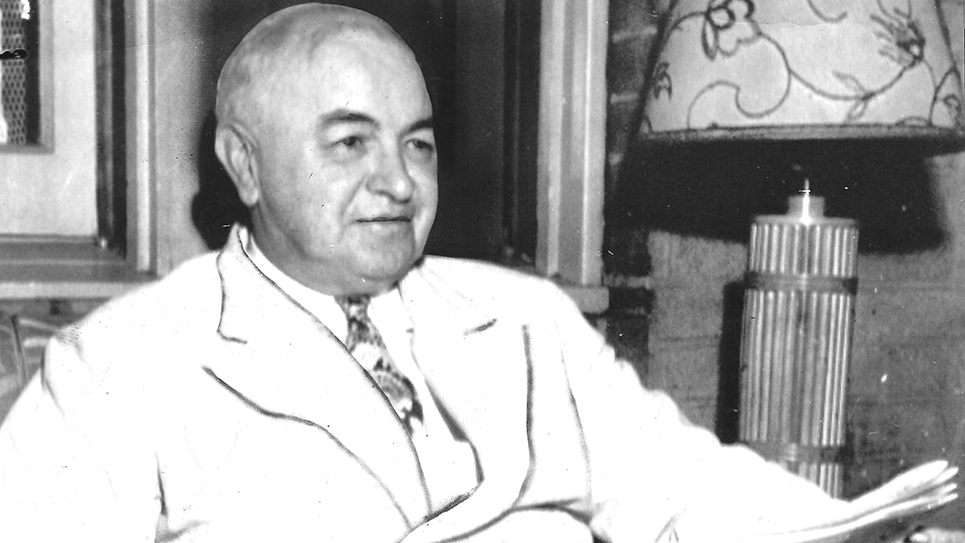
Described as a “charismatic populist” by the Washington Post, Arch Alfred Moore Jr. was the most durable Republican during a time when West Virginia remained a solidly Democratic state. Moore was also the founder of a new political dynasty that still flourishes today. A dynamic leader, canny politician and enthusiastic booster of West Virginia, Arch Moore became an iconic figure. Moore was also a genuine war hero, earning a Purple Heart after surviving a grievous wound in World War II when a machine gun round pierced his jaw and tongue.
During a 2003 interview for the West Virginia Public Broadcasting system, Moore recalled, “In my platoon, I had 36 people, and only three of us survived. I’ve run for public office for over 50 years and I’ve never talked about those times because I live with them daily. What happened to me happened to a lot of fine young Americans, some of whom never came back.”
Moore had been left for dead, lying in a pool of his own blood for two days. The injury to his tongue kept Moore from speaking for more than a year. The future governor had to endure facial reconstruction surgery. Arch Moore spent considerable time recovering from his wounds before entering law school and earning a degree.
In 1952, just a year after graduating from law school, Moore ran for West Virginia’s House of Delegates and was elected as a Republican in the northern panhandle of the state. Clearly ambitious, Arch Moore ran for Congress in 1954 against incumbent Robert H. Mollohan, a protégé of powerful U.S. Senator Matthew M. Neely, who was also a resident of West Virginia’s First Congressional District. Moore made a race of it, winning better than 47% of the votes cast.
Senator Neely had long been Mollohan’s political patron saint, naming him to head the state’s Boys’ Home while Neely had been governor. After returning to the U.S. Senate, Neely backed Mollohan against Congressman Robert Ramsay in the 1950 Democratic primary. Neely once again demonstrated his clout by pushing Mollohan’s nomination for governor in 1956.
1956 was to prove the high-water mark for Republicans in West Virginia for decades to come. Engulfed by a scandal, Bob Mollohan lost the governorship to Republican Cecil Underwood, while former U.S. Senator Chapman Revercomb defeated Governor William Marland for a seat in the Senate. Arch Moore was running once again for the U.S. House of Representatives and defeated Democrat C. Lee Spillers by exactly 762 votes out of more than 129,000 ballots cast. Dr. Will E. Neal won a seat in Congress as well, giving the Republicans two of West Virginia’s seats in the House.
As good as 1956 had been, two years later, West Virginia was especially suffering from a nationwide economic recession. Matthew Neely had died in office, and Governor Underwood had appointed Republican John D. Hoblitzell to fill the vacancy. That fall, both Senators Revercomb and Hoblitzell were soundly defeated. Congressman Will E. Neal was narrowly beaten, and Arch Moore proved his durability by winning reelection against perhaps the strongest candidate the Democrats could nominate, his predecessor in office, Robert Mollohan. Moore won with nearly 55% of the vote in a terrible year for Republicans, both nationally and in West Virginia. That election definitively proved Arch Moore was no mere political mistake, but rather a force to be reckoned with.
As a congressman, Moore paid close attention to his constituents and presided over an office that was remarkably attuned to the people he represented, and he and his staff specialized in constituent service. Congressman Moore was easily reelected in 1960, carrying every county in West Virginia’s First District and winning slightly more than 60% of the vote.
Following the census, the West Virginia legislature combined Moore’s district with that of veteran Congressman Cleveland Bailey, who had first been elected to the House in 1944. The Democrats did all they could to beat Arch Moore and aid the 75-year-old Cleve Bailey. President John F. Kennedy came to West Virginia to campaign for Bailey, although he made a highly embarrassing slip of the tongue, initially endorsing Moore instead of his fellow Democrat. Despite several notable Democrats coming to campaign for Bailey, the charismatic Arch Moore shocked virtually everyone when he won easily, pulling almost 60% of the vote. Moore was reelected in 1964, surviving the landslide for Lyndon Johnson, beating future State Treasurer Larrie Bailey by more than 43,000 votes.
As his political star continued to rise, Arch Moore was frequently mentioned as a candidate for either governor or United States senator. After twelve years in Congress, Moore announced he was running for governor in 1968. Moore faced a contentious primary with Cecil Underwood, who had long been the most prominent Republican in West Virginia. Since 1932, only two Republicans had managed to win statewide office in the Mountain State; Chapman Revercomb had been elected twice to the United States Senate, in 1942 and the 1956 special election. Cecil Underwood had won the governorship in 1956, but had a spotty electoral record since that time. Underwood had run against Senator Jennings Randolph in 1960 and lost. Underwood had tried to win back the governor’s office in 1964 and lost. Cecil Underwood had also made enemies by his interference in a primary involving the state’s other notable Republican, Chapman Revercomb. Underwood had endorsed Revercomb’s opponent when the former senator was seeking the GOP nomination for governor in 1960. That would come back to haunt Underwood eight years later.
The former governor stubbornly insisted upon running yet again, challenging Moore. That brought an endorsement from Senator Revercomb.
“He is a winner,” Revercomb said of Arch Moore. “It is time for Republicans to nominate a candidate who can win and not just run. We have had enough of those who make an appeal by appearance, and when they face opposition in the fall, succumb and are defeated.”
Moore won intense attention throughout the state campaign by helicopter. The rivalry between Arch Moore and Cecil Underwood was bitter. Moore won an astounding 93% in his home county of Marshall, while Underwood swept his own home of Cabell County by 75%. Overall, the present subdued the past, and Moore won decisively with better than 57% of the vote.
The congressman was injured when the helicopter crashed just days before the general election. That may have given Moore the advantage of a sympathy vote. Moore was yet again the only successful Republican in the state of West Virginia. While Richard Nixon was losing the Mountain State by more than 66,000 votes, Arch Moore won the governorship by 12,785 votes.
Arch Moore won a reputation for being decisive, a trait many voters liked in a chief executive. Moore demonstrated that when highway employees went on strike in a bid to have the state government recognize their union. Governor Moore responded by firing those employees who had walked off the job. That was a threat to the safety and welfare of the people of West Virginia, the governor said. The governor proposed pay increases for West Virginia’s educators and staff at schools in the Mountain State. Moore also supported insurance benefits for hospital employees. The governor won recognition when he helped to settle a nationwide strike by coal miners. Moore also browbeat the legislature to increase workers’ compensation benefits a whopping 75%. Governor Moore was known as a roadbuilder, burrowing routes through the scenic mountains of West Virginia.
Moore faced a strong challenge from John D. “Jay” Rockefeller IV, scion of America’s first billionaire, when he sought reelection in 1972. Jay Rockefeller had come to West Virginia and made himself at home while running for office as a Democrat. In 1968, Rockefeller had been elected secretary of state in anticipation of a campaign for governor in 1972. Rockefeller had his hands full, even though he spent liberally out of his own bottomless pockets. Once again, Arch Moore overcame the political odds through hard work and his own personality and ability. Moore won the general election against Rockefeller by 73,000 votes. Moore became the first person ever to be elected to serve two terms as governor of West Virginia.
During his second term as West Virginia’s chief executive, Arch Moore worked to establish medical schools at Marshall University and in Lewisburg. The governor also pushed the development of what became the West Virginia Culture Center at the State Capitol.
Unable to succeed himself as governor in 1976, Moore chose not to run against Senator Robert C. Byrd, who was unbeatable. Moore’s ultimate goal was to win a seat in the United States Senate, and he looked longingly at the seat of aging Jennings Randolph, who had first been elected to Congress in 1932 and had been a wheelhorse of the New Deal. Most observers believed Randolph would retire, but the veteran senator announced he was running for another term. Two things impeded Moore’s march to the U.S. Senate: the first being a trial where the former governor had been charged with extortion, for which he was acquitted by a jury. Secondly, Senator Randolph’s campaign outspent Moore 5-1. Arch Moore lost the general election by only 4,717 votes.
Two years later, Moore ran a quixotic campaign to retake the governor’s office from Jay Rockefeller. Once again, Rockefeller spent vast sums of his own money, and one wag quipped that Rockefeller fed more West Virginians fried chicken than had voted for him. Moore’s own campaign distributed bumper stickers that read, “Make Him Spend It All, Arch!”
Moore ran for governor once again in 1984 and beat the speaker of the West Virginia House of Delegates, Clyde See, by more than 48,000 votes. Ironically, had he run for the U.S. Senate seat vacated by Jennings Randolph, he likely would have won. Jay Rockefeller had only beaten unknown John Raese by 29,000 votes.
Arch Moore’s third term was not as notable nor as successful as his first two. The State of West Virginia was in terrible shape, with the highest unemployment rate in the country. The coal industry was in near collapse, and Governor Moore did his best to pump life into the state’s ailing economy. Moore proposed tax credits in the hope of attracting businesses to locate in West Virginia. Yet Moore’s final years as governor were peppered with both controversy and rumors of scandal.
Moore won a narrow victory over John Raese inside the GOP primary when seeking a fourth term in 1988. Governor Moore lost the general election with less than 42% of the vote to Gaston Caperton. West Virginia would not elect another GOP governor until 1996, and remarkably, it would be Cecil Underwood who became both the youngest and oldest man ever elected governor of the Mountain State.
Arch Moore was the target of a federal investigation, which resulted in the former governor pleading guilty to five felonies. Moore served two years in prison and an additional four months in home confinement in West Virginia. For the remainder of his life, Moore tried to retract that guilty plea. “I followed the advice that I got,” Moore later recalled, “that was not the right advice.”
Yet Moore retained the love and loyalty of a multitude of West Virginians, and he remained busy for the rest of his long life. Married to Shelley Riley, the couple had four children. Their daughter, Shelley Moore Capito, made it to the United States Senate, where she still sits today. Senator Capito has much of her father’s ability to make people feel welcome and comfortable. Senator Capito’s son, Moore Capito, was a candidate for the GOP nomination for governor, but ran second. Another grandson of the late Arch Moore, Riley Moore, is the Republican representative for Congress from West Virginia’s Second District.
In that same interview with the West Virginia PBS, former Governor Arch Moore told his interviewer, “I’m proud of my governorships, all three of them. You’ll run into Arch Moore stories the rest of your life, and nine-and-a-half out of 10, I think, will be a positive reflection. I’m still working on the other half.”
© 2025 Ray Hill