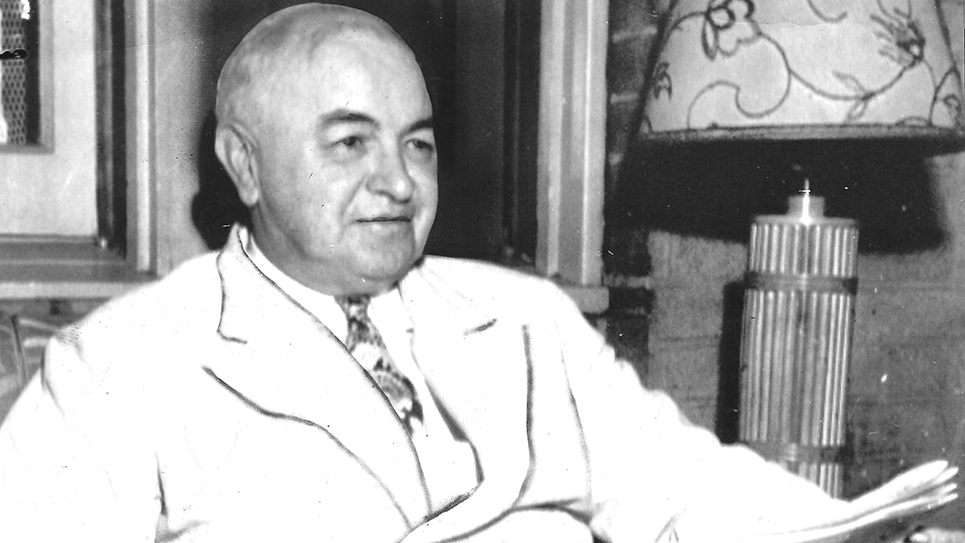

Long forgotten by most, the late Congressman Robert Ashton “Fats” Everett was one of the more colorful politicians from the political pages of Tennessee’s history. Everett was, by any measure, a political professional well before he ever was elected to Congress. “Jovial, glad-handling” and “deadly serious” about his work was the description of one newspaper reporter covering Congressman Everett.
Tall and weighing in at over three hundred and fifty pounds, the genial Bob Everett was called “Fats” by most everyone. Former Congressman John Tanner recalls Everett’s father, “Mr. Charlie,” as saying about his son, “Why, Fats don’t mind hard work. He’ll lie down right beside it and go to sleep!” One young man who got his political start driving Everett around his district was a young Ned McWherter.
The Jackson Sun remembered Everett as a “remarkably energetic person,” who was only slowed by health problems in his later years. Fats Everett was one of those congressmen who really did know what the folks back home thought and believed, and when he spoke, he spoke in an authentic voice. A distinctly cheerful man whose “jolly, friendly spirit” was such that the Sun believed Everett “would have made friends and acquaintances all over the country” even had he chosen to follow a different profession.
Born on a farm near Union City, Tennessee, on February 24, 1915, Bob Everett attended public schools before heading to Murray State College. Everett graduated from college in 1936 and that same year made his official political debut, winning election to the Obion County Court, the forerunner of the county commission. Everett was only 21 years old at the time. Four years later, Everett was elected clerk of the circuit court. Initially, some thought “Fats” Everett was some sort of political clown because of his weight and amiability. His geniality hid a very strong drive to succeed and an equally strong personality.
Like many other young men of the time, “Fats” Everett’s career was interrupted by World War II. Everett served in the U.S. Army for three years, from 1942 until 1945, when he was discharged. Bob Everett did not immediately return to Obion County after the war but found a job in the nation’s capital instead. Everett became the secretary, or chief of staff, to U.S. Senator Tom Stewart of Tennessee. During his time working for Senator Stewart, Everett became very good friends with Congressmen Tom Murray of Jackson and Cliff Davis of Memphis.
Stewart, Tennessee’s junior senator, was an amiable and unassuming man who worked hard to do things for Tennessee and Tennesseans. Senator Stewart was largely overshadowed by Tennessee’s more colorful and powerful senior senator, Kenneth D. McKellar. Fortunately, the two got along rather well, and Stewart seemed not to mind deferring to the influential McKellar.
“Fats” Everett enjoyed Washington, D.C., which had to be quite a change from Obion County. Everett enjoyed taking a drink and liked the social life of the Capitol, although he remained a lifelong bachelor.
Senator Stewart carried Obion County by a better than two-to-one majority, a sign of “Fats” Everett’s political potency in his home area, but lost the 1948 Democratic primary. With the defeat of Senator Stewart, “Fats” was out of a job but had a bigger job in mind for himself. “Fats” Everett spent two years in preparing to pursue his dream to serve in Congress. The 35-year-old Everett announced he would challenge Congressman Jere Cooper in the Democratic primary. It was a bold move as Cooper had been in the House of Representatives since 1929 and was a high-ranking member of the powerful House Ways and Means Committee. Cooper had also been a stalwart of the Roosevelt and Truman administrations.
The two men were a portrait of contrasts in some ways; Cooper tended to be lean and was balding and more reserved. One newspaper reporter wrote Congressman Cooper could be described as “quiet, solemn almost stern, confident, deliberate, possibly aloof.” “Fats” Everett was “jolly and demonstrative; as energetic as a teenager, as enthusiastic as an auctioneer; he’s a back-slapper, ever ready with verbal quips and House-shaking laughter.” Cooper stressed his seniority while Everett made a calculated effort to involve the younger people of the district, many of whom did not know Cooper personally and saw the congressman as a distant and absent figure. Over the years, Cooper was spending more and more time in Washington and less in his district.
“Fats” Everett gave Jere Cooper the scare of his political life. When the campaign was over, Cooper had 26,675 votes to 25,055 for Everett. “Fats” Everett’s campaign for Congress in 1950 demonstrated both his shrewdness as a politician and his popular appeal. Congressman Cooper only barely beat back the challenge from Everett. Just after losing the congressional race, a friend encountered Everett and said he believed “Fats” had lost a lot of weight. “Fats” said he was down to 260 pounds. His friend marveled at the weight loss and asked how he had done it. “I took the Cooper treatment,” Everett bawled.
The Democratic primary was barely over when Gordon Browning announced he was hiring “Fats” Everett as administrative assistant to the governor. “I think he will make a fine man for the post,” Browning said. “He has unbounded energy and is always considerate of the public. He will be useful both to this office and to the people of the state.”
Everett’s first comment after his appointment was, “I am a workhorse and ready to go.”
For Browning, hiring “Fats” Everett was a shrewd move and was regarded by many Tennessee political observers as reaching out and plucking an important operative from the enemy camp.
Browning lost the 1952 Democratic primary, and Everett demonstrated an ability to land on his feet. “Fats” was hired as the first executive secretary of the Tennessee County Services Association. The TCSA was the lobbying arm of the county governments in Tennessee and hiring “Fats” Everett was a masterful move. The amiable Everett, despite his outsized appearance, carried a virtual political encyclopedia inside his head. Everett knew just about everybody worth knowing in the state and, in his capacity as an assistant to Senator Stewart and Governor Browning, had done a passel of favors for folks all across the state.
Shrewd, able and industrious, “Fats” Everett had an unusual ability to see issues clearly. “We in county government have not kept pace with the times,” Everett told a reporter in 1957. “If we don’t clean our own house, the state and federal governments are going to move in and do it for us.”
As it turned out, Bob Everett’s return to Washington, D.C. was merely delayed. Jere Cooper died of a heart attack on December 18, 1957. A special election was called, and “Fats” Everett, after having run such a strong race against a popular and powerful incumbent, was well positioned to win the Democratic primary. Everett drew two opponents yet won the primary contest with a majority of the vote. Everett took his seat in Congress on February 1, 1958. The first decision Everett made was to announce he was keeping Miss Hope Hart, who had been Congressman Cooper’s prime assistant for his entire 29 years in Congress. “Fats” Everett would remain in Congress for the rest of his life.
Representing a largely rural district, Congressman Everett was a more traditional, conservative Southern Democrat. Everett excelled at constituent service and took care of his people quite well. Touring the district in a baggy suit to fit his large frame comfortably and oftentimes wearing a string tie, Bob Everett was highly popular.
Despite not having the seniority of many other Southern Democrats, “Fats” Everett understood both politics and the institution. Everett quickly gained more influence than others might have under the circumstances. When Congressman Everett became irritated with a game warden in his district, a Johnson administration official hurriedly wrote the Interior Department to remind them of the “indispensability of Everett to this Administration in Congress.”
Part of Everett’s charm was his self-deprecating humor. The congressman frequently said he weighed “one pound less than a ton.” Muckraking columnist Drew Pearson related that Everett tried to have “Robert A. ‘Fats’ Everett” put on the name plate of his suite of offices, but there wasn’t enough room and he had to be content with “Robert A. Everett.” One constituent complained and wrote the congressman to say, “Dear Fats: I’ve never changed the name of a mule, and I’m not going to start calling you by another name either since you’ve moved to Washington.”
Politically, “Fats” Everett missed few tricks. He moved around his district frequently and remained highly popular. Congressman Everett faced no opposition inside the Democratic primary in his 1960 reelection campaign. Everett did draw an opponent in 1962, but crushed his challenger, winning 41,158 votes to a paltry 3,293 votes. Everett faced slightly more serious opposition in the 1966 Democratic primary from a candidate named for his late predecessor but won once again handsomely.
When President Lyndon B. Johnson came to Tennessee to campaign in Nashville in 1964, Congressman Everett was on the platform, along with most every other important Democrat in the state. Republican strength in Tennessee was beginning to surge, and Democrats were united that year. LBJ, a meticulous organizer, even had all the former living governors of Tennessee at the War Memorial Building that year. Prentice Cooper, Gordon Browning and Jim McCord were all in attendance, vestiges of a time that had long gone by.
Young Ned McWherter learned much from “Fats” Everett, and even as a youngster, he was admitted into the congressman’s circle of political and personal friends. Some close to the late governor believed McWherter actually patterned his own political career after that of “Fats” Everett. The congressman kept his campaign headquarters at the David Crockett Hotel in Union City. There, young Ned McWherter would join Everett and his friends to socialize and plan out their politicking. The hotel was owned by the parents of Bette Jean Beck, who was McWherter’s wife. McWherter himself later said he licked stamps and drove Everett around the district during campaigns. Everett, at 6’4” and well over 300 pounds, was a colorful role model.
Everett favored a white Stetson that had cost $100, a mighty expensive hat for the times. Someone purloined the congressman’s Stetson while he was at a speaker’s table. “I’d heard of losing your shirt at a convention, but this is the first time I ever heard of losing your hat,” “Fats” grumbled. “The hat’s insured, but the trouble is that my insurance agent is the chairman of the Republican party in Obion County.”
Congressman Everett had once again had no opposition in the Democratic primary in 1968. It was a year of bitter political strife, but Everett was largely missing from the campaign trail. “Fats” Everett was ailing and confined to Bethesda Naval Hospital. The congressman’s doctor described Everett as “a mighty sick boy” during the campaign. Everett had come out of a coma and recognized his doctor. The congressman was suffering from kidney trouble.
Eventually, Everett was transferred to a hospital in Nashville. Only 53 years old, Robert Everett died from pneumonia, which had been complicated by “a flu-like virus and diabetes, on January 26, 1969.
Being a bachelor, “Fats” Everett left no widow or children. Many others served in Congress much longer than the twelve years Everett served, but few attained the kind of influence he did so quickly. Less interested in foreign affairs than in doing favors for his constituents and taking care of his people, what the congressman did leave behind were thousands of friends.
Those same folks erected a statue that stands outside the Obion County Courthouse. “Fats” is shown in full regalia, hat, bow tie and all. The statue bears an inscription of a quote from Congressman Everett that Ned McWherter often repeated: “If a man don’t want to work, he hadn’t ought to hire out.”
© 2025 Ray Hill