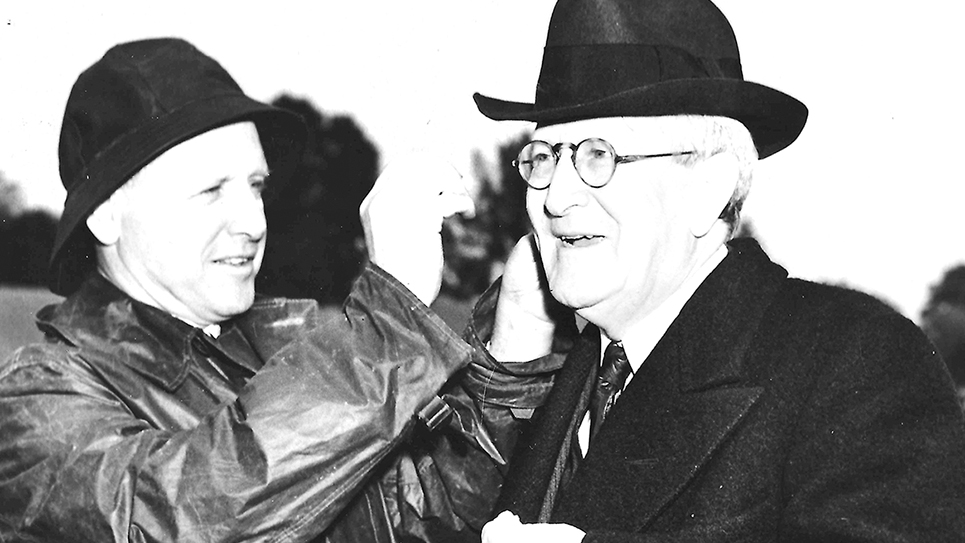
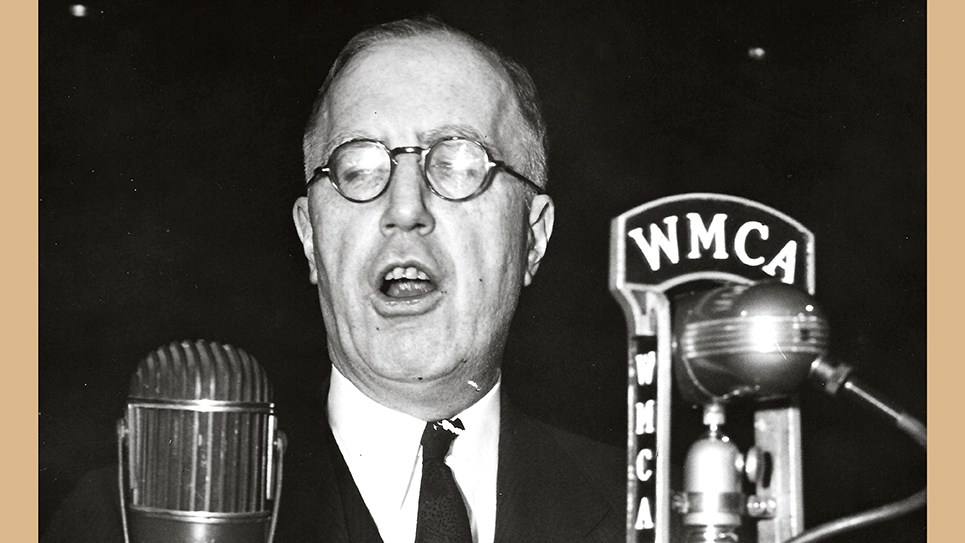
During his brief political career, Lewis Schwellenbach was a national figure. Loud and partisan, Schwellenbach’s failed campaign for governor of Washington State led to his election to the United States Senate at the height of the New Deal in 1934. Coming to Washington in 1935, Lew Schwellenbach took the oath of office with the new U.S. senator from Missouri, Harry Truman. The two became personal friends and Truman was the reason why Schwellenbach made a highly unusual decision and returned to Washington, D.C. “Big and balding,” Schwellenbach came to the Capitol as a fervent supporter of President Franklin Roosevelt and the New Deal. Indeed, one observer declared Schwellenbach was “at least as New Dealish as President Roosevelt.” Depending upon one’s point of view, Schwellenbach was either a stalwart of the Roosevelt Administration in Roosevelt’s effort to pack the Supreme Court or a New Deal “hatchet man.” A man with a formidable temper, which could and did erupt in public, Lew Schwellenbach was never afraid to denounce the enemies of the New Deal in no-uncertain terms. The senator dismissed the members of the more conservative Liberty League as “leeches, rascals and crooks.” Nor was Schwellenbach hesitant to take on the razor-tongued Huey Long of Louisiana, who delighted in puncturing the dignity of President Roosevelt and what the Kingfish saw as the missteps of the New Deal. Bespectacled and oftentimes seen chewing a cigar, Lewis Schwellenbach was a mild man whose political career was a rollercoaster of “the dull and the intriguing.” At heart, Schwellenbach was a studious man with a judicial temperament. While undisputedly friendly to organized labor, Schwellenbach was also fair to management and industry.
The Schwellenbach family had moved to Spokane, Washington, when young Lew was eight years old. Even as a boy, Schwellenbach admired the golden-throated orator William Jennings Bryan, three times the Democratic Party’s presidential standard-bearer. Lew Schwellenbach worked hard at an early age, selling newspapers and magazines on street corners and saved his money. Even then, Schwellenbach was anticipating going to college. In college, Schwellenbach excelled at debate and was involved in politics before he ever left the classroom. Lew Schwellenbach was a Democrat in a state that was, at the time, largely Republican.
Schwellenbach’s legal career began in 1919 when he was earning approximately $35 per month. The young attorney first came into local prominence when he represented James A. Mahoney in what was known in Spokane as the “trunk murder.” Naturally, such a lurid title riveted the attention of the trial at a time well before television, and the newspapers were avidly following the case in its pages across the entire Northwestern part of the country. Schwellenbach fought hard for his client, although Mahoney was convicted and hanged. Still, the trial made Lew Schwellenbach’s name familiar to the people of Spokane and Washington State.
Schwellenbach was involved with the Brotherhood of Locomotive Engineers and several of its business enterprises, including a bank and a laundry service. The laundry failed, and its investors lost a considerable amount of money. That allowed political opponents to ridicule Schwellenbach as “Lewie the Laundryman.”
Lewis Schwellenbach had been a lawyer who had made his living through working on labor issues and was often employed by unions and union members. When Senator Clarence Dill announced he would not be a candidate for reelection in 1934, Schwellenbach became a candidate to succeed him inside the Democratic primary. Two years earlier, Schwellenbach had run third in the primary, but had run a good race. Organized labor got behind Schwellenbach’s candidacy, and he won a six-man Democratic primary decisively. The general election was never in doubt. The people of Washington State strongly supported Franklin Roosevelt and the New Deal. Schwellenbach won a seven-man race and won more than 60% of the votes cast. Lewis Schwellenbach carried every county in the state except for one, where he tied with his GOP opponent, Reno Odlin.
Once in the United States Senate, Schwellenbach became especially good friends with Sherman Minton of Indiana, Joe Guffey of Pennsylvania and Harry Truman of Missouri, all of whom had also been elected in 1934. All of them were avid supporters of Roosevelt and his New Deal. Guffey was once asked what he would do on a given issue and candidly replied, “Why, I’ll do whatever Frank Roosevelt tells me to.”
During his six years in the Senate, Schwellenbach disliked the extreme humidity of Washington, D.C., and he never considered the Senate to be his career. It was no secret he longed for an appointment to the federal bench. Schwellenbach was also one of the few colleagues who traveled to Missouri to help his friend Harry Truman, who was embattled, facing a popular governor in the Democratic primary who had the backing of the Roosevelt Administration despite the senator’s strong support for the New Deal in 1940. Truman never forgot it.
Franklin Roosevelt was more appreciative of Lewis Schwellenbach, whom he nominated to serve as a federal judge in 1940. Schwellenbach watched with interest as his friend replaced Henry Wallace in 1944 as FDR’s vice-presidential running mate. Truman succeeded to the presidency when Roosevelt died on April 12, 1945.
After a month and a half, President Harry Truman elbowed three of Roosevelt’s appointees out of his Cabinet. Claude Wickard, Secretary of Agriculture, was replaced by Congressman Clinton Anderson of New Mexico. Francis Biddle, Attorney General, was replaced by Tom Clark of Texas, who had been a deputy in the Justice Department. Frances Perkins, the first woman to serve in an American presidential Cabinet, resigned as Secretary of Labor. To replace Madame Perkins, Harry Truman summoned Lewis Schwellenbach to visit the White House. According to TIME magazine, Sherman Minton, a former U.S. senator from Indiana and a member of the Class of 1934, had written the president to suggest Truman appoint Schwellenbach to a high position in his administration. The three had sat together in the rear of the Senate Chamber together. Minton’s recommendation confirmed what had already occurred to Truman, who had asked the judge to come to the Capitol. Evidently, Truman told Lew Schwellenbach he wished the man from Washington State to play the same role in his administration as Harry Hopkins had under that of Franklin Roosevelt. Schwellenbach, who was sitting in a lifetime job as a federal judge, politely turned down the offer. Truman persisted and offered Schwellenbach the appointment as Secretary of Labor to succeed Frances Perkins. Perkins had served in the spot throughout Roosevelt’s long presidency, and Schwellenbach was well aware of the labor unrest in the country, which would surely grow as World War II was coming to a close. Schwellenbach refused the offer and hurried back to Washington State. Truman was persistent in his pursuit of Lew Schwellenbach and followed up his offer with several telephone calls. TIME believed what changed Schwellenbach’s mind about giving up a lifetime appointment was the lure of another; the president supposedly promised to appoint Lewis Schwellenbach to the first vacancy on the Supreme Court of the United States. That was Lew Schwellenbach’s ultimate ambition: to serve as a justice of the U.S. Supreme Court.
The three years Lew Schwellenbach spent as Secretary of Labor had to be a frustrating experience for the former senator, as his advice was frequently ignored by President Truman. Schwellenbach had never wanted the job and realized the challenges that he would face. One writer labeled the Labor Department “the stepchild” of the Truman Administration. Truman seemed to turn more often to a former official in the Labor Department, Dr. John Steelman, a sociologist and “practical conciliator,” for advice rather than to Secretary Schwellenbach.
History was repeating itself. Wages had been high, and unions had begun a steady rise, and as the troops came home after the war had ended, the country’s economy had begun a difficult period of readjustment, which caused a fury of strikes. By the end of 1919, 4.1 million workers had participated in 3,630 strikes. By the fall of 1945, just months after the end of World War II, there was widespread turmoil with strikes or unions threatening strikes amongst “miners, oil workers, longshoremen, telephone operators, auto workers,” and others. Worse still, some half a million workers were idle.
As he had feared, all eyes were on Lewis Schwellenbach, who was sitting in the most uncomfortable seat in the country. TIME magazine exulted in pointing out that the Truman Administration was largely ill-equipped, especially compared to organized labor. “One of the reasons was that labor had all the weapons: the New Deal reforms had done that.” The government was also hindered by giving up the powers it had enjoyed during wartime and no longer had. Naturally, workers wanted to keep the bigger paychecks they had collected during the emergency wrought by the war and America’s urgent effort to fuel its war machine. Schwellenbach had tried hard to negotiate the dispute between oil companies and their workers without success. President Truman responded by seizing the refineries, and the workers came back to work. Technically, the workers were working for the government of the United States.
The Secretary of Labor’s failure to arbitrate the dispute caused some to question his ability to do his job. Even on Capitol Hill, questions were raised. Union membership had swelled to 14.5 million members and they desperately wanted to keep their gains made during the war years. Not even union officials seemed to be able to calm rowdy local members.
When auto workers demanded a 30% increase in wages, Charles Wilson (a future member of President Eisenhower’s own Cabinet) president of General Motors, refused, saying the demand was “unreasonable and inflationary.” “While your union may have the power by coercion to close our plants and those of our suppliers, with or without the approval of a majority of the workmen, it is not clear that your union can or will live up to its agreements,” Wilson snapped.
Unlike his predecessors as Secretary of Labor, Lewis Schwellenbach faced a changing country, as well as a different complex with the union movement. There were numerous labor leaders and even more special interests. Some of the Departmaent of Labor’s powers had been eaten piecemeal by the alphabet agencies of the New Deal, including the National Labor Relations Board and the War Labor Board. As soon as he returned to Washington, with the strong support of organized labor, Lewis Schwellenbach hurriedly tried to reorganize the Department of Labor, bringing several agencies either impaired or slowly dying back under the auspices of his own department.
Schwellenbach may have held, outside of the presidency, the most difficult job in the country following the Second World War. Frequently chewing his cigar to pulp, the stress of being Secretary of Labor took a toll on Schwellenbach despite being only 51 when he was first appointed to the office by President Truman.
There were reports in the newspapers that Truman was trying to make it easy for Schwellenbach to resign his office. The Little Man from Missouri angrily said those reports were nothing but lies. Those reports floated around while Secretary Schwellenbach was hospitalized for an “upper respiratory infection” at the Fort Jay Regional Hospital on Governor’s Island in Washington State. A hospital spokesman merely said the secretary was “doing as well as could be expected,” a not especially encouraging report. Schwellenbach had been plagued since a fall in the shower, which broke one of his vertebrae. That necessitated the secretary wearing a brace, which kept his back in position.
The ailing secretary went to Walter Reed Army Hospital outside Washington, D.C., for a “checkup,” allegedly to discover the source of the respiratory infection he had caught on a trip to Panama a month earlier. Details were vague as hospital officials said they did not know when Schwellenbach would leave the hospital or return to the Department of Labor. Schwellenbach never returned to his desk as he suffered a heart attack and died on June 9, 1948. The former senator was only 53 years old.
Ironically, the death of Lewis Schwellenbach may well have paved the way for his friend Sherman Minton to accept an appointment to the U.S. Supreme Court that likely would have been his otherwise in 1949.
© 2025 Ray Hill