
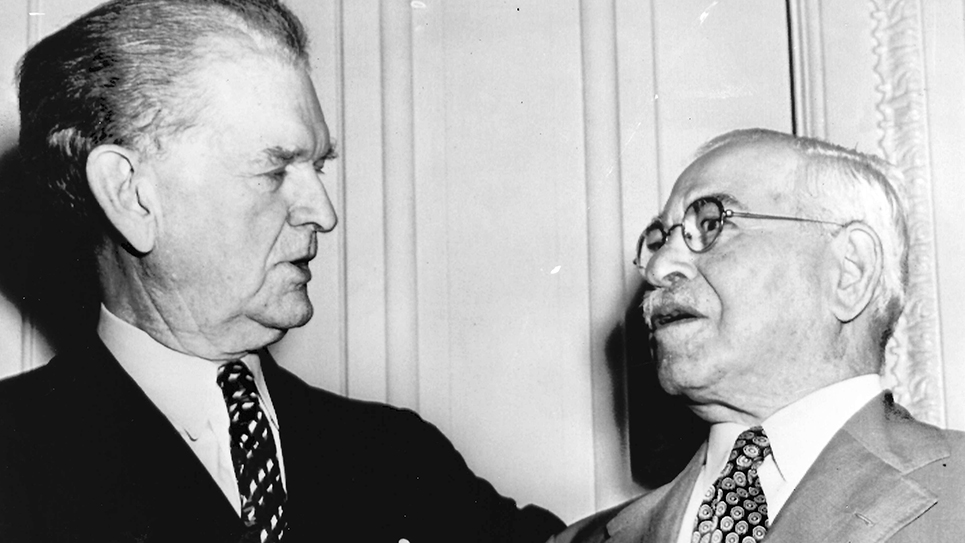
Edward Eugene Cox represented Georgia’s Second Congressional District for more than 25 years in the U.S. House of Representatives. In time, Cox would become one of the most powerful members of Congress. Those who knew him well described the fiery Georgian as “fearless,” “forthright and outspoken,” as well as one who “despised any form of hypocrisy, sham and pretense.” Strong-minded and an able orator, E. E. “Gene” Cox could have served as a prototype for the ideal Southern congressman of his time.
Unlike many of his colleagues from Georgia and the South, Cox was not a follower of Franklin Roosevelt and by and large, he was an opponent of the New Deal. Profoundly conservative at heart, Gene Cox became a leader of the formidable coalition of conservative Democrats and Republicans in the House of Representatives.
Born near Camilla, Georgia, on April 3, 1880, Gene Cox was educated in the public schools and attended Mercer University, where he earned both undergraduate and law degrees. Cox commenced the practice of law after he graduated from Mercer University, but it was not long before he found his true calling. Just two years out of law school, Cox was elected mayor of Camilla in 1904 at age 24. E. E. Cox served two years as mayor, but his interest in politics was as intense as ever. He attended the Democratic National Convention that nominated William Jennings Bryan to make the last of his three campaigns for the presidency in 1908.
When Circuit Court Judge Frank Park won a special election for Congress, E. E. Cox was appointed to take his place. Cox was elected to retain his judicial post and remained in office until 1916, when he abruptly resigned to run against Frank Park for Congress. Despite waging a hard-fought campaign, Gene Cox lost the Democratic primary. Cox, out of office, returned to his law practice but remained politically active.
Sensing the time was right, Cox announced he would make yet another bid for Congress in 1924. This time, Cox was successful in ousting the aging Congressman Park, who died shortly after the election. It was the first of 13 successful campaigns for Congress and Gene Cox would remain in Congress for the rest of his life.
Like so many others of his generation and colleagues, Cox was usually referred to as “judge” rather than congressman. It seemed the favored honorific of many, especially in the South.
Taking office on March 4, 1925, Gene Cox worked hard for his district and quickly established a record of effective constituent service. There were occasional rumblings about Cox and nepotism, and it was said at one time or another that there were nine relatives on his Congressional payroll. The charges did little to damage his reputation inside the Second Congressional District and Cox was responsible for the appointment of the first female page in the House of Representatives, although it certainly involved nepotism. Cox’s daughter, Gene, became the first female page in 1939.
A member of the powerful House Rules Committee, Gene Cox soon accumulated enough seniority to influence legislation in that body. Staunchly conservative and oftentimes antagonistic to much of the New Deal under President Franklin D. Roosevelt, Gene Cox helped to form a coalition between conservative Southern Democrats and Republicans. Even though Cox was not the chairman of the Rules Committee, many believed him to be the single most influential member of the committee due to his prominence inside the coalition of Democrats and Republicans.
The chairman of the House Rules Committee was Adolph Sabath, who represented the Jewish west side district of Chicago and had been in Congress since 1907. Sabath was not considered an especially effective chairman and recognized Cox’s influence on the committee. The late Robert V. Remini, a former historian of the U.S. House of Representatives, told an amusing story in his book on the House about the wily Sabath and Gene Cox. The coalition had been quite successful in blocking consideration of bills they opposed, and when Congressman Cox declared he intended to move a resolution through the Rules Committee to allow its membership to call up bills that the Chairman was against, Adolph Sabath was aghast.
Chairman Sabath immediately begged Cox not to bring up his resolution, claiming that if it passed the committee, it would kill him.
“I don’t care,” Cox airily replied.
Sabath then promptly fell out of his chair and sprawled on the floor.
“Oh, my God! I’ve killed him!” the stunned Cox cried.
The ailing Sabath was gingerly carried to another room and tenderly placed on a sofa by committee members, who hurried off in search of a doctor. Congressman Clarence Brown of Ohio, a Republican, remained beside the apparently unconscious Sabath, who finally began to revive. Sabath’s eyes flew open, and it slowly began to dawn upon Brown that the chairman was faking it.
“Why, you old rascal!” Brown chortled.
Sabath smiled and pointed out that Gene Cox hadn’t introduced his resolution after all.
The Chicago congressman and the fiery Georgian once disagreed so violently that they came to blows. When Sabath denounced the coalition of conservative Democrats and Republicans, Cox jumped to his feet and called the 83-year-old chairman a liar. For good measure, Cox, who was then 69 years old, punched Sabath, knocking off his glasses. Congressmen quickly separated the two, and apologies were soon forthcoming from both of them.
Cox’s temper frequently got the better of him, and physical altercations with the high and the low were not uncommon for the Georgia congressman. A member of the Workers’ Alliance who was highly critical of Cox for opposing a $150 million relief bill screamed that the people of Georgia “would remember it at the next election.” Gene Cox then drew back and slapped the man across the face, snarling, “Remember that, too.”
One heckler in Boston sniffed that he couldn’t be bothered with shaking hands with “cheap little politicians” and was slapped so hard by Cox that he fell to his knees.
Cox’s rhetoric frequently matched both his personality and his one-time red hair, and he once warned labor leader John L. Lewis and his “communistic cohorts” to stay away from Georgia. Congressman Cox told Lewis that Georgia would not stand for another invasion by carpetbaggers, especially one that flew “under the red banner of Soviet Russia.”
Congressman Cox lambasted the Roosevelt administration’s proposed wage and hour bill, violently denounced FDR’s attempt to pack the U.S. Supreme Court, damned numerous bills designed to aid organized labor, as well as the conduct of the Federal Communications Commission, which led to the greatest personal embarrassment of his long career.
In 1942, Cox launched an investigation in the Federal Communications Commission, with the express intention of driving Chairman James L. Fly out of office. The investigation was to have serious consequences for the congressman.
Cox had been approached to help radio station WALB get a license; it was not at all uncommon for radio stations (and later television stations) to seek help with licensing problems from local congressmen and senators. What was unusual was that Cox apparently accepted a $2,500 fee from the owners of WALB to pursue the license. Under the law, it was illegal for members of Congress to accept payment for what was ordinarily a routine constituent service.
Obviously, when Cox launched the special investigation into the FCC, he had no idea the payment would come to light. He denounced FCC Chairman James Fly as “the most dangerous man in Washington.” Cox went on to compare the FCC to the Gestapo, a mighty serious charge when one considers World War II was then raging across the globe.
After enduring relentless attacks, another member of the FCC, Commissioner Clifford Durr, himself a Southerner, found a copy of the endorsed check paid to Congressman Cox. Durr made hundreds of copies of the cashed check available to members of the press, House Speaker Sam Rayburn and the Department of Justice.
While neither Speaker Rayburn nor the Justice Department paid much attention to the evidence, when the press was notified, all hell broke loose.
Eugene Meyer, owner and publisher of the Washington Post, wrote an editorial that took the hide off Gene Cox. Just days after the editorial roasting by Meyer, Cox made a tearful speech resigning as chairman of the special committee investigating the FCC. Clearly, Cox had suffered a serious loss of credibility and his position was no longer tenable with his colleagues. It was the low point of Cox’s congressional career, although he was never prosecuted.
Gene Cox’s congressional career did not suffer much from the embarrassing revelations during his investigation of the FCC, nor did his standing with the people of his district. Cox was routinely reelected, oftentimes without opposition. Cox returned home to Georgia frequently and worked hard at constituent service, and the South especially prized seniority, so it was not often that incumbents lost elections.
With the death of Franklin D. Roosevelt, the feisty little man from Missouri, Harry S. Truman, succeeded to the presidency. Cox had been a sharp critic of much of the New Deal, and despite Roosevelt’s enormous popularity in Georgia, the congressman remained highly popular as well. Roosevelt, who had a home in Warm Springs, regularly referred to Georgia as his “second home.” FDR tested that popularity in 1938 when he set out to purge Senator Walter F. George. Many Georgians resented the idea of the president attempting to select their officeholders and Roosevelt’s candidate ran third.
Gene Cox got along with Harry Truman no better than he had with FDR and was oftentimes highly critical of the Fair Deal administration. Cox remained an important cog in the coalition between conservative Democrats in the House and Republicans. Cox gave out the names of eight individuals whom he claimed were “Communist sympathizers, socialists and collectivists” who were vital to designing the Marshall Plan, named for General George Marshall. Highly esteemed, Marshall served as both Secretary of Defense and Secretary of State during the Truman administration. The Marshall Plan was to help revive a war-stricken Europe following World War II. The United States of America pumped billions of dollars into rebuilding Europe, in part to help stop the cancer of Communism from spreading. Most of the individuals named by Congressman Cox were driven out of government positions.
Cox began another investigation in 1951 when he sponsored a resolution to investigate private educational and philanthropic foundations with the purpose of “social reform” as well as those involving “international relations.” Tennessee Congressman B. Carroll Reece questioned the motives of many of the foundations, considering the wealth and power available to them. Both Cox and Reece worried that the foundations encouraged universities and institutions well to the left of the political spectrum to indoctrinate their students with the same philosophies. Cox believed and, in fact, proved that funds were being used by the tax-exempt foundations to subsidize what he and some of his colleagues believed to be subversive causes.
Gene Cox did not have the opportunity to make much of this particular investigation. Time was running out for the fiery Georgian. The real contest at the time was inside the Democratic primary, and the voters inside his district showed no inclination to retire Gene Cox. The congressman was reelected in November at age 72 to a fifteenth term, but Cox was ailing. At the time of his election, Gene Cox was being treated for a heart ailment at Bethesda Naval Hospital.
Cox was admitted to the Bethesda Naval Hospital in December. Cox died from a massive heart attack on Christmas Eve 1952, ending a long and contentious Congressional career.
The Atlanta Constitution remembered Gene Cox as a man of courage who had stood up for the farmers, fought for states’ rights, and supported the cause of private enterprise. The urban daily newspaper readily acknowledged with gross understatement that while it did not always agree with the late congressman, “We always knew where Gene Cox stood.” The newspapers admitted, “He was a man who had the courage of his convictions.”
© 2026 Ray Hill