By Ray Hill
Republicans are not especially plentiful in Maryland, and GOP candidates have always had to swim upstream to win elections in the Free State. Phillips Lee Goldsborough was no exception, and he managed something no other Republican has accomplished to date: he was elected both governor and United States senator. When Goldsborough was elected governor, he was only the second Republican to occupy the office.
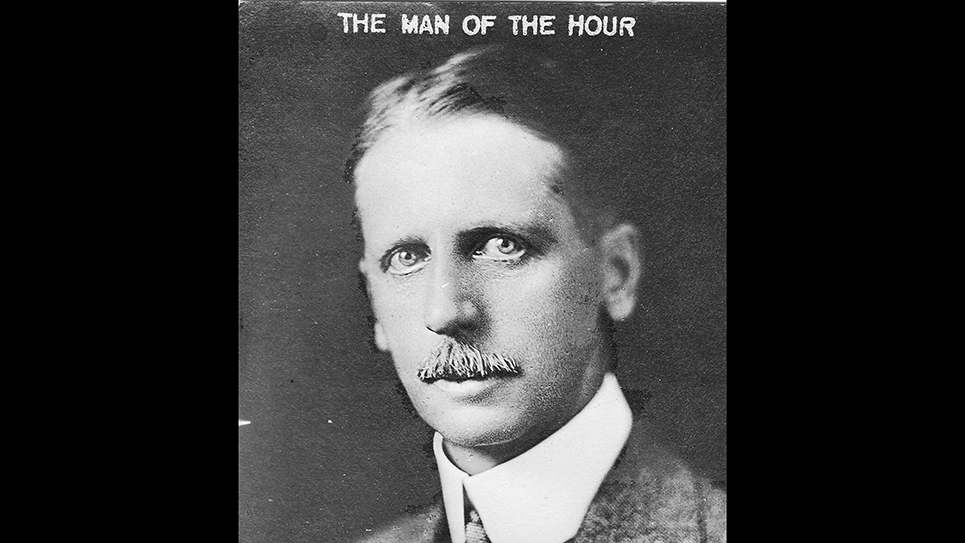
To say that Phillips Lee Goldsborough bore a pedigree might well be an understatement. There were Marylanders who believed the Goldsborough family’s standing exceeded that of the Carrolls in Maryland in the state’s ancient society. Tall, trim and sporting a moustache, Goldsborough was by vocation an attorney, but he was involved in politics throughout most of his adult life. Phillips Lee Goldsborough was known as a man of kindness, courtesy, tolerance and “unpretentious bravery.”
Those qualities helped to launch Goldsborough into a successful political career in a state where he was part of a distinct minority politically. The scion of one of the oldest families in the Free State, Goldsborough’s first job was as a Navy clerk, although he eventually earned a law degree and his first public office was that of the State’s Attorney for Dorchester County. Serving in that post for six years, Goldsborough was elected comptroller of the Maryland State Treasury in 1896 in a special election. Running for a full four-year term in 1898, Goldsborough lost to Dr. Joshua Hering. Only two Republicans have ever been elected to serve as comptroller of Maryland to this day.
Returning to the practice of law, Phillips Lee Goldsborough was tapped to serve as the Collector of Internal Revenue for Maryland, a prime patronage post at the time. Goldsborough remained collector of the IRS for his home state for nine years. Gubernatorial elections in Maryland at the time were held in the off-year, and Phillips Lee Goldsborough announced his candidacy for governor in 1911. Goldsborough faced Arthur Pue Gorman Jr., son of a United States senator who had served Maryland from 1881 until his death in 1906, in the general election. The younger Gorman was a member of the Maryland State Senate.
The Republican nominee hit Gorman for ties with a corrupt political machine in Baltimore, and Goldsborough claimed the state Democratic Party was “in the hands of a corrupt and unscrupulous organization.”
Goldsborough proved to be an able candidate and a good campaigner. The GOP gubernatorial nominee toured Western Maryland by automobile, a relatively new concept at the time. Goldsborough methodically canvassed several counties before boarding a train bound for Baltimore. Goldsborough visited cities, towns and hamlets, walking into businesses to meet and greet voters and shaking hands with everyone he met. A typical campaign stop was the one he made at Williamsport Bryon & Sons’ tannery, where he spoke before 500 men who worked there. Goldsborough greeted youngsters from an elementary school, cheerfully shaking hands with each student. Noticing about fifty men putting up a barn in the countryside, Goldsborough stopped to visit with them.
Maryland Democrats were stunned as the election returns began to trickle in on the evening of the election. Final returns showed Phillips Lee Goldsborough elected by 2,997 votes out of about 210,000 ballots cast. Even in solidly Democratic areas of Maryland, Goldsborough had run ahead of the usual GOP vote. Gorman only narrowly carried Baltimore County, where Goldsborough made a strong showing. The Baltimore Sun reported the Democratic ticket had lost in the “independent” wards where the GOP ticket had run strongly. The Sun noted even in the heavily Democratic voting precincts there had been a “general slump” in support for Gorman and the ticket. Phillips Lee Goldsborough had run very well inside the City of Baltimore, much to the shock and chagrin of Democrats.
As the votes were still being tabulated and Goldsborough was acknowledged to be in the lead, Arthur Gorman refused to concede and snapped that he was certain he had been elected. As the returns were finalized, Goldsborough was declared the winner.
Four years earlier, Phillips Lee Goldsborough had sought to be named the GOP gubernatorial nominee but had been rejected at the last moment. The Republican ticket had gone down to defeat that year, and four years later Goldsborough’s victory had helped raise the vote totals of many GOP candidates. Inundated by jubilant Republican visitors, telephone calls and a deluge of congratulatory telegrams and letters, Goldsborough was careful to thank not only Republicans but also political Independents and Democrats who had supported him.
“Without in the least detracting from the magnificent work done by my own party,” the governor-elect told newsmen as he praised the various county chairmen, as well as “the hearty co-operation of the advisory committee and the Young Men’s League” in his election. Goldsborough pledged himself to be the governor of all the people of Maryland, saying, after looking at the election returns, “That teaches me that I must be more than a partisan governor. I owe my election to the people, and they shall I serve to the best of my ability.”
Goldsborough did not ignore the close vote, which he said “serves to emphasize that naturally Maryland is a Democratic State.”
Once sworn into office as the Free State’s second Republican governor, Phillips Lee Goldsborough worked hard at reforming education in Maryland.
After his term as governor expired in 1916, Goldsborough announced his candidacy for the GOP nomination for the United States Senate. Some local Republican bosses, not content with the success of Governor Goldsborough, decided to support the candidacy of Dr. Joseph I. France, who was wealthy and brought his own considerable checkbook. Bolstered by the bosses, France won the Republican senatorial nomination by 920 votes out of 54,982 in the GOP primary.
Former Governor Goldsborough had accepted the presidency of the National Union Bank and Republicans began to worry about Joseph France’s chances in the coming general election. Those running the France campaign quickly decided they needed Goldsborough to make speeches in Maryland on behalf of Dr. France. It had belatedly occurred to those running the France campaign that perhaps irrespective of the recent primary election, Phillips Lee Goldsborough likely remained the most popular Republican with the general electorate in Maryland. A procession of well-dressed men appeared at the National Union Bank asking to speak to the former governor. Goldsborough received each caller with his customary courtesy, listening quietly as caller after caller heaped praise on him personally and his administration as governor of Maryland. Some confessed that it had been Phillips Lee Goldsborough who had given the Republican Party respectability in the Free State. Each caller reluctantly got to the point, which was if Goldsborough did not take to the stump, Dr. France might well lose the general election.
For a time, Goldsborough did little but listen, although the Baltimore Sun noted the former governor “has been a politician since he was a baby” and would almost surely answer the call of his party and make a few speeches for Joseph France. Goldsborough and William P. Jackson, one of the GOP bosses, dined together at the Belvedere Hotel and made political peace. The two had been friends before becoming bitter enemies. Whatever healing balm was applied, both left the dinner feeling much better and resolved to help the GOP ticket. Joseph I. France won the senatorial race over Congressman David Lewis by 3,922 and won with a plurality of the votes cast.
Phillips Lee Goldsborough was frequently mentioned at every election as a potential candidate for high office, but the former governor waited until 1928 when he announced he was running once again for the United States Senate for the seat he had failed to win 12 years earlier. Senator France had lost his 1922 reelection bid to William Cabell Bruce.
Neither Goldsborough nor Senator Bruce encountered serious primary opposition. The GOP organization and leadership in Maryland coalesced behind the candidacy of the former governor. After his loss in 1916, Goldsborough had been reluctant to run once again, and it took serious effort by the GOP leadership to convince him to run again in 1928. Likely one of the requirements exacted by Goldsborough was that he have no primary opposition. The Republican leadership in Maryland agreed that the strongest statewide candidate they could field was Phillips Lee Goldsborough.
Much of the campaign centered around the issue of prohibition, and Senator William Cabell Bruce was one of the “wet” leaders in the United States Senate. Prohibition was also an issue in the presidential election between New York governor Alfred E. Smith, who was a “wet,” and GOP nominee Herbert Hoover.
Goldsborough announced a tour of Maryland throughout the month of October. The Republican senatorial candidate said he was devoting ten full days to campaigning in Baltimore and Baltimore County. Once again, Phillips Lee Goldsborough proved his vote-getting prowess by defeating Senator William Cabell Bruce soundly, winning 54% of the vote, and his majority was more than 41,000 votes.
After serving six years as U.S. senator, Goldsborough was yet again lured by the Republican leadership in Maryland to forego a race for reelection to the Senate and become a candidate for the GOP nomination for governor. There were already four candidates running for the nomination. Goldsborough was being promoted as a “compromise” candidate who many thought could bring about harmony. Goldsborough did run for governor, but the leading candidate for the nomination, Harry W. Nice, refused to pull out and continued running hard. Nice upset Goldsborough inside the primary, winning decisively with almost 53% of the vote while the senator ran well behind with 29%. That defeat ended Phillips Lee Goldsborough’s career in elective politics.
President Roosevelt appointed Goldsborough to serve on the Board of Directors of the Federal Deposit Insurance Corporation in 1935. Goldsborough continued in that post for the remainder of his life.
The 81-year-old former senator became ill and required surgery from which he did not recover, dying ten days later, October 22, 1946, in Union Memorial Hospital. Goldsborough’s wife, Mary Ellen, had died in 1930 while he was serving in the Senate, and he lived in a pleasant apartment at the Tudor Arms in Baltimore.
After his passing, the Baltimore Sun published an editorial recalling the late governor and U.S. senator’s life, noting any hard feelings he might have had had long since dissipated, as had those of any of his foes for him. The newspaper acknowledged it was rare for Goldsborough to hold a grudge, and his personal character and nature were such that it was equally hard for others to hold a grudge against him. The editorial readily confessed the Sun had frequently opposed Goldsborough in his political campaigns and had once compared him to an opponent unfavorably, only to have the former governor tell audiences on the political hustings he aspired to be nothing more than a simple Maryland gentleman. The editorial noted Goldsborough’s political career “was extraordinary in duration and in achievement.”
“For so modest a man, he was astonishingly shrewd in the ways of men,” the editorial stated. “He had an almost instinctive understanding of the forces that play upon the minds and the emotions of people.” The Sun marveled at Goldborough’s ability to ascertain just what was possible in public affairs and government. “Since most such people in Maryland are Democrats, Mr. Goldsborough had a personal pulling power outside his party that no other Republicans of his time could equal,” the editorial concluded.
© 2026 Ray Hill