
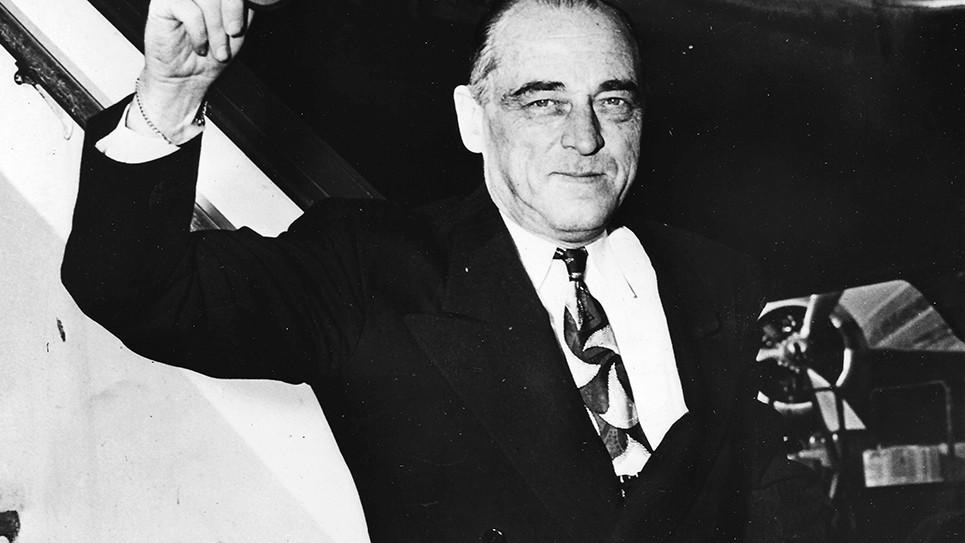
Andrew Lawrence Somers has long since been forgotten, but his was an important voice in the U.S. House of Representatives for many years. Somers was first elected to Congress when only 29 years old and stayed there for the rest of his life. The service of Andrew L. Somers coincided with some of the most challenging times ever faced by our country, including the crash of the stock market, the Great Depression, and the Second World War, as well as the coming of the Atomic Age. Somers represented a Brooklyn-based district whose population was mostly Jewish and Catholic. Many of those represented by Congressman Somers had first come to the United States as immigrants. Andrew Somers’ voice was one of the loudest in Congress about the need to help the Jewish people escape the long arm of Hitler’s Nazi regime and the Holocaust. Inside the House of Representatives, Andrew L. Somers was acknowledged by his peers and colleagues to be an expert in the field of legislation involving monetary issues. President Franklin Roosevelt had appointed Somers as a delegate to the International Monetary Conference in London in recognition of the congressman’s knowledge of fiscal policy.
Somers’ father, Arthur, was well known and well-liked in Brooklyn where he was the Superintendent of Education. Andrew Somers was born in Brooklyn and lived there his entire life. Those who knew Andrew L. Somers well readily acknowledged he was no extrovert but rather a more scholarly type of person. Colleagues remembered Somers as having been both well-educated and well-read. A kind and tolerant man most of the time, Andrew Somers knew the people he represented well because he had lived among them his entire life. Majority leader John McCormack of Massachusetts remembered “Andy’ Somers as a serious man who took his responsibilities as a congressman as a duty and acted accordingly. While not a baby-kisser or backslapper, Andrew Somers was a man of some considerable personal charm with a kindly nature and a powerful intellect. Somers was largely remembered by his fellow congressmen for his helpful nature, always happy to show new members how to get things done or assist them however he could.
Like most of his generation, Somers volunteered for the armed forces to fight during the First World War, where he was initially assigned to the U.S. Naval Flying Corps. Somers was reassigned to the Marine Corps where he rose to the rank of captain, although only 23 years old. Somers would live to see his son, Arthur, rise to the rank of captain in the Marines as well as see his offspring awarded the Distinguished Flying Cross. Married to Ruth Edna McCormick, who had been a classically trained pianist and singer, the couple had five children together and lived in a nice home at 1328 President Street in Brooklyn, New York.
Political bosses and political machines have always known that returning veterans usually make very good candidates for office ranging from the courthouse to the White House. Somers came to the attention of John H. McCooey, popularly known as “Uncle John,” by New York City Democrats. McCooey was a loyal member of New York’s famous or infamous, depending upon one’s point of view, Tammany Hall and rose to become New York State’s Democratic National Committeeman. It was McCooey who engineered Andrew L. Somers’ rise in New York City politics. In 1924, Andrew L. Somers became the Democratic nominee to face former Congressman Warren I. Lee, who had first been elected to the U.S. House of Representatives in the 1920 Republican landslide. Lee lost his reelection campaign in 1922, but was trying for another comeback in the 1924 election. Somers won the election at age 29, winning with a plurality of the vote due to a Socialist candidate siphoning off roughly 7.5% of the ballots. Still, Somers polled 3,123 more votes than his Republican opponent to go to Washington, D.C., as a freshman congressman.
Electorally speaking, Andrew L. Somers held a safely Democratic district and his office did all it could to assist constituents. Rarely did Somers ever face tough opposition in either primary or general elections. An exception was the 1930 election, which Somers won once again with a plurality of the vote, but the congressman faced three opponents. Joseph Myerson was the Republican nominee and Norman Thomas, a nationally known figure, ran as the Socialist candidate, while Earl Browder, longtime leader of the American Communist Party, ran as well. Norman Thomas had been the Socialist Party’s presidential nominee in 1928, as well as that party’s nominee for mayor of New York City in 1929. TIME magazine recorded that when Thomas accepted the Socialist nomination to run for Congress, “orthodox politicians” had been shocked. Designated at the time as New York’s Sixth Congressional District, Norman Thomas told newsmen, “It represents a cross-section of Greater New York. Yet it represents in Congress one man – – – John McCooey, politically the owner of Brooklyn.” Thomas denounced Congressman Andrew L. Somers as one of John McCooey’s several political puppets. Thomas did not run to win but rather to shine a light on John McCooey and make life at least somewhat uncomfortable for the political boss.
Browder only polled 802 votes but Norman Thomas received an astonishing 21,938 votes, which was 22% of the ballots cast. Myerson won just over 30% and ran almost 17,000 votes behind Andrew Somers, who won with 47%. Never again would Andrew L. Somers face a close reelection campaign.
Holding a safe seat allows an incumbent to attain seniority, and Andrew Somers began climbing the seniority ladder in the House of Representatives. Somers had little influence while Republicans dominated the House until 1931. When Franklin D. Roosevelt ousted Herbert Hoover from the White House in 1932 and brought hefty Democratic majorities to both houses of Congress, Somers grew in influence. Congressman Somers was a vocal and strong supporter of President Roosevelt’s New Deal and shepherded FDR’s effort to devalue gold through to passage in the House. Somers chaired the House Committee on Coinage, Weights, and Measures. Somers had been assigned to the Committee on Mines and Mining, which he eventually chaired from 1931 until 1939, a rather curious committee assignment for a representative from the streets of New York City. Somers also served on the House Committee on Public Lands, which he also chaired for a time. Dewey Short, a conservative Republican from the Missouri Ozarks, praised Somers as being a congressman with a “national point of view,” as interested in the problems of rural Americans as he was of those in America’s cities.
With a significant Jewish population inside New York’s Tenth Congressional District, it is not surprising Andrew Somers was an ardent supporter of the Jewish people and eventually Israel. Congressman Somers was one of the most vocal members of Congress in speaking about the Holocaust and Hitler’s systematic murder of millions of Jews. Senator Robert F. Wagner, a stalwart of the New Deal and New York State’s US senator, sponsored a bill that would have allowed refugee children into the United States, which Somers fervently supported. Congressman Somers continued to press the Roosevelt administration to create what eventually became the War Refugee Board. Palestine was a British protectorate after the Second World War, and Congressman Somers was keen on the idea of creating the state of Israel. On May 14, 1948, President Harry Truman officially recognized Israel, and Somers was delighted, lauding Truman’s decision. Somers said the birth of Israel would provide a home for those who had survived the Holocaust, as well as promoting democracy in the Middle East, most of which were monarchies.
Aside from representing tens of thousands of Jews as their congressman, Somers supposedly had never forgotten a story handed down through his family. His grandmother had immigrated from Ireland and had a small infant who would later become Andrew Somers’ father. The young woman and her baby were without means and struggling to live when they became the beneficiaries of the kindness of a Jewish family. Somers was a Catholic.
Congressman Andrew Somers did little to ingratiate himself with the Roosevelt administration with his insistence upon prodding the State Department and the president to do ever more to help those Jews in Europe. Roosevelt was not only powerful but also highly popular with most Democrats, and it was never easy for a Democratic congressman to challenge a chief executive from his own party. Like Roosevelt, Somers was a liberal Democrat, but while FDR was leading the country through the bloodiest conflict it had ever known, the congressman had no responsibility to run the war. Plainly put, Andrew Somers thought the United States could and should do more to help the Jews. Some went so far as to suggest that President Roosevelt should have ordered that those known locations of concentration camps be bombed to allow the prisoners to flee, but one can easily imagine the death and suffering compounded and what the judgment of history would have been. Ultimately, the United States proved to be instrumental in rescuing more than 200,000 Jews in the final months of the Second World War.
Although not entirely well, Congressman Somers continued to work hard as a member of Congress and even visited the front lines when Israel fought its war for independence in 1948. The congressman was given a two-week tour of the battlefront by Israeli military officials. Somers was in the forefront of Israel’s supporters in the House of Representatives, demanding recognition for the Jewish state as well as providing Israel with American foreign aid.
Somers was a candidate for reelection in 1948 and remained popular inside New York’s Tenth Congressional District. Somers defeated GOP candidate Arthur Hirsch and Ada B. Jackson, who ran as the nominee of the American Labor Party, which was a force in New York State.Ms. Jackson polled quite nearly 18% of the vote while Congressman Somers won with a comfortable majority of more than 37,000 votes and tallying just over 56% of the ballots cast.
Although a veteran of the House, Somers lost his temper and screamed “Idiot” at Congressman Arthur Miller, a Nebraska Republican. Speaker Sam Rayburn frowned up at the very idea that the 89 new freshmen Democrats in the House might pick up bad habits from their seniors and asked “the House’s Emily Post,” Congressman George Dondero, a professorial Republican from Michigan, to provide a fatherly lecture upon proper decorum on the floor of the House of Representatives.
Congressman Somers was recognized by many organizations for his support for Jews and Israel. Somers had been the recipient of the “Free Palestine Award” in 1947 in light of the congressman’s “outstanding contributions in Congress to the fight for Hebrew freedom.”
Shortly before his passing, Congressman Andrew Somers was part of a committee planning the celebration of the first birthday of Israel with a gigantic rally and event at Madison Square Garden.
It was no secret on Capitol Hill that Andrew L. Somers was an ill man. Congressman Emanuel Cellar later recalled, “It was not pleasant to see his pain.”
On March 1, 1949, Congressman Andrew L. Somers was rushed to the St. Alban’s Naval Hospital in Queens after complaining of pains in his stomach. The congressman’s office issued reassuring bulletins saying Somers was “recuperating nicely” but would need an additional “two or three weeks” of treatment before he could be released. Andrew Somers never came out of the hospital alive. Somers died on April 6, 1949, of cirrhosis of the liver, according to physicians at the Naval Hospital, along with other “complications,” with his wife at his bedside. Andrew L. Somers was only 54 years old.
Newspapers across the country remembered the congressman as the Gentile defender of the Jewish cause.
Congressman Emanuel Celler stood up on the floor of the House to recall and pay tribute to his friend of thirty years. Celler said that while some considered death to be a punishment, for others it was a gift and still others a favor. Due to the illness of Andrew Somers, Celler suggested, “The good Lord wished to end his woe and bestowed upon him the favor of death.”
© 2026 Ray Hill