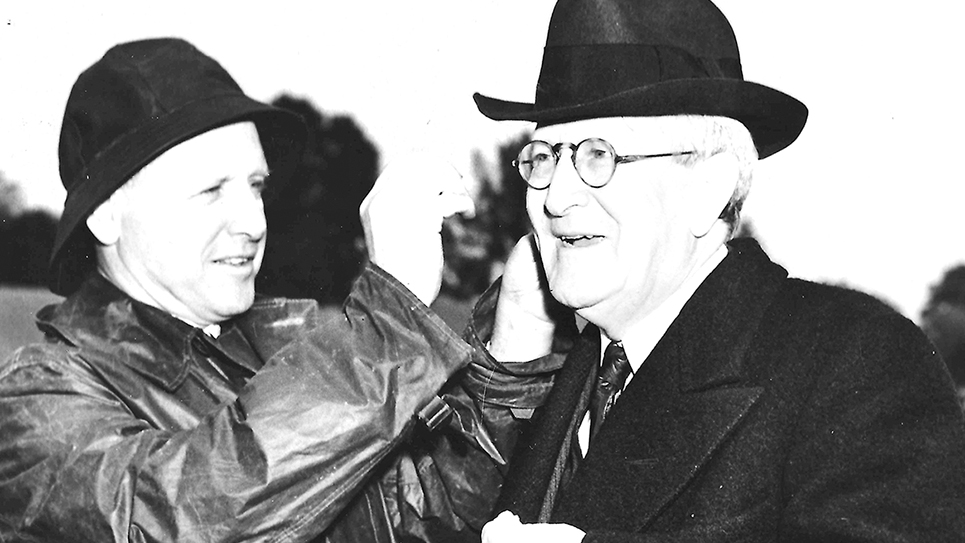
Contrary to what we are led to believe, not everything is big in Texas. Morris Sheppard, who served more than 38 years in Congress for the Lone Star State, was a diminutive 5’4. Yet in fractious Texas, where bare-knuckled politics were commonplace, Sheppard never lost an election. Today, Morris Sheppard is largely remembered, when he is remembered at all, for his sponsorship of the Eighteenth Amendment to the Constitution. That is the amendment that imposed prohibition on the country. A reporter for TIME magazine once described Morris Sheppard as a “small, prim man with greying hair and narrow eyes.” A genial man of great sincerity, Sheppard was respected by even those who sharply disagreed with him. Morris Sheppard was also a man of faith and a devout Methodist. When President Theodore Roosevelt removed “In God We Trust” from a series of special coins through executive order, then-Congressman Sheppard loudly objected. Sheppard took to the floor of the House, where he pointed to what he believed was the “divine purpose” in the formation of the United States of America. Later that same year, Congress passed a law that permanently established the motto on America’s coinage.
John Morris Sheppard was the oldest of seven children and named for his father, John Levi Sheppard, who was an attorney, judge and congressman. The future senator’s mother, Margaret, whose family gave Sheppard his name, was a direct descendant of Robert Morris, who had signed the Declaration of Independence.
Morris Sheppard followed in the footsteps of his father all the way to the halls of Congress. The younger Sheppard first followed his father into law school and the two practiced law together in Texarkana. Judge Sheppard was elected to the U.S. House of Representatives in 1898 and reelected twice. The 50-year-old congressman died on October 11, 1902. Congressman Sheppard’s health had deteriorated steadily over the course of a year as he suffered from Bright’s Disease. The elder Sheppard tried to restore his health by visiting several hot springs and just the week before he died, he was joined by his son, Morris, in traveling to Mineral Wells, where he hoped the waters would restore him.
With the death of any politician, speculation begins with the incumbent’s last breath. Immediately, that speculation centered largely upon 28-year-old Morris Sheppard. The young attorney ran in the special election to determine the nominee of the Democratic Party, which at the time was tantamount to an election. Morris Sheppard proved to be a compelling speaker and wore the mantle of his father’s popularity in the district quite well. The election returns gave Sheppard a healthy majority over several opponents.
Morris Sheppard’s home life was happy. The congressman married Lucile Sanderson, a Texas belle from a well-to-do family from Texarkana. The couple had three daughters together.
Congressman Morris Sheppard was routinely reelected by his district every two years. Sheppard was still serving in the House of Representatives when he was elected to the United States Senate on January 29, 1913, by the Texas legislature. In fact, the state legislature elected Sheppard to the U.S. Senate twice; once to complete the term of office of Senator Joseph Weldon Bailey, who had resigned, which expired on March 3, 1913. The Texas legislature also elected Morris Sheppard to serve a six-year term beginning on March 4, 1913. Sheppard had run in a 1912 preference primary, which the Texas state legislature honored. It was the closest election of Morris Sheppard’s long career. The congressman won the Democratic nomination by 36,231 votes out of 320,331 ballots cast.
Senator Sheppard’s close attention to the people back home paid handsome dividends at the ballot box. When he sought reelection in 1924, Sheppard easily swept past two competitors to win quite nearly 65% of the vote. Sheppard did even better in 1930 when he won more than 71% in the Democratic primary.
No less than five opponents entered the Democratic primary in 1936 to oppose the veteran senator for renomination, including a sitting congressman. Once again, Texans gave Senator Sheppard a resounding victory, winning almost 65% of the vote against the entire field. At the time of his death, Sheppard had already announced he intended to seek reelection to another six-year term in 1942. Morris Sheppard’s goal was to serve longer in Congress than any other person.
Senator Sheppard was one of the most conscientious of the Senate’s members, keeping a little black book in which he kept the details of his daily attendance. The average was less than a day’s absence per year over a period of 38 years, a remarkable tribute to Sheppard’s diligence and good health. The secret to Morris Sheppard’s personal popularity and political success in a state as vast as Texas was very simple. The senator was always ready to do whatever he could to help Texas and Texans. TIME referred to Sheppard as a “typewriter Senator” who answered every scrap of mail he received. Morris Sheppard envisioned himself as less a statesman than as the emissary of Texas to Washington, D.C. He was there to do whatever he could for his state and his people.
In keeping with his diligence and attention to his work, Sheppard’s service on the Senate’s Military Affairs Committee made him one of a very rare species: the true civilian expert on military matters.
The proudest achievement of Sheppard’s time in Congress was certainly August 1, 1917, the day when the United States Senate made national prohibition a part of the country’s Constitution. Since that time, Senator Morris Sheppard got to his feet and sought recognition from the Senate’s presiding officer each January 16, the date the prohibition amendment took effect. Senator Sheppard spoke every January 16 to commemorate the anniversary of the occasion. Normally, the senator favored a gray or blue sack suit, but every January 16, Sheppard appeared on the floor of the Senate in full formal dress, which was referred to as “morning attire.” Morning attire for men consisted of a morning coat, which is a coat with tails, a waistcoat or vest, and striped trousers. Morning dress usually only occurs for some weddings or governmental functions involving royalty or high government officials. I recall many years ago, President Ronald Reagan receiving Emperor Hirohito of Japan in morning attire.
The Texan, as a schoolboy, had studied physiology and saw a picture of an alcoholic’s stomach illustrated in lurid colors, which he never forgot. Unlike many of his colleagues who espoused the cause of prohibition, Morris Sheppard lived and died as a teetotaler. Sheppard had helped mustachioed Andrew Volstead author the prohibition act, but speakeasies flourished all across the country and the illegal sale of alcohol became big business and saw the rise of gangsters like Al Capone, who made millions. Oddly, it was Congressman Volstead who seemed to catch the worst of it. Few took the time to denounce the affable and kindly Senator Sheppard. Unlike Volstead, Sheppard was not a zealous fanatic. Morris Sheppard simply believed alcoholic beverages were horrible and might as well be poisonous. As TIME once noted, “Texas went right on drinking and re-electing Morris Sheppard.”
Senator Sheppard had been greeted by a committee of one thousand marchers representing prohibitionists who presented the Texan with a resolution, which was the suggested language for an amendment to the Constitution. Morris Sheppard carried the resolution from the east entrance of the Capitol building to the Senate, where he introduced it later that very day. It took several tries before Sheppard was successful and was hailed as the “Father of the Eighteenth Amendment.”
On January 16, 1933, Senator Sheppard rose not to laud prohibition but to attempt to stem the tide of its repeal. Pulling out his gold pocket watch, opening it and laying it on his desk on the Senate floor, the senator told his colleagues, “Ten years ago, lacking six days, I addressed the Senate on the subject of the proceedings of the League of Nations. Now I propose to take up where I left off …” It was the beginning of a one-man filibuster to keep the Senate from considering a resolution to repeal the prohibition amendment. Vice President Charles Curtis sat glumly at the rostrum of the Senate as the senator from Texas spoke while other senators fled from the chamber.
The will of the voters had been expressed clearly by the recent election. TIME noted the “spectacle of one little Dry defying the U.S. electorate.” Sheppard spoke until 10 p.m. that night before unexpectedly picking up his pocket watch from his desk and dropping into his seat, exhausted. The following day, the Senate voted to hear the repeal resolution. Many southern Democrats, including the new majority leader, Joe Robinson of Arkansas, had long held dry views, but the platform of the national Democratic Party called for repeal of prohibition. In truth, they would have likely ignored it had they not believed it was also the view of the country. It was the beginning of the end of a failed experiment.
Three years earlier, Senator Sheppard had boasted, “There’s as much chance of repealing the 18th Amendment as there is for a hummingbird to fly to Mars with the Washington Monument tied to its tail.” Sheppard must have caught his breath as the hummingbird and the Washington Monument whizzed past his head, as his home state of Texas became the twenty-third state to ratify the repeal of the Eighteenth Amendment to the Constitution. Even the voters in Sheppard’s own Texarkana favored repeal.
Senator Morris Sheppard was working especially hard as chairman of the Military Affairs Committee, spending as many as eighteen hours in committee, in his office, and on the floor of the Senate. The great majority of Americans were highly suspicious of foreign entanglements and clearly wished to avoid being involved in yet another European war. Reflecting those same opinions were numerous congressmen and senators who were labeled “isolationists,” although a better description might well be “noninterventionists.” As the chairman of the Military Affairs Committee, it fell to Senator Morris Sheppard to defend on the Senate floor all measures coming out of that committee for American armed forces and preparedness. Sheppard studied hard to be able to answer any questions put to him by critics of any bill coming out of the Military Affairs Committee.
The Second World War had begun in late 1939, and the Japanese Empire was becoming ever more aggressive in the Far East and its war with China still raged. America faced the challenge of readying its armed forces for whatever might come, and Senator Sheppard worked even harder, taking care of his people and working on preparedness for his country. The overwork eventually caught up with the little man from Texas. Senator Sheppard suffered a cerebral hemorrhage on April 4, 1941. Sheppard remained conscious until later that day. The senator was treated by his physician at home until he was finally taken to Walter Reed Hospital. Senator Morris Sheppard died on April 9, 1941, aged 65.
President Franklin Roosevelt paid handsome tribute to Senator Sheppard. “Courteous, kindly, he had, besides superb courage, enthusiasm and great charm of manner.” Roosevelt said the senator refused to pay attention to the warnings of doctors and friends that he was “overtaxing his physical resources and he has gone to his account with every obligation to duty fulfilled.” President Roosevelt was likely sincere in saying Sheppard had been his friend, and his regret at his loss was genuine.
Sheppard’s grandson, Connie Mack III, would also serve in the United States Senate, and his great-grandson, Connie Mack IV, would also serve in the U.S. House of Representatives. Both represented the State of Florida and were Republicans.
© 2026 Ray Hill