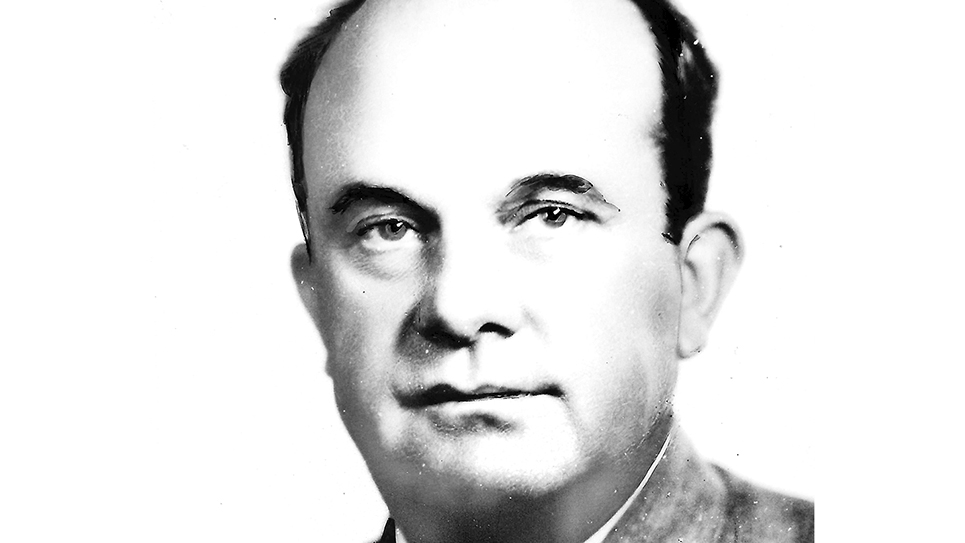
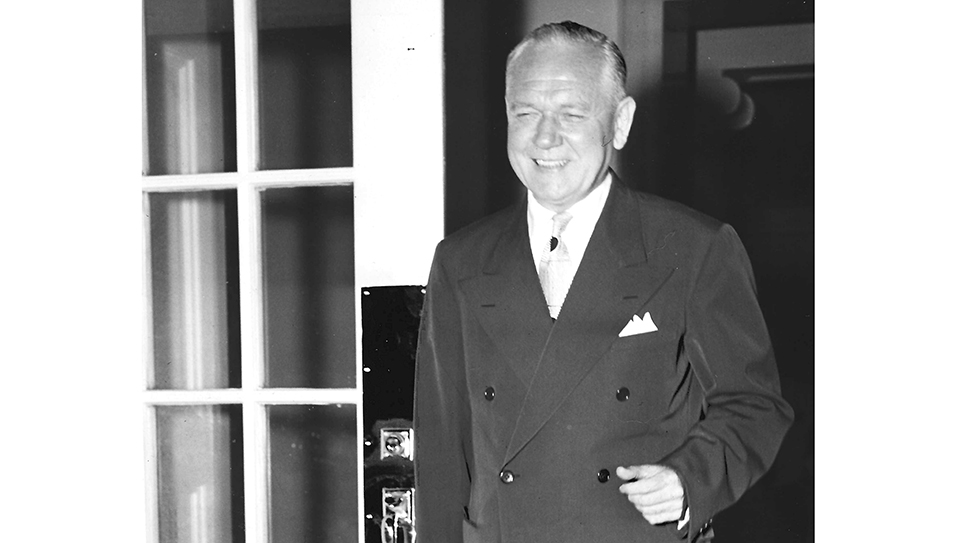
For the better part of two decades, Monrad C. Wallgren was one of Washington State’s most popular politicians. The people of Washington elected Wallgren to hold the highest offices within their gift, electing him to the U.S. House of Representatives, the United States Senate, and the office of governor.
Wallgren was the son of Swedish parents and came to Washington State when he was ten years old. Friendly and approachable, Mon Wallgren was a canny politician whose greatest achievement was quite likely the creation of the Olympic National Park, which had been bitterly opposed by many of the lumber interests in Washington State. Wallgren was an excellent billiards and poker player. Mon Wallgren once won second place in a national amateur billiards contest. Later, he challenged the champion player, Percy Collins, and the two played a 200-point match, which Wallgren won. Wallgren liked his leisure and was an ardent golfer and enjoyed hunting and fishing.
Mon Wallgren, a jeweler by profession, began a successful political career with good timing and a lot of luck. Wallgren won a hotly contested Democratic primary by only 379 votes and went on to soundly thrash GOP incumbent Congressman Lindley Hoag Hadley. The backlash against President Herbert Hoover and the Republican Party was especially strong in Washington State, and Congressman Hadley only polled just over 35% of the vote. A once-popular incumbent, Lindley Hadley had served 18 years in the House of Representatives.
Throughout his career, Mon Wallgren was a liberal and was reelected to the House in 1934, 1936 and 1938 without difficulty. Wallgren was, as might be expected, a New Dealer and voted enthusiastically for TVA, the NRA, the Agricultural Adjustment Act, the Social Security Act and virtually every other Roosevelt priority.
When Senator Lewis Schwellenbach opted not to run for reelection and accepted an appointment as a federal judge, Mon Wallgren ran to succeed him in 1940. Washington State used what it called “the blanket primary,” where all the candidates ran irrespective of political party. Congressman Wallgren ran second, more than 40,000 votes behind Republican Stephen Chadwick. With Franklin Roosevelt once again at the top of the ticket, Mon Wallgren was elected to the United States Senate with just under 54% of the ballots cast.
As a member of the Senate, Wallgren dutifully followed the administration line, which might be expected by one who had always been buoyed by the political popularity of Franklin Delano Roosevelt.
In 1944, Senator Mon Wallgren was considered the strongest Democrat to snatch back the governorship from Republican Arthur Langlie. The incumbent was highly popular with business interests and was an able campaigner who always ran well ahead of his own GOP ticket, cutting heavily into the usual Democratic majorities. Wallgren was carried into the governor’s mansion by the rising tide of President Franklin Roosevelt’s popularity. While FDR was carrying Washington State by 125,000 votes, Mon Wallgren beat Governor Langlie by just over 28,000 votes.
As governor, Mon Wallgren was a free spender, saying the state had much to do after the Second World War came to an end. As his first act as governor, Mon Wallgren rewarded his longtime chief of staff, Hugh B. Mitchell, by appointing him to the seat in the United States Senate he had just resigned to take the oath of office. During his time as governor, Wallgren pushed the legislature to create the state retirement program for teachers, adopted what was then the most liberal welfare program in the country, and increased unemployment compensation benefits, which were also the highest in the nation. Aside from welfare programs, Governor Wallgren saw to the establishment of a highway safety program and kick-started a building program for schools in the state. The governor also finalized Washington’s acquisition of the Puget Sound Ferry System, although the agreement was signed under the administration of Arthur Langlie following Wallgren’s defeat in 1948.
In July of 1945, President Harry Truman boarded the presidential plane, then dubbed “The Independence” after his hometown in Missouri, and headed for Washington State. Looking down, the president could see the lush greenery of the famed forests of fir trees, as well as the majestic peaks of white-topped Mount Rainier. When Truman walked down the steps from his plane, there waiting was his old Senate colleague, Mon Wallgren. Then serving as the state’s chief executive, Wallgren escorted the president back to the Governor’s Mansion, a Georgian-style brick edifice which sat atop the crest of Capitol Point.
For five glorious days, Harry Truman shed the cares and burdens of his office and did exactly as he pleased. Harry Truman pilfered clothes to relax in from Mon Wallgren’s own closet, choosing “a battered hat” as well as “an exclamatory sweater knitted by Vancouver Island Indians.” The two men bet one another $5 the suit he was wearing was the older of the pair. Truman won as his had been purchased in 1939. The president played the piano in the governor’s residence and found an organ under the dome of Washington’s State Capitol, where he played Beethoven’s Minute in G along with the Blackhawk Waltz. Truman, Wallgren and the governor’s press secretary then broke into song, singing “Peggy O’Neil” and “Melancholy Baby.”
It was with some regret that Harry Truman took off the garish Indian sweater and put on his suit to once again assume the burdens and pressures he carried with him daily.
In 1948, both Harry Truman and Mon Wallgren were running for reelection to the offices they respectively occupied. Wallgren faced a formidable foe in the general election, albeit one he had defeated previously. Governor Wallgren had been considered a vice-presidential running mate for Truman and had let the press know he would accept if the spot were offered to him, adding, “but I’m not trying to get it.”
The 1948 election was a rematch from four years earlier, and there was no doubt that Arthur Langlie was the most popular Republican in Washington State. Langlie was a shrewd campaigner and highly popular with business interests, and ran well ahead of most Republicans, even in normally strongly Democratic counties. As Harry Truman was carrying Washington State by more than 31,000 votes, Mon Wallgren was losing to Arthur Langlie by almost 29,000 votes in an election year that was excellent for Democrats.
Ever loyal to a fault where his friends were involved, Harry Truman promptly nominated his friend Mon Wallgren to serve as a member of the National Securities Resources Board. While the board was somewhat obscure, it paid rather well. As a former member of the Senate, Wallgren likely anticipated a swift and easy confirmation by his former colleagues. That was before hellraising maverick U.S. Senator Harry P. Cain, a Republican elected in 1946, began a noisy campaign to discredit and defeat Wallgren’s nomination. Speaking for more than six hours on the floor of the Senate, the eccentric Senator Cain amused reporters by “scratching under his arms, hitching his trousers, sipping milk and raising one foot after the other so that his male secretary could change his shoes.”
The most widely read news magazine of the day, TIME, referred to Wallgren as “an amiable mediocrity” who had “no visible qualifications for the job of planning the military, industrial and civilian mobilization of the U.S.” Virginia’s U.S. senator, Harry Byrd, joined with six Republicans to turn thumbs down on Wallgren’s nomination inside the Senate’s Armed Services Committee. That doomed the former governor’s nomination to serve on the National Securities Resources Board. Wallgren asked the president to withdraw his nomination for the post.
Never one to abandon a friend, especially one in need, Harry Truman stubbornly nominated Wallgren to serve as a member of the Federal Power Commission in 1950, and the nomination was promptly confirmed by the Senate. Truman’s support for Wallgren was oftentimes criticized by Republican newspapers, who jibed that the former governor knew little about either power or military resources but knew quite a lot about playing poker with the president. Harry Truman had once told aides that Mon Wallgren would soon be arriving, “and I’m going to bring him over and have him show you fellows how to play” poker.
Wallgren resigned as chairman of the Federal Power Commission, effective October 1, 1951. President Truman accepted the resignation “with genuine regret.” Wallgren’s resignation was hardly a surprise as rumors swirled that he was contemplating a return to politics and elective office.
Mon Wallgren considered another try for governor, but disliked the idea of another race against Arthur Langlie, who was seeking a third term in 1952. Wallgren then pondered the possibility of challenging Harry Cain, but Congressman Henry Jackson was already running hard as a Democrat against the firebrand senator. Following a visit to the White House to see his friend Harry Truman, Wallgren told reporters he had purchased a grapefruit orchard in Indio, California, and was returning home to Everett. Wallgren made the announcement that he considered himself to be out of politics, as he did not believe he would ever again seek election to another office.
Following his retirement from politics and public life, Mon Wallgren and his wife lived most of the year in Palm Desert, California, but spent their summers in Everett, Washington, where the former governor relished in seeing his old friends. The couple was back home in Washington State when Wallgren stopped and pulled over because he had a flat. The former governor got out of his car on the Nisqually Bridge in Olympia to change a flat tire. Gerhard Schock, a 22-year-old National Guardsman, stopped to help the 70-year-old Wallgren. The two were hit by a pickup truck, which killed Schock and gravely injured Wallgren. The pickup hit Shock, pinning the soon-to-be married young man between Wallgren’s Cadillac and the truck. The National Guardsman was swiftly taken to Madigan Army Hospital, where he soon died after arriving. The impact of the truck knocked Mon Wallgren 70 feet down the bridge. The driver of the pickup was later charged by the district attorney with driving under the influence.
The former governor was rushed to St. Peter Hospital, where doctors said Wallgren was suffering from a multiple compound fracture of his right leg, which had been broken in eight places. Wallgren had also suffered a compound fracture in his left leg, as well as “deep lacerations of the left arm.” Mon Wallgren had gone into shock because of loss of blood, and doctors announced his condition could be considered “poor” at best. Doctors later upgraded the former governor’s condition to “fair,” but Wallgren almost immediately began having complications brought on by the severity of his injuries. The politico’s physicians stated the obvious when they released a statement to the press that Mon Wallgren would remain in the hospital for a “considerable time.” Days later, doctors acknowledged the former governor had shown only “slight improvement” since being admitted to the hospital. Visitors were barred, except for Mrs. Wallgren.
Doctors were alarmed by the fact that the circulation in Wallgren’s terribly injured right leg was quite poor. The former governor was rushed into the operating room in an attempt to improve the circulation in the affected leg. Wallgren remained in “good spirits,” although it was becoming clear that at least part of his leg would have to be amputated. The former governor’s doctor told the press, “We hope we don’t have to amputate above the knee. But we won’t know for sure until about the first of next week.” Wallgren’s condition was labeled as merely “satisfactory.” On July 24, 1961, Mon Wallgren’s badly shattered right leg was amputated just above the knee.
At one point, the former governor’s physician declared his patient was coming along “splendidly.”
Mon Wallgren never left the hospital. The former governor’s condition continued to deteriorate. Eventually, Wallgren’s heart and kidneys began to give out. Wallgren lapsed into unconsciousness and was placed under an oxygen tent. Monrad C. Wallgren died around 6:15 p.m., September 19, 1961, at age seventy.
© 2026 Ray Hill