The route to high public office is different for every person. For Harley Martin Kilgore, it was like a rocket ship to outer space, rising from an obscure local judge of the criminal court to the United States Senate in a matter of months. Few states have the same kind of rough and tumble politics that West Virginia experienced decades ago; it more closely resembled the feud between the Hatfields and McCoys. It was hard fought and deadly serious.
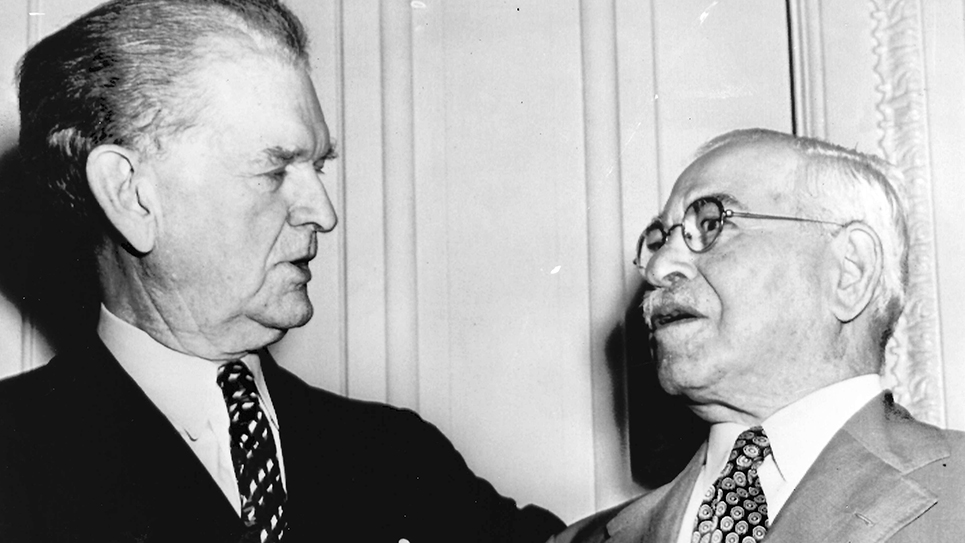
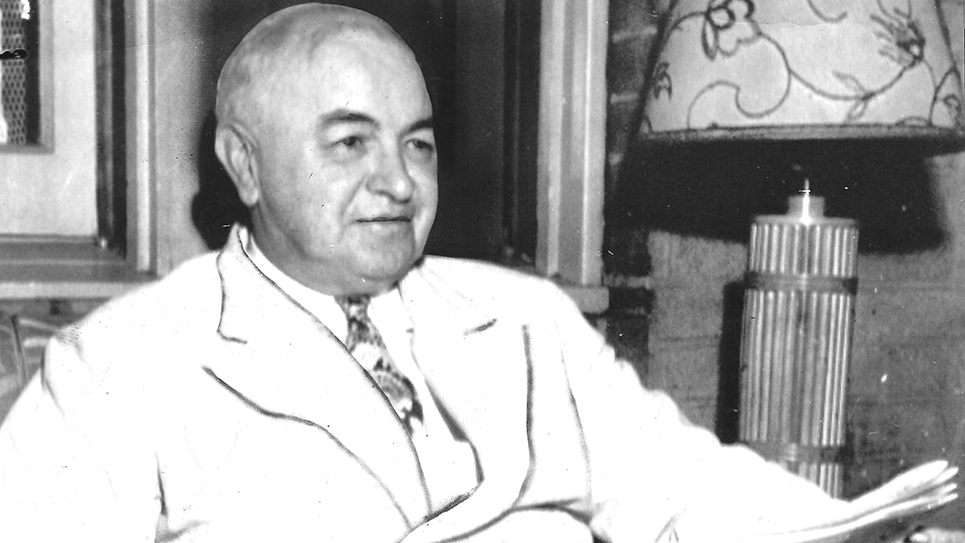
Harley M. Kilgore looked very much like a small-town judge, which is exactly what he was before being elected to the United States Senate. Balding, well-fed, neatly and conservatively dressed, Harley M. Kilgore was a kindly man who enjoyed both a cigarette and a drink. Senator Kilgore was deeply interested in social legislation, as well as legislation affecting labor, as befitting an elected official representing West Virginia. Kilgore was an all-out supporter of both the Roosevelt and Truman administrations. Indeed, Kilgore was a personal friend of Harry Truman’s from their time in the Senate together, where they served on the investigating committee that uncovered waste and fraud during America’s war effort in the early 1940s. Kilgore took his duties in the Senate seriously and was the first person ever to be elected to three consecutive terms from West Virginia. During the fifteen years Harley Kilgore served the Mountain State in the U.S. Senate, he wrote legislation expanding Social Security, unemployment compensation and mine safety. Senator Kilgore also carried bills to eradicate adult illiteracy, help small businesses and fight monopolies.
To get a start in life, Kilgore taught school, worked as a principal at the school and finally entered law school, graduating and passing the bar exam in 1916. Harley Kilgore, like so many others of his generation, served in the infantry during the First World War and left the Army with the rank of captain. Back home in West Virginia, he helped to organize the National Guard in the Mountain State and finally retired in 1953 as a colonel. Kilgore made his first political campaign at the age of 21, when he sought to be elected clerk of the circuit court in Monongalia County. Kilgore lost that race but learned from the experience.
It was some years later when West Virginia, once a largely Republican state, experienced a political realignment with the advent of Franklin Roosevelt and the New Deal. The suffering wrought by the Great Depression in West Virginia was terrible, and the people reached for hope through the New Deal and the Democratic Party. The Mountain State became a solidly Democratic state where GOP candidates faced an uphill climb. When the Democratic ticket carried West Virginia in 1932, it carried Harley M. Kilgore along with it. Kilgore was elected judge of the Criminal Court in Raleigh County.
Kilgore owed his ascent to the United States Senate to the strife between the state and federal factions of West Virginia’s feuding Democratic Party, which had come to power with Franklin Roosevelt and the New Deal. Governor Guy Kump had built a strong statehouse machine in the state, which competed with the federal faction headed by U.S. Senator Matthew Mansfield Neely. Aligned with neither faction after falling out with Neely was West Virginia’s junior United States senator, Rush D. Holt, who was a hellraiser in a category of his own. Neely had sponsored the election of Holt in 1934 only to have his younger colleague turn on him and urge the senior senator’s defeat in the 1936 election. The dispute was over New Deal patronage; Holt thought Neely hogged the most of it and became a caustic critic of Harry Hopkins and his administration of the Works Progress Administration. Senator Holt also became a critic of the New Deal, especially Roosevelt’s foreign policy. Holt was one of the loudest voices in the Senate against foreign entanglements and urged a policy of neutrality and nonintervention for America.
To destroy the statehouse machine, Senator Neely decided to run for governor himself in 1940. Likewise, the leader of the statehouse machine, former Governor Guy Kump, was running for the United States Senate against Rush Holt, who was seeking reelection. It was Matt Neely who reached down and plucked Judge Harley M. Kilgore from the bench in Beckley, West Virginia, to run for the Democratic nomination for the U.S. Senate. Neely brought with him the support of his own federal faction and that of the politically potent United Mine Workers and organized labor, which was quite powerful in the Mountain State.
Politically speaking, Harley M. Kilgore never enjoyed an easy campaign for the United States Senate. Kump was a conservative Democrat, Holt the voice of nonintervention, and the two were, at least to some degree, drawing water out of the same well. Harley Kilgore ran as a supporter of Franklin Roosevelt and the New Deal. Kilgore managed to poll 11,562 more votes than Kump to win the Democratic nomination. Harley Kilgore won the nomination with a plurality, winning 37% of the vote compared to Kump’s 33% and Rush Holt’s 24%. In the general election, Kilgore faced Tom Sweeney, a young GOP state senator and heir to a family fortune earned through the insurance business. It was a Democratic year, and the Democratic ticket of Roosevelt, Neely for governor and Kilgore for the U.S. Senate swept West Virginia. Kilgore polled more than 56% of the ballots cast.
Six years later, Tom Sweeney was once again the Republican nominee, but Senator Kilgore was facing a strong headwind as there was a GOP tidal wave nationally during the midterm elections. John L. Lewis, the bushy-browed president of the United Mine Workers, wielded more political influence in West Virginia than perhaps any other state in the nation. Lewis refused to endorse Senator Kilgore during his 1946 reelection campaign, although he did not endorse Tom Sweeney. Republicans won three of West Virginia’s five congressional districts, and Kilgore only barely scraped past Sweeney by 3,534 votes out of more than 230,000 cast. For the rest of his life, Tom Sweeney blamed his loss on voter fraud. Sweeney took his challenge of the election results to the Senate, which found for Kilgore despite a GOP majority.
In 1952, Harley Kilgore faced the most successful GOP candidate in West Virginia since the Great Depression. Chapman Revercomb had beaten the formidable Matthew Neely, who, having mastered the statehouse machine and making it his own, sought to return to the United States Senate in 1942. Revercomb had upset Neely but lost to the irrepressible veteran campaigner in a 1948 rematch. The former senator was trying again in 1952 and waged a hard-hitting campaign, accusing Kilgore of being soft on communism. The tactic seemed to backfire, and Revercomb ran behind both Dwight D. Eisenhower and Rush Holt, who was the Republican candidate for governor. Chapman Revercomb would once again upset the Democratic candidate when he beat Governor William Marland to succeed Harley Kilgore in the Senate in the 1956 special election.
It was Senator Harley Kilgore who fought to create the National Science Foundation and the West Virginian’s friendship with Harry Truman proved to be instrumental in both fending off other efforts to create a similar institute and eventually making it a reality. Kilgore objected to other bills due to what he felt were defects; for instance, in one version, Kilgore worried it was less a civilian enterprise than an extension of the military. Warren Magnuson and New Jersey senator H. Alexander Smith sponsored bills of their own, but Kilgore and Smith reached an understanding and together sponsored the legislation that President Harry Truman signed into law in 1950, which created the National Science Foundation.
Harley Kilgore headed the Senate investigation into monopolies in the United States, which he was never able to complete due to his death. Senator Estes Kefauver of Tennessee took up where Kilgore left off and won plaudits for his efforts.
One of the biggest issues during the decade of the 1950s was the Bricker Amendment, named for its sponsor, the snowy-haired Senator John W. Bricker of Ohio. The vote on the George Substitute stood at exactly 60-30 when a groggy Senator Harley Kilgore staggered into the Senate chamber. Kilgore had been resting on a sofa in his office for most of the day, and according to news sources of the time, was suffering from a case of influenza; others speculated the senator’s condition was alcohol induced. Ordered by his doctor to go home, the senator remained on Capitol Hill to be able to vote. Groggy, Senator Kilgore looked up at the presiding officer of the Senate, Vice President Richard Nixon. Kilgore, who was in need of a new upper plate of dentures, nervously ran his tongue over his gums. Neither Nixon nor Kilgore spoke a word for a few moments as everyone else remained tense in a silent suspense which gripped one and all. Warren Magnuson of Washington State got to his feet and asked, “Mr. President, how am I recorded as voting?” The clerk glanced down at the roll call sheet and stated what everyone already knew – – – Magnuson had voted against the resolution. Kilgore gave a curt nod to Vice President Nixon, who then said, “The Senator from West Virginia.”
“Mr. Kilgore,” the clerk intoned.
“No,” Kilgore replied, slowly making his way to a seat on the front row of desks on the Democratic side of the aisle.
Richard Nixon announced the vote, 60-31, and as the measure needed two-thirds approval, it had failed. Once the vote was declared, Harley Kilgore got up, walked out of the Senate chamber and went home to bed.
When Harley Kilgore became chairman of the Senate’s Judiciary Committee, it was described by TIME, the most widely read news magazine in the world, as “a wellspring of power.” The committee heard “up to half the legislation submitted to the Senate, passes on all nomination to the federal courts (including the Supreme Court) and all Justice Department positions requiring Senate confirmation.” So, too, did the Judiciary Committee have jurisdiction over issues involving immigration and citizenship. Any amendment to the Constitution went through the Judiciary Committee, as did those bills relating to civil rights. Kilgore also served on the Senate’s powerful Appropriations Committee, where he chaired the subcommittee that held the purse strings for the Department of Justice and the federal judiciary.
Senator Kilgore was suffering from extremely high blood pressure and went to Bethesda Naval Hospital for treatment. Newspapers reported the senator had “taken a turn for the worse” when he suffered a minor stroke. A spokesman for Bethesda Naval Hospital later confirmed Kilgore had indeed had a stroke. Harold Miller, the senator’s administrative assistant, confirmed Kilgore’s condition was “serious,” but also noted some improvement. The improvement was slight and did not last. Harley M. Kilgore died of a cerebral hemorrhage on February 28, 1956. Kilgore was only 63 years old.
Senator Matthew Neely lamented the loss of his Senate colleague, saying Kilgore had been “one of the nation’s outstanding liberal lawmakers.”
The senator’s widow, Lois, announced her own candidacy to succeed her husband in the Senate. Mrs. Kilgore paid the $225 filing fee required by West Virginia state law and the necessary paperwork to become a candidate. “I am filing today because the policies and ideals for which Harley Kilgore stood are at stake,” Lois Kilgore said. “I am convinced the people of West Virginia would like these policies continued through the term for which he was duly elected.”
Governor William Marland, barred from seeking a second consecutive term as governor, was a candidate in the 1956 special election to succeed Senator Kilgore and never contemplated appointing the widow to fill the vacancy. Marland appointed a placeholder and proceeded with his own campaign. When West Virginia’s Attorney General John Fox entered the Democratic primary and Lois Kilgore saw the Democratic Party was not rallying around her candidacy, she wisely withdrew.
Senator Kilgore rests today in Arlington National Cemetery.
© 2026 Ray Hill