By Ray Hill
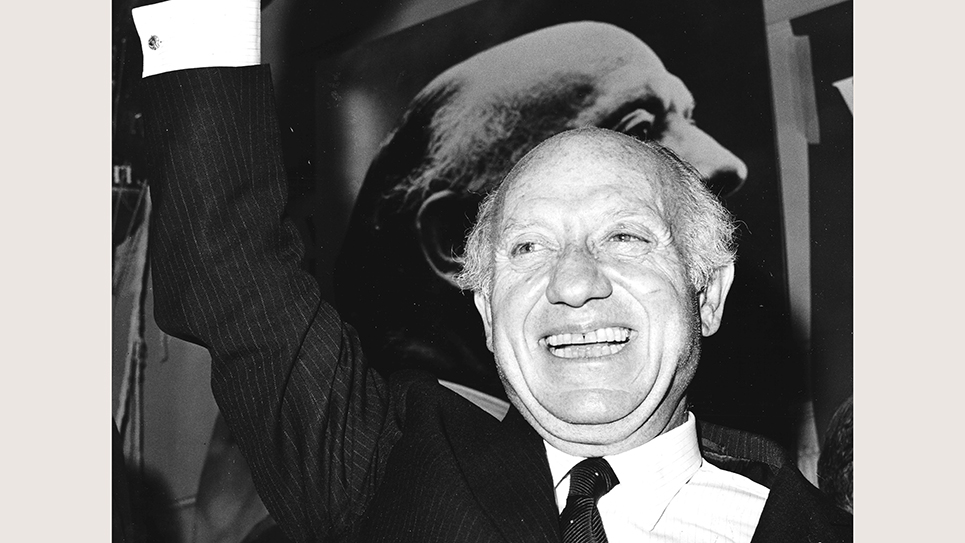
Readers are likely not familiar with Edouard V. Izac, who led a life filled with adventure and heroism, service and sacrifice, danger and deprivation. When he died, Izac was the last surviving Medal of Honor recipient from the First World War. A graduate of the Naval Academy, author, congressman, newspaperman and gentleman farmer, Ed Izac accomplished much and was devoted to his large family, which eventually included five children, 19 grandchildren and 25 great-grandchildren.
A tall man with a striking appearance, Edouard Victor Michel Izac was born in Cresco, Iowa, a tiny, rural hamlet. Izac knew the thrill of success and the valley of loss and anguish. Izac altered his age, making himself two years younger to get into the Naval Academy. Izac was on board the U.S.S. President Lincoln, a troop ship, crossing the Atlantic when it was torpedoed by a German submarine, U-90. Three torpedoes hit the USS President Lincoln, causing the ship to sink. Izac was taken aboard the submarine, where he was well treated by the Germans, who allowed him to sleep in the area reserved for officers, fed him, and even invited him to play cards with them. While being taken into Germany as a prisoner of war on a train, Izac attempted a daring and highly dangerous escape by trying to jump through a window while the train was still moving at a moderately high speed. Injuring his head and knees, his escape failed and he was beaten for his trouble. Once inside a prisoner of war camp, Ed Izac was maltreated with poor food and further beatings by angry guards.
Izac repeatedly attracted attention to himself and drew the fire of guards so that others could escape the camp. He eventually got away himself, walking through the mountainous area of southwest Germany and swimming across the Rhine, living on raw vegetables and whatever he could find. At the time of Ed Izac’s death, Gene LaRoque, a retired rear admiral, said, “Even among Medal of Honor winners, Izac stands out as a particularly heroic figure.”
Assistant Secretary of the Navy Franklin D. Roosevelt presented Izac with the Congressional Medal of Honor. Yet for the entirety of his long life, Ed Izac remained humble about his bravery and exploits. “He never considered himself a hero; he said he did what anybody would do,” Suzanne Quinlan, his daughter, said after her father’s death.
Izac, unable to continue serving in the Navy with the injuries he sustained during the war, was retired with an embarrassingly small pension. Clearly a man of tenacity and determination, Ed Izac sued the German government for brutality. One piece of evidence Izac cited during the trial was the court martial of the guard who had broken the stock of his rifle on Izac’s head and had been convicted of destruction of government property. Izac won an award of $27,000 (almost $447,000 today) and penned a book, “Prisoner of the U-90.”
Izac was married to the daughter of General DeRosy Caroll Cabell, whom he met at a dance. Agnes Cabell and Ed Izac married the day after the young man graduated from the Naval Academy. The couple’s daughter, Cabell Berge, recalled, “Grandfather Cabell ordered his daughter to San Diego.” The general also helped his son-in-law find a job at the San Diego Union newspaper. Izac sold advertisements for the newspaper but also became something of a freelance writer, covering a myriad of topics.
Ed Izac had lost his job with the onset of the Great Depression and left San Diego for a short time. He had returned and was urged to run for Congress in 1934. Izac challenged Republican Congressman George Burnham, who had originally immigrated from Great Britain after having been encouraged to run by other veterans. California’s Twentieth District consisted of two counties, San Diego and Imperial. Izac very narrowly carried Imperial County by 128 votes, while Congressman Burnham won San Diego County by a healthy enough margin to be elected by 4,725 votes.
Burnham chose not to run again in 1936, which was the pinnacle of the New Deal era, and President Franklin D. Roosevelt carried every state in the country except Vermont and Maine. Democrats had consistently increased their majorities in both houses of Congress in 1932, 1934, and again in 1936. Once again, Edouard V. Izac was the Democratic nominee for Congress from California’s Twentieth District. Facing Republican Edward Sample, Izac won a decisive victory, polling more than 56% of the ballots.
Once a member of the House of Representatives, Ed Izac was assigned to the Naval Affairs Committee, a plum assignment for a congressman representing San Diego. Like the great majority of the American people and many of those who had fought in the First World War, Congressman Izac was quite wary of involving the United States in any entanglements that might lead to war. Izac lent his voice to the powerful noninterventionist bloc, which critics referred to as “isolationists.” Congressman Izac was a liberal voice in the House and, as might be expected, his record reflected his strong support for veterans. Izac regularly attached amendments to pending bills benefitting veterans and their dependents to appropriation legislation.
Izac proved to be popular and increased his margin of victory in the 1938 election to just over 60%. During the presidential year of 1940, Izac’s majority fell when he faced a stiff challenge from Ed Fletcher, a state senator. Congressman Izac was reelected by 3,742 votes. Redistricting eliminated Imperial County from the newly redrawn Twenty-Third Congressional District in California. Izac represented San Diego County in the U.S. House of Representatives.
It was a very different time, and Edouard V. Izac was not as well known then as he likely would be today as a congressman. Even today, flying home every weekend from Washington, D.C., is arduous for many congresspeople. When Ed Izac was in Congress, he did not return home every weekend, but rather remained in Washington, D.C., most of the time. “Izac was the last of an era of congressmen … unable to frequently fly back and forth,” said former Congressman Lionel Van Deerlin in 1990. “He thought he had been elected to help run the country and didn’t pay that much attention to running his district.”
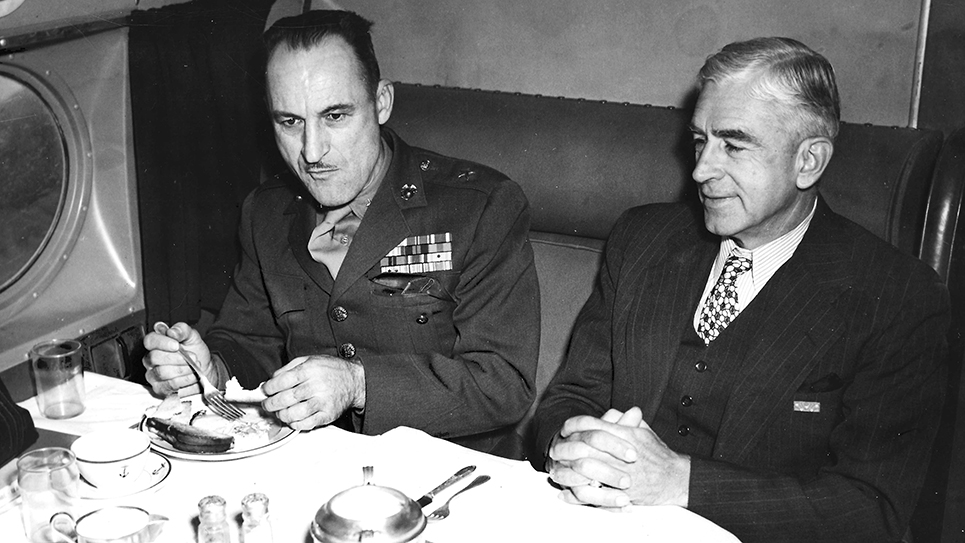
It was likely easy for a congressman, especially one who was rising in seniority, to feel he carried the weight of the world on his shoulders during a critical period in American history. With his role on the House Naval Affairs Committee, Izac toured the Pacific war theater to visit American bases.
There was also a growing feeling inside the Twenty-Third district that Congressman Izac took very good care of the Navy, while doing little for San Diego. Running in the newly redistricted Twenty-Third Congressional district of California, Congressman Ed Izac faced Republican James B. Abbey, a former district attorney general who waged a campaign sharply critical of the incumbent. Abbey said the congressman was “adept at fence straddling” and pointed to Izac’s stand on the draft bill. “He was quoted by the newspapers as terming the bill an obnoxious measure, and saying that while congress could not fail to carry out the desires of the President, he protested the recommendations of the President’s advisors,” Abbey complained. The challenger pointed out Izac had said it was “wrong to draft 18-year-olds, but he voted for it in spite of his convictions.” Abbey said the congressman wanted to have his cake and eat it, too. That, at least according to James B. Abbey, was the hallmark of Congressman Edouard Izac’s service in the House of Representatives. “The Izac technique is to go on record both ways, just to be safe,” Abbey grumbled.
At the time, the congressman had said, “I bow to the will of my commander-in-chief but I protest the recommendation of his military advisers.
“My voice may be the only one raised in protest on this floor, but I cannot remain silent when my better judgment, my own experience, tells me they are wrong.”
1942 was the most difficult year of the war for the United States, both in terms of morale and progress. It seemed the newspapers brought reports daily of new losses and reverses across the globe. The discontent and unrest of the people were reflected at the polls. The voting was light as the able-bodied men were dispersed to the far corners of the earth to fight for freedom, while many womenfolk took the places of fathers, husbands, brothers and sons in factories to help produce the desperately needed war materials to fight the Axis powers. Republicans picked up nine seats in the United States Senate and 47 seats in the House. Congressman Ed Izac only barely managed to turn back James Abbey, winning by 777 votes.
If there was a message in the vote totals for the congressman, Ed Izac ignored it, giving his complete attention to his duties as a Member of Congress and especially to his work on the Naval Affairs Committee. In 1944, James Abbey sought a rematch with Congressman Izac, and in a presidential election year and with America faring much better in the war, the incumbent won a clear victory with 55% of the total votes and a winning majority of almost 16,000 ballots.
Izac had always said he was willing to serve in the House of Representatives as long as his people seemed to want him there. It was no surprise when he announced he was seeking another term in 1946. The congressman pointed to his service on the Naval Affairs and Foreign Affairs committees, posts he insisted were of vital importance to the future of San Diego.
Izac’s opponent in 1946 was Charles K. Fletcher, a member of the Naval Reserve, a successful businessman and civic leader. “Too many congressmen have been too close to the Washington scene too long and should be retired in favor of men who know the acute conditions and problems on the home front,” Fletcher said. It was the theme of his entire congressional campaign.
The crisis of the Second World War was past, and there were numerous challenges facing the American people as the members of the armed forces returned home to their families or to start a new life and family. Americans were more than eager to be done with the sacrifices imposed by the war effort, the shortages of goods and products. Detroit had not made automobiles, having retooled its factories to produce tanks, airplanes and military vehicles. New tires were almost impossible to procure as rubber was a scarce commodity utilized for the American war machine that brought down Hitler and the Japanese Empire. Employment, one of the most notable effects of the Great Depression, was still at more than 14% in 1939 but had fallen to 1.2% by 1944. It remains the record for the lowest unemployment in the history of the United States.
1946 was the best year the Republican Party had enjoyed since 1928, winning control of both the House and the Senate. One of the Democratic casualties was Edouard V. Izac, who lost, polling less than 44% of the vote.
In retirement, Ed Izac lived in Virginia, where he kept a cattle farm in Gordonsville for some time. Later, after the death of his wife, the former congressman moved into the home of his daughter, Susie Quinlan. Izac grew strawberries and tomatoes, which he shared with neighbors. A man who believed in punctuality, Izac left Saturday night for evening mass at the same time with remarkable precision each week.
Izac also had to endure probably the worst tragedy of his life when his 19-year-old son Forrest committed suicide, citing his belief that he could never be the hero his father had been. One can only imagine how that must have tormented a grieving father. A devout Catholic, Ed Izac retreated to his faith and his family.
The former congressman remained hale and hearty even unto his 98th year when he died on January 18, 1990, in Bethesda, Maryland.
© 2026 Ray Hill