By Ray Hill
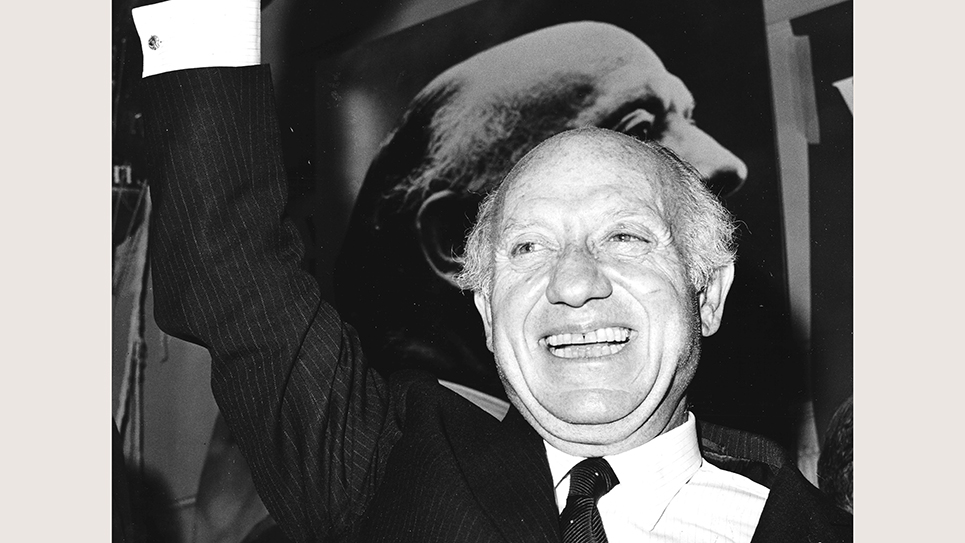
Most of history is unknown, and it is always fun for me to dust off certain tales and people and share those stories. Largely forgotten today, James Graves Scrugham lived an interesting and productive life. At various times, he was an engineer, a professor, the publisher of a major daily newspaper, and was elected to the three highest offices within the gift of the people of Nevada: governor, congressman and United States senator. Balding and compact, James G. Scrugham looked more like a country storekeeper than a politician.
Coming from a sparsely populated state, a successful politician has to know people on a personal basis, as well as have a strong grasp of what drives that state’s economy. The successful officeholder understands the needs of farmers and industry, as well as everything in between. James Scrugham knew and understood Nevada and her people very well. Scrugham gloried in simply living in the American West, frequently telling the tale of how he once watched in wonder as a mother eagle nudged her fledglings out of the nest high on the edge of a cliff one by one. The future governor saw the chicks fall and the mother sweeping down to catch her young before they hit the ground and repeat the process until each learned to fly.
Coming from a big cattle-producing state, as a congressman, Scrugham didn’t like the idea of the U.S. Army & Navy wanting to buy canned corned beef from Argentina. As Nevada’s lone member in the U.S. House of Representatives, Jim Scrugham was the author of an amendment attached to legislation coming to the Senate which kept out South American beef. Congressman Scrugham’s amendment forbade the government from buying clothing and food produced outside the United States. “I come from a district dependent almost entirely on beef and wool,” Scrugham explained. “I’m sent here to protect the interests of those growers. If I don’t they’ll kick my ass.”
Scrugham was a native of Kentucky and graduated from the University of Kentucky with a degree in engineering. Jim Scrugham moved to Nevada to become a professor of engineering at the University of Nevada. Scrugham’s reputation and ability as an engineer helped to raise the University of Nevada from a small college to a level comparable to the larger schools in the West.
Governor Emmet Boyle appointed Scrugham state engineer for Nevada in 1917. The following year, Scrugham went into the Army, where he was commissioned as a major when the United States entered World War I. He was quickly promoted to the rank of lieutenant colonel in an artillery company. Jim Scrugham maintained the same rank as a member of the reserve.
Back home in the United States in 1919, Scrugham became one of the incorporating members of the American Legion and also resumed his duties as state engineer. James G. Scrugham also became a member of Nevada’s Public Service Commission in 1919 for a term of four years. Scrugham frequently represented the interests of his state, beginning with the Panama Pacific International Exposition held in San Francisco in 1915. Later, Scrugham was one of Nevada’s members of the first Colorado River Commission. Jim Scrugham also represented Nevada during the preliminary stages of the consideration of the building of the Boulder Dam.
In 1922, James G. Scrugham made his first bid for public office, announcing as a candidate for governor. Scrugham won the Democratic nomination handily, beating an attorney from Reno, James T. Boyd. The general election was hard fought, but Scrugham won a comfortable victory in the general election with almost 54% of the vote against Republican John Miller.
During his administration as governor, Scrugham extended Nevada’s state highway system, which also expanded the state highway department. Governor Scrugham utilized the expanded highway department effectively for political purposes as well, setting a pattern for future governors. The nucleus of the highway department was helpful to Scrugham when he sought a political comeback in 1932.
Scrugham’s political career was launched by Governor Emmet Boyle who had groomed him as a successor. When Emmet Boyle died in 1926, it was a terrible blow to Scrugham, who had managed to alienate many of his fellow Democrats by being abrupt, “unwilling to listen to advice and devoting too much attention to promoting historic affairs.”
Governor Scrugham lost the 1926 election in an upset to Fred Balzar, a highly popular former sheriff of Mineral County, when Nevada saw a rise in Republicanism. Scrugham bought the Nevada State Journal from the widow of his predecessor as governor, Mrs. Emmet Boyle. Scrugham became the editor and publisher of the State Journal until he sold it to F. W. McKechnie in 1932. Scrugham also accepted an appointment as a special advisor to Secretary of the Interior Hubert Work in 1927 during the administration of Herbert Hoover on the development of the Colorado River.
The political horizon had darkened considerably for GOP candidates with America in the grip of the Great Depression. Scrugham announced as a candidate for Nevada’s lone seat in the House of Representatives and easily beat Maurice Sullivan, a former lieutenant governor, for the Democratic nomination. The former governor faced Congressman Samuel S. Arentz, a Republican, in the general election. Arentz had been first elected in the 1920 GOP tidal wave, which swept across the country that year. Arentz did not run for reelection in 1922, choosing to seek the Republican nomination for the United States Senate and losing by a mere 315 votes. Arentz sought to regain his seat in the House in 1924, which had been won by Democrat Charles L. Richards. It was a very close election with Arentz winning by 227 votes. Congressman Arentz had been easily reelected in 1926 and 1928. Arentz won again in 1930, albeit more narrowly, beating Lieutenant Governor Maurice Sullivan with 54% of the ballots cast.
The suffering wrought by the Great Depression was even more intense in 1932 than in 1930. Franklin D. Roosevelt carried Nevada overwhelmingly against President Herbert Hoover, winning quite nearly 70% of the vote. Roosevelt’s coattails allowed Democrat Pat McCarran to eke out a narrow win over Senator Tasker L. Oddie. James Scrugham ran well ahead of McCarran, taking 60% of the vote over Congressman Arentz.
For the next decade, Jim Scrugham was one of Nevada’s most popular public officials and routinely won reelection every two years as the Silver State’s Congressman-at-Large. As a congressman, Scrugham was a supporter of President Roosevelt and the New Deal. Scrugham was strong enough politically not to have any primary opponent once he had been elected to Congress. When Senator Key Pittman died days after the 1940 general election, Scrugham was an obvious choice for appointment to fill the vacancy. Governor E. P. “Ted” Carville looked elsewhere for a senatorial appointee, choosing Berkeley L. Bunker, the 35-year-old Speaker of the Nevada State House of Representatives. Carville likely chose Bunker precisely because he was not a high-profile candidate, nor one who triggered outrage from the competing and powerful political factions inside Nevada’s Democratic Party. Scrugham was a leader of the faction headed by the late Senator Pittman, while the other combine was headed by Senator Pat McCarran, who led a formidable organization.
Scrugham had been somewhat of an independent, or as one Nevada political writer termed, “had played a lone hand” since his election to Congress. It was almost universally conceded that Scrugham would be a candidate for the U.S. Senate in 1942, although the congressman had said nothing about running himself. Senator McCarran and Congressman Scrugham had not been especially friendly, to put it mildly. McCarran was a very strong personality who proved unable to get along with any of his senatorial colleagues, and Berkeley Bunker was no exception. McCarran and Bunker had feuded about political patronage.
While the Carville administration supported Senator Bunker, many in McCarran’s camp backed Congressman Scrugham. If Scrugham were to bump Bunker out of the U.S. Senate, it would also remove him as a threat to McCarran’s own reelection in 1944.
Although he had never run statewide before, Berkeley Bunker proved to be an energetic candidate, almost 30 years younger than Jim Scrugham. Political observers believed the senatorial campaign would be a real horse race. There were a few differences in their positions on the issues; both had records of support for President Roosevelt and his program. The campaigns fired salvos at one another through handbills and mailers, attacking specific aspects of one another’s records. The two hotspots of the campaign for the Democratic nomination for the senatorial nomination were the two most populous counties, Washoe (Reno) and Clark (Las Vegas). Many supporters aligned themselves with the candidate closer to their own generation. Longtime Democrats sided with Congressman Scrugham, while many young Democrats were enthusiastically for Senator Bunker.
The race was decided by 1,146 votes. Bunker won Clark County, albeit by only 85 votes. Scrugham won Washoe County by 1,248 votes, which was more than enough to provide his margin of victory in the Democratic primary. Senator Bunker carried eight counties while Congressman Scrugham carried nine.
1942 was a good year for Republican candidates across the country, but not in Nevada, where the Democratic ticket won across the board. James G. Scrugham beat GOP senatorial nominee Cecil Creel with roughly 59% of the vote. Maurice Sullivan finally won the congressman-at-large seat, Governor Carville was reelected, and the late Senator Pittman’s brother, Vail, was elected lieutenant governor.
James G. Scrugham was sworn in following the certification of the election results in December of 1942, giving him seniority over the other senators elected in 1942. At the time of his election, Jim Scrugham was 62 years old. While it was obvious he would not be able to accrue considerable seniority in the Senate, there was reason to believe he could serve at least a couple of terms.
Scrugham managed to secure a place on the Small Business Committee and was named chair of the subcommittee on Mines & Mining, a post of some importance to Nevada. Mining was also a vital concern during the Second World War when the United States was going all out to produce materials and machinery for its use and that of its allies. It was in that capacity Senator Scrugham embarked on a trip to hold hearings in Reno and Las Vegas in Nevada, as well as Tucson, Phoenix, Riverside, California, Sacramento, Los Angeles, Denver, Salt Lake City, and Grants Pass in Oregon. The purpose of the hearings was to help coordinate a program to fully develop mineral resources for the war effort.
Once in the U.S. Senate, Scrugham’s personal relations with the cantankerous Pat McCarran improved somewhat, and the two worked together for Nevada. Scrugham also helped stave off defeat for McCarran in the 1944 Democratic primary.
Senator Scrugham’s activity in the Senate slowed considerably due to illness. Scrugham was reported to be resting at a remote ranch in Clark County in May of 1944 and had been sick since January. The senator had gone to Bethesda Naval Hospital that January, reportedly because of influenza. Scrugham’s office reported late in January that the senator would return to his office very soon. Following November 1944, Jim Scrugham only appeared on the Senate floor twice.
By 1945, Berkeley Bunker had won Nevada’s seat in the House of Representatives, and he was anxious to return to the U.S. Senate. Governor Carville, disappointed by Scrugham’s failure to support him for a federal judgeship, was also avidly eyeing the senator’s seat in the Senate. Scrugham’s deteriorating health had many of the senator’s supporters thinking he would not be a candidate for reelection in 1946 in any event.
Jim Scrugham’s health was getting no better, and the senator was carried by stretcher to board a Navy plane in Las Vegas and then flown to the Naval hospital in San Diego, California. It was reported he was suffering from a kidney infection. Senator Scrugham never recovered and died in the Naval hospital on June 23, 1945, at age 65.
© 2026 Ray Hill