Some years ago, both political parties in Connecticut were careful to bolster their respective tickets with ethnically balanced tickets. Aside from the old “Yankee” population, there were Jews, Italians and a substantial Polish population to think about. Statewide tickets included someone from every large ethnic group. Nor did either party ignore the idea of tipping their hats to the women’s vote, as they almost always nominated a woman to serve as their elected secretary of state.
Antoni N. Sadlak was an industrious and ambitious young man who went to work for Boleslaus J. Monkiewicz, who had been elected to the U.S. House of Representatives in 1938 as Connecticut’s congressman-at-large. At the time, the Nutmeg State was closely divided and very much a swing state. Congressman Monkiewicz lost reelection in 1940 but came back to beat the Democrat who had ousted him from office in 1942. Antoni Sadlak served as the “executive secretary” (chief of staff) to Congressman Monkiewicz throughout his time in public office. Monkiewicz was defeated again in 1944 with Franklin Roosevelt at the top of the Democratic ticket.
Like most young men at the time, Sadlak enlisted in the armed forces as America was winning the Second World War. Returning to the United States in 1946, Sadlak got a job in Connecticut’s Department of Education as a supervisor of “distributive education.” It allowed Sadlak to travel the state, visiting on-the-job training programs to ascertain how well they were working and if they were benefiting the students.
Monkiewicz wanted the GOP nomination to run for congressman-at-large once again in 1946, but encountered determined opposition in the person and campaign of Milton H. Richmond, a former lieutenant colonel in the Army. The nomination was contested in a state convention rather than a primary, and the two candidates deadlocked. GOP state leaders put their collective heads together. Sadlak proved to be acceptable to his former boss, ex-congressman Monkiewicz, as well as the Richman supporters, who conceded that having a Pole on the ticket would be good for the entire Republican ticket. Sadlak’s experience in working for Monkiewicz gave him a claim to knowing Washington, D.C., and its ins and outs. The GOP candidate also had the benefit of running as a veteran of the Second World War, and he touted having served in the Navy. Many of the returning veterans came home and offered themselves as candidates ranging from the courthouse to the United States Senate.
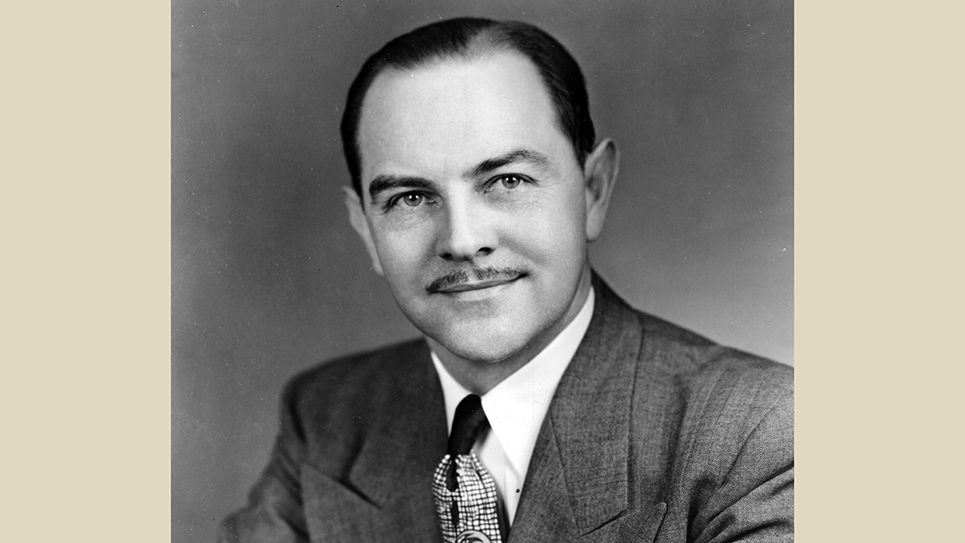
A compact man with a receding hairline and sporting a pencil-thin mustache in a style that was popular in the 1940s and 1950s, Antoni Sadlak was a hail-well-met fellow who never met a stranger. Having served as the chief of staff of a congressman-at-large, Sadlak knew how to run a congressional office as well as his home state of Connecticut. Rarely ever did Sadlak refuse an invitation to speak before the folks back home and he quickly developed a reputation for providing excellent constituent service. After his death, Sadlak was remembered for his willingness to be helpful to constituents.
During the 1946 campaign, his first race for elective office, Sadlak certainly did his part for the GOP ticket, attending dinners, get-togethers and club meetings. Antoni Sadlak spoke at countless luncheons and never missed an opportunity to shake hands with as many people as possible wherever he went. Sadlak was a young man who paid close attention to being well-groomed and nattily, albeit conservatively dressed, always ready to make a good first impression.
A typical engagement was Sadlak’s appearance before the Shoestring District Republican Club, which was held at Polly’s Inn in Montville. Antoni Sadlak was also a highly sought-after speaker for Polish-American gatherings. The congressman-at-large candidate headlined the gathering for the GOP ticket at the Polish National American Hall in New Haven.
Sadlak knew how to speak before bipartisan groups as well as when to toss red meat into the GOP-friendly audiences. Speaking before a group of 125 Polish-American veterans, Sadlak said it was imperative for them to vote for Republican candidates “if the American way of life is to survive.” It is likely difficult for readers today to imagine what life was like in the United States during World War II when many items were rationed, including butter and sugar. New tires were unavailable for cars as rubber was needed for the war effort. There were no new cars to buy as automobile factories had been converted to produce tanks, jeeps and airplanes. One needed a gasoline rationing card to be able to fill up one’s own automobile. By 1946, Americans were exhausted from the war and ready to get back to work and the opportunity to have and provide for a family. Carroll Reece, a Tennessee congressman, was the chairman of the Republican National Committee, and supervised a shrewd national campaign to reap votes from Americans tired of bureaucracy, shortages and rationing. The GOP slogan was the blunt, yet highly effective: “Had Enough?”
Antoni Sadlak reiterated the theme while campaigning in the Nutmeg State, telling audiences it was time to drive the bureaucrats and “other political termites” out of the Capitol and Washington. Sadlak said it was time that “the element that would have a few men in high places decide the manner in which a free people shall work and live” give way to a representative government.
One big issue with Polish-Americans was the takeover of Poland by the Soviet Union, which promptly installed a Communist puppet regime. Sadlak always hit that issue hard when speaking before his fellow Polish-Americans, charging the Truman administration with having “let down the Polish people in this country and sold out Poland itself when it recently consented to giving a third of Poland to the Russians.”
The Republicans had long been wandering in the political wilderness, but saw a revival in their fortunes in 1946, which proved to be the best election year for the GOP since 1928. Antoni Sadlak was elected over incumbent Joseph F. Ryter in a sweeping victory, polling just over 55% of the vote to the congressman’s 41%. Two minor candidates polled the remainder of the ballots cast. Antoni Sadlak was one of 54 newly elected Republicans in the U.S. House of Representatives. Republicans won a majority in both the House and the Senate. In Connecticut, Governor Raymond Baldwin was elected to the United States Senate, and the GOP swept every statewide office on the ballot.
Off to Washington, D.C., Sadlak immediately put together his office and sought to establish excellent constituent service as he represented every resident of the state, just like the two U.S. senators from the Nutmeg State. The freshman congressman-at-large was assigned to the Post Office and Civil Service Committee, which he said would allow him to be of service to every citizen of the state.
Running for reelection in 1948, a year when Republicans expected even greater victories, including putting New York Governor Thomas E. Dewey in the White House over the hapless Harry Truman. Dewey never deviated from mouthing platitudes and stuck to safe topics while campaigning as if he were an incumbent, while Truman fought a hard-hitting campaign and toured the country by train. Truman proved to be a rather shrewd politician and not so hapless after all, upsetting the overconfident Dewey to win a term as president in his own right after having succeeded Franklin D. Roosevelt. In Connecticut, Dewey won a close election, edging out Truman by just over 14,000 votes. Three out of five GOP congressmen from Connecticut lost reelection, while Antoni Sadlak beat his Democratic opponent by just under 4,000 votes.
Congressman-at-large Sadlak won reelection to a third term in 1950 in another close election, although he did manage to increase his margin slightly, winning by 7,427 votes against Democrat Fred Trotta.
Representative Sadlak remained a faithful Republican member of the House and was a critic of the Truman Administration. As 1951 dawned, congressmen all across the country were hearing from housewives who were complaining about the high inflation the country was experiencing through their letters, telephone calls and whenever they saw their elected representatives.
Sadlak’s outgoing personality allowed him to make friends easily, which in the House of Representatives is very helpful. Congressman Sadlak joined Governor Sherman Adams of New Hampshire (later chief of staff to President Dwight Eisenhower) and the Granite State’s congressional delegation in urging that a steel mill be sited in New England. Congressman Sadlak sent a telegram to Secretary of the Air Force Stuart Symington about approving an application for a steel mill. “I urge your immediate approval application of New England steel development corporation for a certificate to do business at New London, Conn. It may be later than we think,” the congressman’s wire read. The New Hampshire delegation was pushing a site in their own state, naturally, while Sadlak was doing his best for his own state of Connecticut.
Congressman Sadlak’s tireless efforts on behalf of his state were rewarded when he sought reelection in 1952. Sadlak proved to run better in many Democratic areas of Connecticut than the nominees for the United States Senate as voters were filling a vacancy due to the death of Senator Brien McMahon. It helped that Dwight D. Eisenhower was atop the GOP ticket and ran extremely well in Connecticut. In the Democratic citadel of Hartford, Eisenhower trailed Democratic presidential nominee Adlai Stevenson by a few hundred votes, 7,125 to 7,417. Sadlak ran almost as well, losing Hartford by only 539 votes to his Democratic opponent, with 94% of the eligible voters trooping to the polls at a time when there were no mail-in ballots and no early voting. Sadlak was reelected by more than 111,000 votes statewide, winning quite nearly 55% of the vote.
For the remainder of his career in the U.S. House of Representatives, Antoni Sadlak remained a supporter of President Eisenhower and his administration. Sadlak went through the peaks and valleys of Eisenhower’s popularity with the people of Connecticut. Eisenhower always managed to remain more personally popular with the people than the members of his own political party. Sadlak was hard-pressed by Democrat Joseph P. Lyford in the midterm election of 1954, winning by 18,698 votes statewide. In 1956, with Eisenhower once again at the top of the ballot, Antoni Sadlak won his greatest victory at the polls, winning by more than 250,000 votes out of more than two million cast. The congressman polled more than 61% of the ballots cast.
Politics is the most fickle of all mistresses, and only the foolish forget that the political pendulum always swings in both directions. Midterm elections are rarely kind to the party in power in Washington, D.C., and the congressional races were further complicated by a serious recession in the economy in 1958. Car sales fell by 31% as new housing construction slowed and faltered due to increasing interest rates. The Eisenhower administration had slowed orders from the Department of Defense, while mining, lumber and the textile industries were especially hard hit by the slowing economy. Voters were unhappy, and Republican candidates suffered at the polls accordingly. Antoni Sadlak could not overcome the tidal wave of Democratic votes in his home state of Connecticut that year, losing his seat as congressman-at-large by over 116,000 votes to Frank Kowalski.
Sadlak tried a comeback in 1960 and ran better, but with John F. Kennedy, a native New Englander, heading the Democratic ticket, the former congressman fell short, losing to Kowalski once again. One of Sadlak’s greatest disappointments was that his own political party, despite his ability to win statewide in six elections, never considered him for higher office by nominating him for either governor or the United States Senate.
Antoni Sadlak did finally return to elective office, winning an election to become a judge of the probate court in 1966. Sadlak died suddenly of a heart attack on October 18, 1969. He was only 61 years old. Yet for 12 years, Antoni Sadlak had walked the halls of the mighty and done his level best to help the people who sent him to Washington, D.C.
© 2026 Ray Hill