The final report of the Reece Committee, which had been charged by the U.S. House of Representatives with the task of investigating the ties between tax-exempt foundations and the American education establishment, set off a firestorm. The disdain for the committee and its hearings from much of the press was immense. Some accused Reece and his staff of incompetence while Wayne Hays, one of the leading opponents of reauthorizing the committee, and the Eisenhower White House, on behalf of the foundations, made things difficult for everyone. Clearly, Reece and the committee staff had to overcome a hostile news media, the White House and the determined opposition of many Democrats.
At the time, the Republicans held the majority in both the House and Senate and a GOP incumbent occupied the White House in the person of Dwight D. Eisenhower. The chairman of the Select Committee to Investigate Tax-Exempt Foundations and Comparable Organizations was Carroll Reece, long-time congressman from Tennessee’s First Congressional District. The committee was in its second incarnation and had first been known as the “Cox Committee” after its first chair, E. E. “Gene” Cox of Georgia, who had been a Democrat. Cox had died on December 24, 1952, of a heart attack and in 1953, Reece, who had been unhappy with the report of the Cox Committee, sought to renew the special select committee, which the GOP majority approved.
Known as B. Carroll Reece in the rest of the country for his first name of “Brazilla,” a Biblical name, the Tennessean had been the Republican National Committeeman from 1939, a post he continued to hold until his death in 1961. Reece had been elected as chairman of the Republican National Committee in 1946 and did not seek reelection to Congress that year. Reece experienced tremendous success utilizing the slogan “Had Enough?” which expressed the growing frustration of American consumers following the Second World War. Reece presided over the biggest political comeback made by the Republican Party since 1928 as the GOP won control of both the Senate and the House in 1946. Reece thought he saw an opportunity to win statewide office in 1948 with the Democratic Party being seriously split both nationally and in the Volunteer State. Carroll Reece became the first serious GOP candidate for the United States Senate since 1916, running on a ticket with country music legend Roy Acuff as the Republican gubernatorial candidate.
Reece was a nationally known and respected figure and the most prominent Republican in the South, which was then almost completely dominated by Democrats. A genuine hero from his service in the First World War and decorated for his bravery by both the American and French governments, Carroll Reece was no golden-throated orator. One friend and supporter once laughed while saying Reece’s speechmaking was comparable to that of a fourth-grade elementary school student. Reece’s enormous personal popularity inside Tennessee’s First Congressional District was rooted in his constituent service, which was impeccable. Reece had followed the example set by Senator Kenneth McKellar and provided prompt and courteous service to every constituent who called upon him for assistance.
Liberals suggested Carroll Reece was an “Old Guard” Republican and he was very conservative, having opposed most of Franklin Roosevelt’s New Deal and Harry Truman’s Fair Deal. Those on the left wing of the political spectrum dismissed Reece as an “isolationist,” but it was more accurate to observe that like many of those who had actually fought in a bloody war, he was more of a “noninterventionist.” Certainly, Reece was not averse to fighting and, in one notable scuffle, the congressman had once quite nearly bitten the ear off an officer who tried to prevent him from reboarding a ship to meet his wife and daughter. One scholar writing about the Reece Committee years later described Carroll Reece as “the prototype of the liberals’ idea of an ‘anti-Communist crusader’ is supposed to be.”
The left-leaning press of the country set about to demolish the final report of the Reece Committee, and the crescendo came at a January 26, 1955, meeting of the National Press Club in Washington, D.C., when Robert Hutchins, then president of the Fund for the Republic, blasted Carroll Reece. The Tennessee congressman was present when Hutchins let loose. One can easily gather Hutchins’ own opinion of himself by considering he had taken himself quite seriously as a candidate for the 1940 Democratic nomination for vice-president to run with Franklin Roosevelt, a suggestion made by Secretary of the Interior Harold Ickes, while he was still president of the University of Chicago. It was an absurd notion likely made to promote Ickes’ own vice-presidential aspirations or divert FDR’s attention away from his rival, Secretary of Agriculture Henry A. Wallace. Hutchins was one of the jewels in the crown of the higher educational establishment and foundations in the country. Robert Hutchins was the kind of pillar in the educational and foundation community to serve as the spokesman for both.
Congressman Reece was sitting at the head table when Robert Hutchins got up to speak. Hutchins charged that “the Reece investigation in its inception and execution was a fraud.” Hutchins decried the “wild and squalid” assault upon the foundations. “Nobody in his right mind could suppose that the great accumulations of wealth left by our richest men were being intentionally used by their trustees to overthrow the institutions of this country,” Hutchins declared.
Hutchins swatted away Reece’s observation that many of the trustees of the foundation were busy with their own affairs and lives that they left the oversight to “officers who were quite often disreputable.” Hutchins lobbed his own charge, saying the parade of witnesses before the Reece Committee were “of dubious standing” and asserted “the foundations were elaborately attacked by the staff.”
Robert Hutchins scoffed at “one of the more absurd charges of the Reece Committee that the foundations were an intellectual cartel.” “The Reece Committee forced them to huddle together in self-defense,” Hutchins explained. “One more investigation and they might become a cartel.”
Hutchins accused Reece and Congressman Jesse L. Wolcott of having come “bustling out in second-hand suits of anti-empiricism, supplied them by the sages of staff. . .” Hutchins lamented that the Reece Committee investigation had frightened foundations away from funding research in those fields that might be either unpopular or controversial.
“Though this relieved the men of wealth and standing of the charge of being knaves,” Hutchins sniffed, “it did so only at the expense of charging them with being fools. Only fools could be so careless as to allow enormous sums entrusted to them for charitable purposes to be stolen away and lavished on the subversion of their country.”
Robert Hutchins insisted the Reece Committee’s final report was nothing more than an effort to exploit “public concern about Communism and subversion to further political ambition and to work off political grudges.”
“Congressman Reece was scoffed at,” Hutchins smirked. “It was agreed that his investigation was a farce.
“I think he had good reason to be satisfied with himself. I think he won,” Hutchins added.
“Without firing a single serious shot, without saying a single intelligent word, he accomplished his purpose, which was to harass the foundations and to subdue such stirrings of courage, or even imagination, as could be found in them,” Hutchins thundered.
Clothed in a cloud of smug self-righteousness, Robert Hutchins piously exclaimed the foundation he headed made do with a $50 million (almost $600 million today) grant from the Ford Foundation, but noted the Fund for the Republic was independent of its funding source. Hutchins’ speech contained more than its share of both arrogance and disdain and rang clearly with the tones of an ill-disguised elitist.
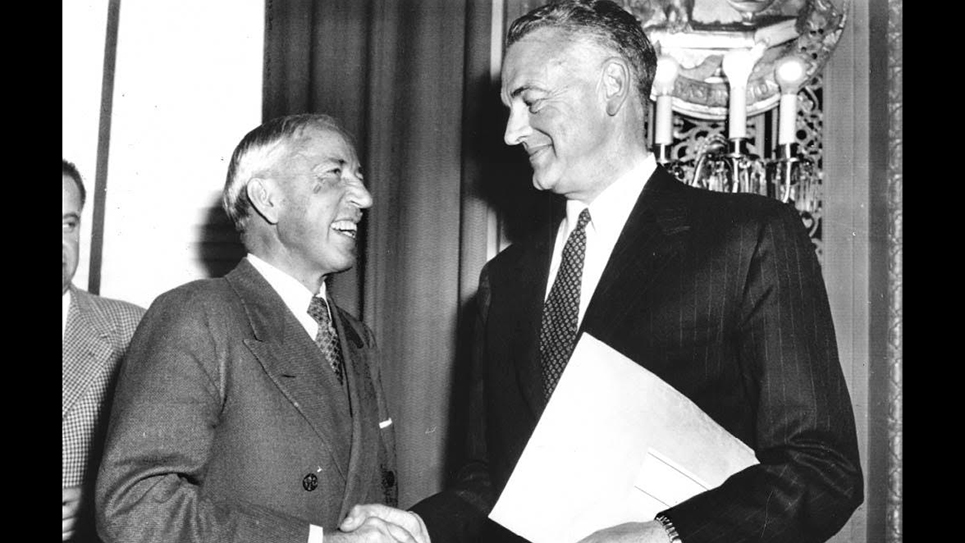
Throughout Hutchins’ speech, Carroll Reece sat composed and politely applauded when the former university president finished. Reece even agreed to pose for a picture with Hutchins, and it was the Tennessean who looked amiable and cordial while Hutchins had a look of condescension on his face.
Reece did turn to someone and say, “He’s pretty hard.” Lucian Warren, president of the Press Club, stated Reece would be welcome as a speaker if he wished to reply. “Later I will take advantage of some forum to make a reply,” Reece promised.
Congressman Carroll Reece did indeed make a reply to Dr. Robert Hutchins the following month in a speech to the National Press Club. Reece dismissed Hutchins, who he said had once been hailed as a “boy wonder,” pointing out the foundation head was no longer either “a boy or a wonder.” The congressman assailed Hutchins and other “top social science planners” for having used “a Communistic tactic” in denouncing the House investigation of foundations. The congressman said Hutchins was a prime example of social planners. Reece said the language used by Hutchins in speaking before the National Press Club was “typical of the vituperation which has been poured on us by the professional operators of foundations.”
Reece told the gathered newsmen the committee investigators had gathered evidence which indicated “that the major foundations, by subsidizing collectivistic-minded educators, had financed a socialist trend in American government.”
“Realizing the impossibility of controverting the massive evidence which we produced, they have resorted to smear and slander,” Reece said.
Congressman Carroll Reece defended the work of the committee as having been completely “competent,” as well as “historic.”
“These planners accuse the committee on foundations of wishing to suppress freedom of thought,” Reece told his listeners. “The fact is that the intellectual cartel which they created itself suppresses freedom of thought by expending millions of foundation money under their control to determine opinion, academic and public, in the leftist directions they favor.”
Doubtless to the horror of the super wealthy and foundation members, Congressman Reece pointed out the fact that average Americans enjoyed a heavier tax burden as the rich avoided paying taxes by funneling their money into tax-exempt foundations.
“The rest of the people must pay heavier taxes, for example, because the Ford family was relieved of estate taxes upon the creation of the Ford Foundation, and because the foundation itself pays no income tax on 90% of the profits of the Ford Motor Co. it receives in dividends.
“Citizens with their own money may promote any cause, good or bad, not forbidden by law, but tax-exempt funds should not be used to propagandize for the theories of either Karl Marx or Mark Hanna.” Mark Hanna had been a powerful Republican United States senator from Ohio who had done more than any other living soul to place William McKinley in the White House. Hanna was an enormously wealthy businessman who promoted the business interests of the country.
Reece noted the personal attacks made on his character by Wayne Hays and said he could have compared military records, but acknowledged it was a childish impulse which he immediately dismissed from his mind. Wayne Hays sat in his seat, his scalp turning crimson beneath his thinning hair.
Congressman Reece pointed out the foundations exercised enormous power over educators through financial subsidies and grants, which enabled them to have a powerful say in what direction education in the country would go. Reece noted, “This power to impose brainwashing at the key points is against everything America stands for.”
John O’Donnell in the New York Daily News chortled that Reece had taken the “hide off of the onetime boy president of Chicago University and let fly at House colleague Hays sitting three chairs away.” O’Donnell caustically noted when Hays had accused Reece of being a coward and liar “all to the tittering applause of the pinkos and the New Deal one-worlders of press, radio and lecture platforms.”
Irrespective of whatever Robert Hutchins said or thought, the people of Tennessee’s First Congressional District cared not at all. Carroll Reece proved to be unbeatable at the ballot box in upper East Tennessee. Reece was reelected yet again in 1960 and sometime later began feeling poorly. Initially, family and friends thought the congressman was suffering from the long-term effects of having been gassed during World War I. Doctors at Bethesda Naval Hospital discovered Reece was suffering from lung cancer.
© 2026 Ray Hill