By Pete Gawda
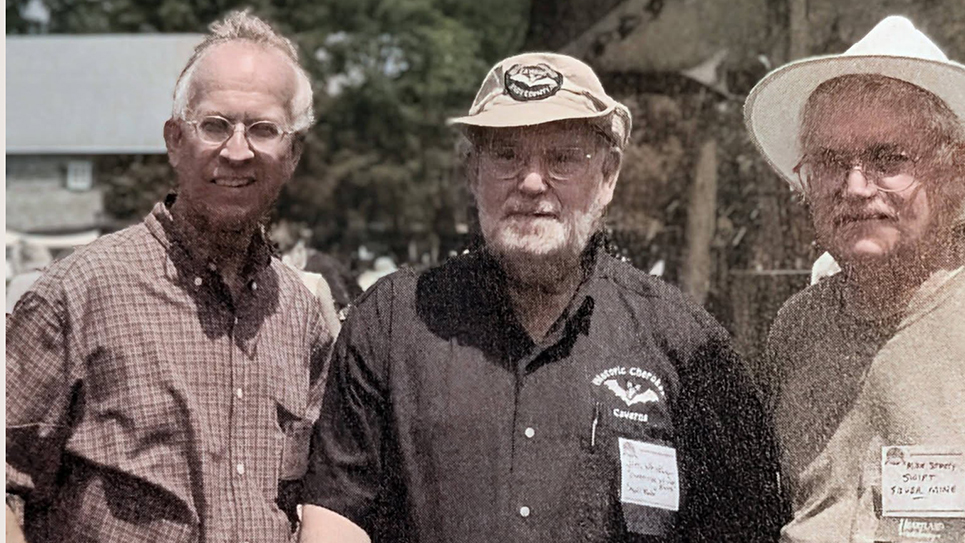
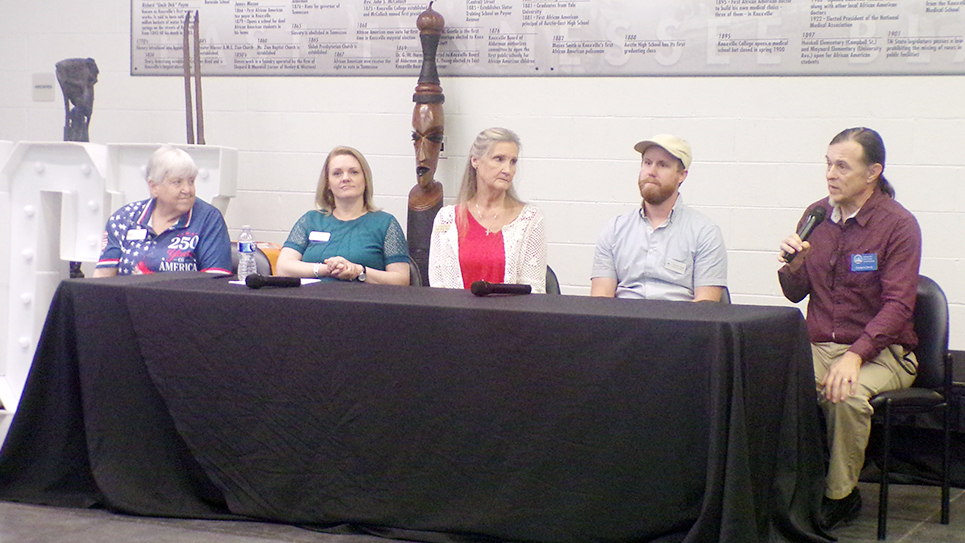
About 30 people interested in preserving historic cemeteries gathered at the Beck Cultural Exchange Center on Saturday morning, July 19, for a cemetery workshop sponsored by Knox Heritage. Several people with extensive experience in cemetery preservation and restoration spoke and then formed a panel for a question-and-answer session.
“Cemeteries are places that tell the story of our community,” Christine Cloninger, executive director of Knox Heritage, said in her opening remarks.
“One grave equals a cemetery in Tennessee,” according to Graham Perry III, historic cemetery preservation specialist with the Tennessee Historical Commission. He gave an overview of state laws defining cemeteries, termination of use, relocation of graves, and desecration laws. Perry maintains an extensive map of several thousand cemeteries in the state. “A cemetery is a cemetery forever,” he said as he spoke of the duties and responsibilities of landowners whose property contains a cemetery. Perry said landowners must grant family members access to cemeteries on their property.
Patrick Hollis, executive director of the Mabry-Hazen House, is also responsible for the two-acre Bethel Confederate Cemetery on Bethel Avenue in Knoxville. This cemetery was established in 1861 by the City of Knoxville for Confederate soldiers. About 1700 people are buried there, mostly Confederate soldiers with a few Confederate widows and some Union soldiers. Most graves are unmarked. Hollis said the location of many graves has been found using ground-penetrating radar. There is a large Confederate monument on the site, and Hollis described the tension between honoring the dead and the backlash from the institution of slavery they fought to preserve. There are three different historical markers on the site. Much of the maintenance is done by volunteers.
“In some cases, a headstone may be the only proof a person exists,” said Amy Mays Emert, an historian with Friends of Cavett Station. Cavett Station, located off Broome Road in Knoxville, is the site of an early 1790s fort as well as the site of Mars Hill Cemetery. Emert, who has done extensive work at Mars Hill, said the first grave in the cemetery is dated 1792, and the total number of graves is unknown because many are unmarked. She explained, using before and after photographs, the process of cleaning, leveling and resetting tombstones. She listed being landlocked, vandalism and lack of funding as some of the challenges of preserving cemeteries.
Marilyn Childress represented the Veterans Heritage Site Foundation. Her organization locates and preserves graves of veterans, especially Revolutionary War veterans. She said there are 50 known Revolutionary War grave sites in Knox County and that there are 250 known graves of veterans in 65 cemeteries in the Great Smoky Mountains National Park. Some of these graves are so remote they have to be located by GPS. This organization works extensively with Wreaths Across America, an organization that places wreaths on veterans’ graves at Christmas
Ellen Rochelle, executive director of Old Gray Cemetery, Knoxville’s oldest cemetery, was also one of the speakers. Guided tours are conducted among the cemetery’s 9,000 graves, and weddings are sometimes held there. Old Gray contains one Revolutionary War soldier’s grave, along with graves of soldiers from the War of 1812 and the Civil War. “It’s really quite lovely,” she said of Old Gray. The cemetery is recognized as an arboretum with 40 trees labeled.