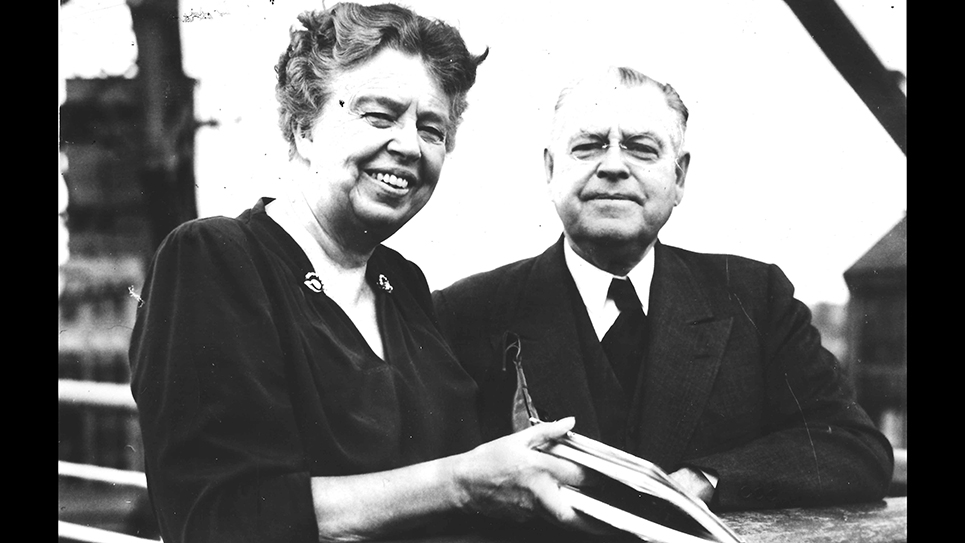
Warren Robinson Austin served in the United States Senate before resigning his seat to accept an appointment from a president of the other political party to become America’s ambassador to the United Nations. Prior to his election to the Senate, Austin had been a very successful attorney.
Austin earned the respect of his colleagues on both sides of the aisle. That same respect caused President Harry Truman, a partisan Democrat, to offer Warren Austin the appointment as the special ambassador of the president and the acting representative of the United States on June 5, 1946. Officially, Austin carried the rather grand-sounding title of Envoy Extraordinary and Ambassador Plenipotentiary. The United Nations was a brand-new entity, and nobody knew whether or not it would be effective, but people all across the globe were hopeful. By resigning his seat in the United States Senate, Austin underscored the importance of being attached to America’s ambassador to the United Nations. It was also a demonstration of Austin’s own belief in the importance of the United Nations and its role in keeping the peace in the world.
When the Republican senator from Vermont was appointed to serve as America’s ambassador to the United Nations, Austin told his senatorial colleagues, “I go with such determination to work for the cause, and such will to throw everything I have, and that God may give me in the future, into that cause, that I fear it not. It is like a divine dispensation … to serve my country and serve mankind.” Indeed, he did.
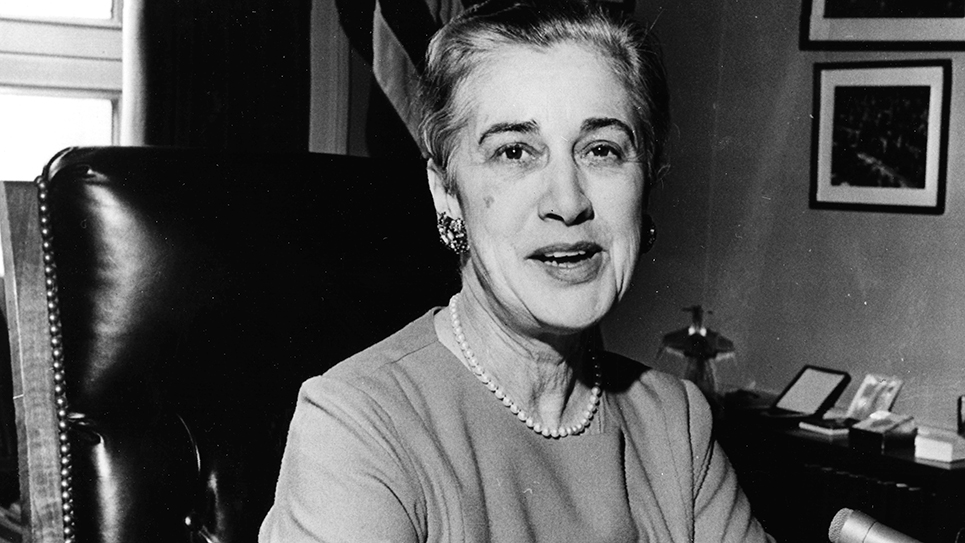
Austin was described by TIME magazine as “reticent, formal, gentle, old-fashioned, a man of controlled emotions and clear purposes.” The most widely read news magazine in the world thought Austin an idealist with a sentimental streak, yet one who had “a hard Yankee core.” Rotund, bespectacled, with a head of steel gray hair, Warren Austin could easily pass for a small-town lawyer or senator of the United States. He had been both.
Ambassador Austin and his wife took up residence in a sumptuous apartment in the Waldorf-Astoria Hotel in New York City, where he presided over a delegation and staff of some 180 people. Ambassador Austin was no figurehead; the former senator regularly consulted with both the White House and the State Department, where he provided advice on America’s role in the world. Warren Austin was most certainly the voice that carried the foreign policy as set by President Truman and his administration to his fellow delegates to the United Nations. Austin remained firm in his conviction that the United Nations was the best means for the world to keep the peace and make every country on the planet secure. He was unshakable in his beliefs. “You can’t kill the United Nations, even with a battle-ax,” Ambassador Austin barked. “The people of the world would never allow this organization to quit.”
When Warren R. Austin assumed his duties as America’s ambassador to the United Nations, the world was still recovering from the bloodiest global war ever known to mankind. The United States was the sole power on earth with a functioning atomic bomb, a secret that Soviet spies would soon uncover for their masters in Moscow. It was also the beginning of the “Cold War” between the United States and the Soviet Union.
With World War II in the past, America embarked upon a new period, which saw the onset of the Cold War between the Soviet Union and the United States. Austin was also the ambassador to the UN when the Korean War broke out due to Communist North Korea invading the Republic of Korea (South Korea). President Truman wrote to Ambassador Austin following a telephone conversation earlier in the morning on August 27, 1950. Truman praised Austin’s “able presentation of the views of the United States Government” in the United Nations. The president praised Austin’s “great effectiveness” as well as the ambassador’s adherence to the instructions he had received from the White House. Truman then reiterated seven points he wished for the ambassador to present to the United Nations.
Serving during a critical period of time when the Cold War seemed oftentimes to heat up and the United States was literally fighting Chinese troops in Korea, Warren Austin’s role at the UN assumed an even greater importance in speaking for the foreign policy of America. Ambassador Austin’s service at the United Nations saw him oftentimes at odds with his counterpart from the Soviet Union. Ironically, the Soviet Union, ruled with an iron fist by the brutal dictator Joseph Stalin, had become the world’s most prominent authoritarian dictatorship after the fall of Hitler and the defeat of the fascist forces in Europe and the Japanese Empire in the Far East. The Korean War was but one aspect of the Cold War’s ability to heat up on a moment’s notice.
Austin proved to be an effective ambassador and knew when to apply quiet diplomacy and when to win headlines. Ambassador Austin accused Communist China of trying “to shoot its way into the United Nations” when he produced a Soviet-made machine gun which had been captured from the North Korean Army. Jacob Malik, the Soviet delegate to the United Nations, left the chamber in a huff rather than look at the machine gun. Ambassador Austin fought for a resolution naming Communist China as the aggressor when it entered the Korean War to bolster its North Korean allies.
Ironically, Warren Austin was not the most well-known member of the United States delegation to the United Nations. Harry Truman had also appointed former First Lady Eleanor Roosevelt to serve as a member of the American contingent to the UN. Mrs. Roosevelt’s appointment was an historic one, as she became the first woman to represent the United States as a delegate to the United Nations. In his letter to Mrs. Roosevelt, President Truman gave her an important and vital charge. “You, as a representative of the United States, will bear the grave responsibility of demonstrating the wholehearted support which this Government is pledged to give to the United Nations organization, to the end that the organization can become the means of preserving the international peace and of creating conditions of mutual trust and economic and social well-being among all peoples of the world. I am confident that you will do your best to assist the United States to accomplish these purposes in the first meeting of the General Assembly,” Truman wrote.
As the U.S. ambassador to the United Nations, Warren Austin headed a stellar delegation, which included Senators Tom Connally of Texas and Arthur Vandenberg of Michigan. Truman was shrewd enough to appoint both Republicans and Democrats as members of the delegation. Connally was a Democrat, while Vandenberg was perhaps the leading GOP spokesman in the United States Senate for a bipartisan foreign policy. Truman was even judicious in keeping with the spirit of bipartisanship in appointing the alternate delegates. John G. Townsend of Delaware was a former U.S. senator and the chief fundraiser for his party’s senatorial campaign arm. Congressman Sol Bloom, a New York Democrat, was the chairman of the House Foreign Affairs Committee and Congressman Charles Eaton of New Jersey was the ranking Republican of the same committee. John Foster Dulles, a Wall Street attorney and a Republican, was a recognized expert on foreign policy and became Secretary of State under President Dwight D. Eisenhower.
One of the most notable speeches of Warren R. Austin’s long political career was one that was made as the United States Ambassador to the United Nations. Austin was especially passionate in his delivery of his speech outlining the “Essentials of Peace.” The thesis of Austin’s speech was that there can be no peace without ensuring the rights of the individual. “The interest of the individual human being in peaceful progress was recognized by all of us when we signed a charter which begins by declaring the determination of ‘we, the peoples of the United Nations … to save succeeding generations from the scourge of war.’” Austin reminded his colleagues the charter was a document which celebrated “the great lights of freedom, tolerance, human dignity, self-determination of peoples, cultural and educational cooperation, and economic and social advancement.” Austin insisted those same principles reflected “the highest spirituality of man.” An open and frank dialogue is always a path to resolving conflict between reasonable human beings.
Ambassador Austin made many a fiery speech on the floor of the United Nations, usually in opposition to the Soviet Union and other Communist countries. Austin was also deeply involved in attempting to sort out numerous conflicts all across the globe, including that between Israel and Palestine and the partition of India after it was removed from under the rule of the British Empire.
Warren Austin truly became the face and voice of the United States through the relatively new medium of television. TIME exulted that the television coverage of the United Nations showed “more than any other ambassador,” Austin was “the voice, the conscience and counsel of the free world.” The most widely read news magazine in the world detailed Ambassador Austin listening as a Communist delegate to the United Nations heaped invective upon the United States and her allies attentively with the resolve of “Hawthorne’s Great Stone Face.” At the time, Austin was 73 years old, somewhat hefty at 200 pounds, while standing just over 5’10. TIME thought the ambassador was “genial-jowled, courtly and oracular in an oldtime way.”
Like everyone else, Warren R. Austin could make the occasional slip of the tongue, as he once did when he urged Jews and Arabs to try and settle their dispute “in a true Christian spirit.” There were envoys to the UN who were more sophisticated as well as some who were more adept at firing off a stinging “verbal riposte.” Nor was Warren Austin especially good at speaking in subtleties. Yet TIME thought Austin unflinchingly thrust himself into the debate at the United Nations with “certain granitelike inner qualities: tenacity, common sense, Old Testament righteousness, and a God-fearing faith in the cause of freedom and collective security.”
Some are fortunate enough to receive the acclaim they deserve during their lifetimes and Warren Austin was the recipient of some 20 honorary degrees bestowed upon him by Columbia, Dartmouth, Princeton, Harvard, Syracuse, and many others. Austin had served as a trustee of the University of Vermont from 1914 until 1941.
Warren R. Austin continued to serve as ambassador to the United Nations until 1953, when President Dwight D. Eisenhower appointed former U.S. Senator Henry Cabot Lodge to the office in which Austin had made his own. Austin and Lodge had several things in common, not the least of which was that both were former members of the United States Senate, both were Republicans from the northeast, and both had long been internationalists in their view of American foreign policy.
When Warren Austin retired from the United Nations, he enrolled in a short class at the University of Vermont for apple growers. The former senator owned an apple orchard, which was his primary hobby and interest. Exchanging his suit and tie for a flannel shirt and pair of overalls, a straw hat clapped on his head, Austin puttered industriously in his orchard, oftentimes accompanied by his wife.
The former ambassador was honored by Vermont’s Jewish community for his role in helping to establish the state of Israel in January 1955. Austin was feted at a banquet honoring him for his service in both the Senate and the United Nations.
Former senator and ambassador Warren Austin returned to his home in Vermont to live amongst the people who had consistently honored him. The former ambassador suffered a stroke in 1956, which caused him to go at a slower pace. Austin lived long enough to hold his great-grandson, Warren R. Austin IV. After a long and productive life, Warren Austin died peacefully at his home in Vermont on Christmas Day 1962 at age 85.
© 2026 Ray Hill