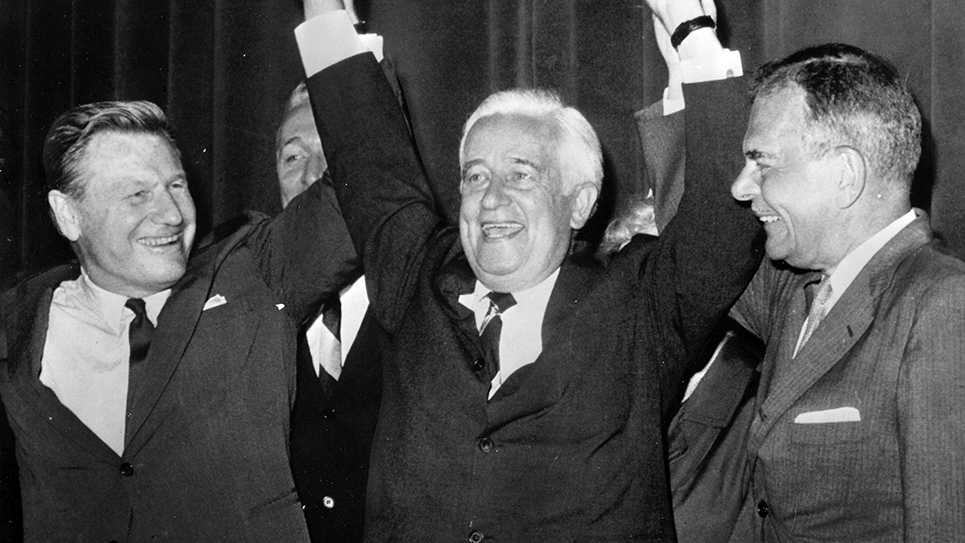
Both political parties had selected their respective nominees for the United States Senate in New York. Republicans had once again nominated Senator Kenneth B. Keating, who had served for twelve years in the House of Representatives before winning a six-year term in the Senate. Keating had repeatedly demonstrated the kind of appeal that crossed party lines and drew support from tens of thousands of Independents and some Democrats. In 1964, Nelson Rockefeller was the governor and had first been elected in 1958 along with Ken Keating and was reelected in 1962. The senior senator from New York was Jacob Javits, a Jewish Republican who had been a congressman before being elected statewide as New York Attorney General. All three – – – Rockefeller, Javits and Keating – – – were liberal Republicans and had much appeal in the Empire State.
The Democratic nominee to face Senator Keating in the general election was without a doubt the best-known candidate for the United States Senate in the 1964 election cycle. Robert F. Kennedy was the younger brother of the late President John F. Kennedy. Bobby Kennedy was also familiar from the televised hearings of the McClellan Committee, which explored the seemingly bottomless pit of labor racketeering. Then came his appointment to serve as his brother’s attorney general for the United States. The tragedy of John F. Kennedy’s assassination remains with those who were alive at the time, ensconced somewhere in the memories of those of us getting along in years. The resulting sadness created considerable sympathy for Bobby Kennedy and more than a little pressure on President Lyndon Johnson to name him as his running mate in 1964. That idea was abhorrent to LBJ as he loathed RFK as much as Bobby Kennedy disliked him. Johnson retained some very real bitterness at those longtime Kennedy staff members who had populated the White House staff during the “Camelot” of John F. Kennedy’s time, who derided Johnson’s southern ways and style. When Johnson had campaigned by train during the 1960 election, the Kennedy men referred to it derisively as “the Corn Pone Special.” LBJ, although a Democrat, had a memory like an elephant and bided his time.
One of the most masterful politicians ever to serve as president of the United States, Lyndon Johnson suddenly announced he would not select any member of his Cabinet as his running mate in 1964. It was a rather transparent way of declaring he would not choose Robert F. Kennedy to run with him. For his part, Bobby was outwardly gracious, but acknowledged he hated to take several good fellows “over the side” with him. However much Bobby Kennedy hated Lyndon Johnson, he grabbed hold of the new president’s coattails and held on for dear life. The Kennedy campaign did all it could to tie the two candidates together. Kennedy-Johnson campaign buttons and bumper stickers proliferated throughout New York State.
There had been some speculation early in the campaign that Senator Keating might opt not to run again with Robert F. Kennedy seeking his Senate seat. “I’m not stepping aside for anyone,” Keating finally snapped. “I don’t care how much money my opponent may have, and I don’t care about his grandiose ambitions. I am not surrendering to the most expensive press, television and radio blitz in the history of any New York Senate campaign. I have worked too hard for the people of New York to allow this kind of ruthless and unprincipled campaign to ride me out of office.”
It was clear that Senator Kenneth Keating had been in the unfortunate position of being behind from the very moment Robert F. Kennedy won the Democratic nomination. The senator had a steep uphill climb to win the general election while just about every advantage was against him.
The Republicans were operating under considerably more restraint as their presidential nominee, Senator Barry Goldwater of Arizona, was considered dead in the water by every political prognosticator as far as the Empire State was concerned. Despite having selected an obscure New York congressman from New York as his running mate, nobody believed Goldwater would fare well in the northeastern region of the country. Keating, well aware that affiliating himself with Goldwater would likely drag him under, had led the New York delegation to walk out when the Arizonan had been nominated at the Republican National Convention.
Senator Keating was open about his refusal to back Goldwater, telling reporters, “I cannot in good conscience conceal my convictions behind a façade of conformity disguised as unity. I seriously doubt that any voter in New York would be impressed by any lip service I might give Senator Goldwater.”
In New York State there was a fledgling Conservative Party that had breathed its first breath in 1962, one of the founders being William F. Buckley. Former Connecticut Congresswoman Clare Booth Luce threatened to run as the candidate for the Conservative Party for the U.S. Senate, but later endorsed Senator Keating. Her husband, Henry Luce, was the publisher of the most widely read news magazine in the world, TIME. Luce placed Keating’s portrait on the cover of TIME’s October 30th edition just before New Yorkers went to the polls to vote in an effort to bolster the senator’s reelection campaign.
The Keating campaign formed “Democrats for Keating,” put out its own campaign buttons for Johnson and Keating, and hammered home the message that Bobby Kennedy was an outlander, not even a resident of New York. Senator Keating was a native-born New Yorker and his campaign loudly proclaimed the senator as “New York’s Own!”
New York City Mayor Robert Wagner sniffed at the issue, pointing to Kennedy’s “personal eminence,” “the appealing nature of his great public achievements…” and “…the dazzling magic of his name.” Mayor Wagner, son of one of the most productive U.S. senators during Franklin Roosevelt’s New Deal, cried, “New York has taken to its bosom millions from abroad and from other parts of the country, giving our state constant infusions of new blood and renewals of vitality. All Americans are at home in New York.”
Even those Democrats who might have been otherwise reluctant to support a candidate from Massachusetts who had lived in Washington, D.C., got behind Bobby Kennedy for the simple reason they wanted to win. The last time a Democrat had been elected to the United States Senate in New York was 1950, 14 years earlier, when former Governor Hebert Lehman, yet another scion of a wealthy family, had been elected to a six-year term after having won a 1949 special election.
During the 1964 Senate election in New York, Robert F. Kennedy was 38 years old, while Senator Keating was 64. The carpetbagger issue began to ring hollow as the magic of the Kennedy name remained fresh in the minds of many voters. Bobby Kennedy attracted large crowds, 2,000 people when he appeared in Buffalo. A good many of them were “squealing teen-agers” hoping to catch a glimpse of a celebrity, but there were also “throngs of voting-age women.” Once again, the Kennedy family fortune generously lubricated the wheels of a finely tuned campaign machine.
The Kennedy money began to tell as the campaign blanketed the media of the day: commercial television and radio. The Kennedy campaign sought to erase Keating’s reputation as a liberal Republican, putting out newspaper ads under the headline of the “Myth of Keating’s Liberalism.” Television ads followed along the same line and the candidate began the same attack against the incumbent. The Kennedy campaign intimated Senator Keating had been “against housing, against aid to education, against labor, against Medicare, against – – – until the last minute – – – the test ban, and against the war on poverty” being waged by LBJ’s “Great Society. “I’m supposed to be against everything that’s good,” Keating fumed.
“Don’t believe these distortions and falsehoods you read,” Keating told audiences across New York. The senator snarled that Robert Kennedy’s was the “most reprehensible campaign that has ever been conducted for the Senate in this state.” Usually mild-mannered and gracious, Ken Keating was angry and defended his record. Senator Keating touted his own support of the Civil Rights bill, the tax cut, Medicare, the Test Ban Treaty, and the poverty bill during the most recent session of Congress.
Keating’s own campaign slung some hard charges of its own, accusing Kennedy of having funneled $60 million of taxpayer money to Nazis by resolving a 20-year dispute over the seizure of General Aniline & Film Corporation by the United States government during the Second World War. Senator Keating chastised Kennedy for what he called walking out on civil rights by quitting as U.S. Attorney General before the Civil Rights Act of 1964 had been approved by Congress. The senator denied he tried to appeal to any specific voter bloc, but his campaign made direct appeals to Jewish voters in pamphlets asking, “Why is Nasser Working to Defeat Keating?” Nasser was the strongman and leader of Egypt at the time.
The Harvard Crimson complained that Senator Keating “used to be thought of as quiet, dignified and unimposing” was running the kind of campaign that gave him the image of “a man who is outspoken, angry, and self-asserting.” The Crimson noted Keating certainly did not possess the “electricity” that Bobby Kennedy had, although it grudgingly acknowledged the senator “does possess a certain warmth that wins respect.” It was true Keating met people very well, smiling and grasping the hand of another person and listening intently to what the other person had to say. Perhaps the most complimentary thing said about Ken Keating by the Harvard Crimson was marveling, “For his age (he is 64) Keating displays an amazing amount of energy.” Pulled between two engagements, speaking to a crowd or missing the funeral of former president Herbert Hoover while already thirty minutes behind his schedule, the Crimson was astonished the senator missed neither.
Election Day confirmed what most, including Ken Keating, had suspected. As the vote returns began to trickle in from upstate New York, where Republicans usually outvoted Democrats by a margin of two-to-one, Bobby Kennedy was running ahead of the usual Democratic ticket. In Manhattan, Kennedy built up a massive margin of half a million votes, impossible for Keating to overcome. Senator Keating lost by more than 700,000 votes, although he had run well ahead of Barry Goldwater, who had been smothered beneath an avalanche of ballots by Lyndon Johnson. The landslide for LBJ helped to defeat GOP candidates all across the country. Democrats won 36 seats in the House of Representatives from the Republicans. Democrats picked up two seats in the U.S. Senate while the only Republican to win a race against a Democratic incumbent had been former movie song and dance man George Murphy in California, who beat Senator Pierre Salinger, JFK’s former press secretary.
Bobby Kennedy said of his victory that it was “an overwhelming mandate” for the policies of John F. Kennedy before quickly adding “and, of course, Lyndon Johnson.”
Senator Keating was, as might be expected, disappointed and hurt by his loss. It was quite true that he had worked very hard on behalf of the people of New York. A year later, voters seemed to acknowledge that when they gave him a massive victory for a seat on New York’s State Court of Appeals. Keating beat his Democratic opponent by more than a million votes to win a fourteen-year term on New York’s highest court. Quite a few political observers at the time referred to Keating’s victory as the apology of the people to a dedicated public servant who had long worked for them.
Robert F. Kennedy went to the United States Senate, serving with his brother Ted. RFK launched a presidential campaign after Senator Eugene McCarthy scored a respectable tally against President Johnson in the 1968 New Hampshire primary. Kennedy ruthlessly undermined McCarthy by announcing his own presidential bid, which culminated in his winning the hotly contested California primary on June 4, 1968. Kennedy was shot that same evening at his victory celebration and later died of his wounds.
© 2026 Ray Hill