Hamilton Fish Kean doubtless is unfamiliar to most readers, but he served in the United States Senate and was part of a political dynasty that exists to this day. Kean’s son Robert Winthrop Kean served in the U.S. House of Representatives for twenty years, from 1939 to 1959. Senator Kean’s grandson, Tom, was elected governor of New Jersey, serving from 1982 to 1990. Senator Kean’s great-grandson, Tom Kean Jr., is a sitting member of the House of Representatives from New Jersey, first elected in 2022. The tale of Hamilton F. Kean is one of family and background; in this instance, it is one and the same.
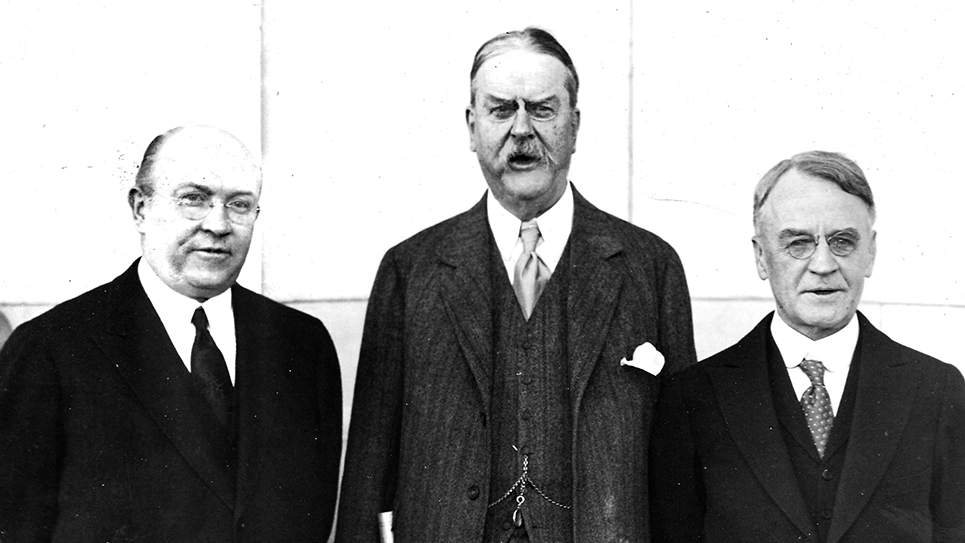
Tall with a thatch of iron gray hair and a weathered face, much of which was covered with an impressive walrus moustache, Hamilton Fish Kean looked every inch like a wealthy country squire.
The senator got his name from his great-uncle Hamilton Fish, who enjoyed a lengthy and successful political career, serving as governor of New York, United States senator, and Secretary of State under President Ulysses S. Grant from 1869 to 1877.
The Keans were patricians, and their descendants lived in Liberty Hall or “Ursino.” The Keans are properly described as a family that goes back to the very birth of our nation. Liberty Hall was originally a fourteen-room house that grew over the decades. The house had been built by William Livingston, the first governor of New Jersey in Union County. Liberty Hall’s visitors read like a history primer for the period of the Revolutionary War, including George and Martha Washington, the Marquis de Lafayette, and John Jay, a founding father of the United States and appointed Chief Justice of the U.S. Supreme Court by President Washington. Alexander Hamilton stayed at Liberty Hall for several months while attending school, having arrived from his home in the West Indies with a handful of letters of introduction. Inside the Kean family, Liberty Hall was known as “Ursino.”
Colonel John Kean, Hamilton’s father, was a very wealthy man who owned a mill and was the president of a bank and a utilities company, as well as a railroad. The colonel left Liberty Hall to his son John, although his wife held a life tenancy under the terms of her husband’s will. Another estate on the other side of the street was left to his son Hamilton. Both of the Kean brothers represented New Jersey in the United States Senate.
After his graduation, Hamilton Kean joined a New York firm, J. Kennedy Todd, and in 1893 partnered with Robert B. Van Cortlandt to form their own company. It later became known as Kean, Taylor and Company. Hamilton Kean did as well in business as his father had before him. The younger Kean was once rated as one of the 50 wealthiest men in New York. Kean lived on his 180-acre estate, Green Lane Farm, where he raised cattle, chickens, pheasants and turkeys. The manager of the farm once admitted that, if the taxes were considered, it could not be considered profitable by any means, although the sale of milk and produce provided enough revenue “to clear a good share of the cost of operating.” One newspaper writer described the manor house at Green Lane Farm as having been “considered one of the best examples of French Provincial architecture in New Jersey.” “The interior was framed in carved oak and the study used by former Senator Kean was paneled in hand-carved wood imported from Nottingham Forest of Robin Hood fame in England,” the newsman wrote.
With his brother having served two terms in the U.S. Senate, it is hardly surprising that Hamilton Kean was an active Republican, being elected as a delegate to local and national conventions. In 1919, Kean became a member of the Republican National Committee for New Jersey.
Hamilton Kean’s first foray into elective politics was challenging U.S. Senator Walter E. Edge in the GOP primary in 1924. Edge was highly popular in New Jersey and had served as the governor of the Garden State prior to being elected to the Senate. Supporters of Edge faulted former Senator Joseph Frelinghuysen for prodding Kean into the primary. Reputedly, Frelinghuysen was bitter because he had lost his own seat in the 1922 election to Democrat Edward I. Edwards and faulted Edge for not having campaigned for him.
Edge proved to be too formidable a candidate to be toppled and won the Republican nomination by soundly defeating Kean, even carrying Kean’s home county of Union. Senator Edge won the GOP nomination by nearly 64,000 votes.
Four years later, former Senator Joseph S. Frelinghuysen decided to try to reclaim his seat in the United States Senate and announced he was a candidate for the GOP nomination. The primary became a three-way fight for the nomination when Hamilton Kean announced he, too, was running. The third candidate was former Governor Edward C. Stokes, who had last won a statewide election in 1904.
The campaign was lively and hard-fought, and the result was close. Kean won the GOP nomination with 167,029 votes, followed closely by former Governor Stokes with 142,123 votes, and former Senator Frelinghuysen with 137,440 votes.
Kean faced incumbent Edward I. Edwards in the general election and was fortunate in that it was a very good year for Republicans. Senator Edwards tried to hitch Kean’s political wagon to local Republican bosses like “Nucky” Johnson of “Boardwalk Empire” fame. At the same time, Kean was pounding Edwards for the senator’s association with the Democratic machine of Frank Hague in Hudson County. Edwards cried that the wealthy Kean was paying handsomely, “many thousands of dollars,” to the local bosses for their support. “How many thousands of dollars has Hamilton Fish Kean given to Davy Baird, Jr., of Camden, and his political money changers who today are manipulating one of the most fraudulent, notorious and corrupt political machines in the United States of America?” Edwards huffed.
Hamilton Kean gave as good as he got, appearing as the speaker before a gathering of 300 Republican women in Bergen County. Kean dismissed Edwards as a “male-Scheherazade,” the primary storyteller in “Arabian Nights,” and accused the senator of trying to divert the attention of voters from his own “somnolent senatorial career.” “His record is as fanciful, though not for the same reasons, as the ‘Thousand and One Nights’ tale that his famous predecessor beguiled the sultan with to save her neck,” Kean chortled.
The sum total, according to Hamilton Kean, of Senator Edwards’ legislative legerdemain was the passage of but one bill, which regulated the height of a building in Washington, D.C. “I dare say, Mr. Edwards has his own idea as to how much good the height of a building in Washington will do New Jersey,” Kean said dryly.
Edwards had made a career in politics by opposing prohibition, cobbling together a coalition of immigrants, ethnic minorities and urban voters, as well as the lynchpin of the Hudson County machine, which produced huge majorities for him. Although Edwards was not one to imbibe alcoholic beverages himself, he was opposed to prohibition. Senator Edwards continued to campaign as an opponent of prohibition in the 1928 election, but Hamilton Kean called for a modification of the Volstead Act, which had implemented prohibition. By October, Kean announced he was as opposed to prohibition as was Senator Edwards. That cost him the endorsement of the Anti-Saloon League, but may have won him the election, as it removed one of the handiest tools Edward Edwards possessed in his political toolbox.
Kean swept past Senator Edwards, who carried only one of New Jersey’s 21 counties and that was Hudson County, the domain of Frank Hague, the mayor of Jersey City. Kean won by more than 233,000 votes, nearly 58% of the ballots cast. Kean had never held elective office before and was on his way to Washington, D.C., where he joined his one-time foe Walter Edge in representing New Jersey in the United States Senate.
The senator-elect traveled to the fishing camp of President-elect Herbert Hoover at Belle Island, Florida. The weather had been poor with heavy rain the day before, which was followed by a “high cold wind.” Kean arrived after breakfast to meet with Hoover to discuss appointments in New Jersey.
The senator-elect was pleased when his Green Lane Farm was awarded a prize for his Jersey Black Giants, a breed of chicken which is approximately one-third larger than other chickens. Not surprisingly, Jersey Black Giants feature a sleek and glossy sheen of black feathers and lay extra-large eggs. Kean’s chickens took second on pullets and fifth on cockerels at the show, which was held in Madison Square Garden.
Senator-elect Kean was wintering in Miami before taking the oath of office. The 20th Amendment to the Constitution, or “Lame Duck” amendment, had yet to take effect, and newly elected members of Congress were sworn in on March 3 after having been elected the previous November.
After taking the oath of office and ensconced in his office in what is now the Russell Senate Office Building, Senator Kean was greeted by numerous personages visiting from New Jersey who dropped by to wish him well. The senator and his wife had been staying at a suite at the elegant Mayflower Hotel, and the couple hosted 1,000 guests for a buffet supper attended by the entire New Jersey congressional delegation. Kean had been assigned the offices formerly used by Senator Matthew M. Neely of West Virginia, a Democrat who had been defeated in the 1928 election. Senator Kean chose a longtime associate, Henry S. Crouch, who also lived in Elizabeth, New Jersey, to serve as his secretary (chief of staff).
On the floor of the Senate, Hamilton Kean sat between two other Republicans who had also been elected in 1928, Phillips Lee Goldsborough of Maryland and Dr. Henry Hatfield of West Virginia.
Kean entered the United States Senate as the result of a Republican wave, and students of history realize all too well that the political pendulum swings back and forth. When Senator Kean sought a second term at age 72, he faced perhaps the best vote-getter the Democratic Party had in New Jersey, Governor A. Harry Moore. The political pendulum had swung sharply back in the other direction with the suffering inflicted by the Great Depression and the advent of Franklin Roosevelt and the New Deal. Senator Kean began the campaign as the underdog but campaigned gamely and largely self-funded his reelection campaign. Kean had been a stalwart Republican in the United States Senate and was an opponent of the New Deal, while Harry Moore campaigned as a supporter of Franklin Roosevelt and his program.
The campaign in New Jersey portrayed Hamilton F. Kean as an out-of-touch millionaire who was profoundly opposed to anything President Roosevelt wanted to accomplish. The contrast between Senator Kean and former governor A. Harry Moore was distinct. Moore was affable and smiling, a seeming everyman, while Senator Kean was viewed as a rather forbidding patrician. While the Republican candidate for governor, Harold G. Hoffman, was winning the state House, Senator Kean went down in defeat. Harry Moore won the general election by more than 231,000 votes, polling almost 58% of the ballots cast.
Once he retired from the Senate, Hamilton F. Kean resumed his business interests and divided his time between a home in New York and his estate in New Jersey. In truth, Kean was an easily recognizable figure due to his towering size and moustache and was as at home in rural surroundings as he was in boardrooms.
The former senator began ailing in November of 1941 and was taken to St. Luke’s Hospital in New York, where he was placed under an oxygen tent. Suffering from what doctors merely referred to as “complications brought on principally by the infirmities of old age,” the former senator never left the hospital, dying on December 29, 1941.
© 2026 Ray Hill