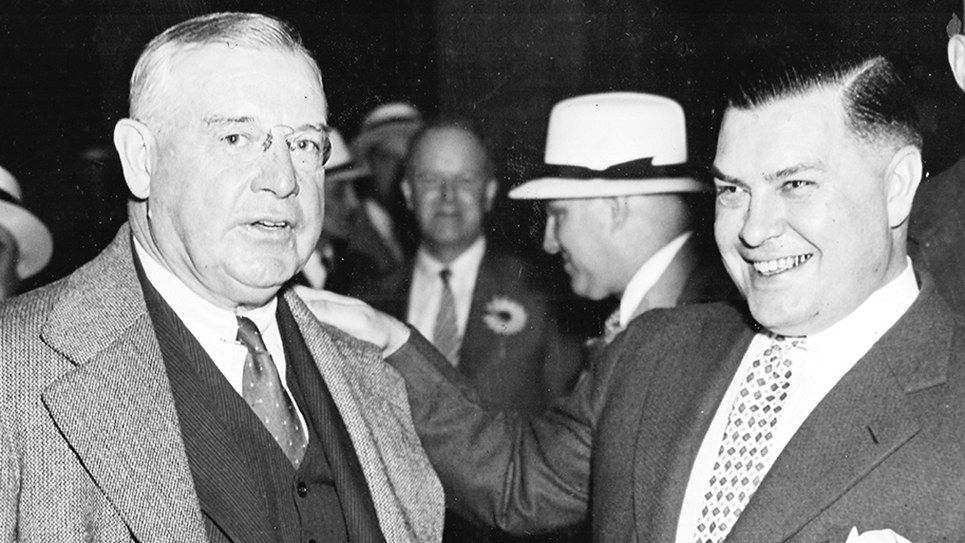
Harold G. Hoffman was a young man in a hurry, climbing the ladder of both the business and political worlds simultaneously. Hoffman was successful, walking the halls of the mighty in the U.S. House of Representatives and being elected to a three-year term as governor of New Jersey at age 38. Following his term as governor, Hoffman continued to hold state office for 15 years as director of New Jersey’s Division of Employment and Security while continuing his career as a banker. No one knew there was a darker side to Hoffman’s success and there would be some blots on his record, and there would be a terrific and full-blown scandal following his sudden death, which followed an investigation into the Department of Employment and Security.
Never averse to hard work, Harold Hoffman was employed as a newspaper reporter while still in high school. As a politician, Hoffman had a flair for attracting attention, both good and bad. Hoffman attracted some unfavorable publicity when he inserted himself into the tragedy of perhaps the most famous kidnapping case in American history, that of the baby son of Charles and Anne Morrow Lindbergh. Governor Hoffman was openly critical of the handling of the Lindbergh baby kidnapping, which caused a serious controversy at the time. Short and stocky with his glossy hair combed back, the governor dressed well and was something of a sleek figure.
From high school student and reporter, Hoffman eventually rose to become city editor at the newspaper where he worked before being elected to the New Jersey General Assembly. During the First World War, Harold Hoffman demonstrated the same ability to rise within the ranks, going from a private to holding the rank of captain when he was discharged from the service. Upon his return to New Jersey, Hoffman began his career in the banking business and served for two years as the city treasurer for his home of South Amboy. Hoffman was elected mayor of South Amboy in 1925 and his popularity was such that he won by a write-in campaign, winning by the largest margin ever given a candidate for the mayoralty to that time. In 1926, Harold G. Hoffman became a candidate for the U.S. House of Representatives and proved to be a potent vote-getter, winning his first term with better than 60% of the ballots cast. Hoffman was easily reelected in 1928, crushing his opposition inside the primary and winning by an even bigger margin in what was a good year for Republicans. Hoffman was not a candidate for a third term in Congress as he had been appointed as New Jersey’s Commissioner of Motor Vehicles, holding both offices until his term in the House of Representatives expired on March 3, 1931. Hoffman shrewdly used the vast patronage powers of his post while, at the same time, adroitly utilizing the commissioner’s office to promote safety on roads and highways, as well as himself. At the time, it was a relatively new concept, and the campaign for motor vehicle safety brought Harold Hoffman plenty of good coverage from the press. That added to the already formidable personal popularity Hoffman had earned throughout his public career.
In 1934, Harold Hoffman swept past three other competitors to win the GOP nomination for governor of New Jersey. Hoffman’s personal popularity helped him to buck the tide of Franklin Roosevelt’s New Deal and defeat Democrat William Dill for the governorship. The entire nation had been horrified and gripped by the story of the kidnapping of the Lindberg baby. Well before the Second World War, Charles Lindbergh was something of a national hero, married to the daughter of a wealthy businessman and former ambassador who had been elected to the United States Senate. The case brought national attention to New Jersey, where the Lindbergh family lived. Bruno Richard Hauptmann was tried, convicted and executed in the electric chair for the kidnapping and murder of Charles Lindbergh Jr. Years later, Hauptmann’s conviction would be controversial, but Governor Harold Hoffman’s public questioning of the investigation shocked a good many Americans and people in New Jersey. Hoffman’s statement that the conviction of Hauptmann did not entirely solve the mystery of who kidnapped and killed the Lindbergh child shocked a goodly number of people. Governor Hoffman rubbed salt in the wounds of a majority of the public who were certain of Bruno Richard Hauptmann’s guilt when he visited the convicted murderer in prison. Many were outraged when Governor Hoffman granted Hauptmann a 30-day reprieve before being executed. Eventually, Hoffman allowed the execution to proceed, and Hauptmann died in the electric chair. Hoffman insisted on what many others later believed: that one man alone had not committed the crime. The governor continued to insist the investigation had been bungled, and he later fired Norman Schwartzkopf, chief of the New Jersey State Police. Some 19 years later, Schwartzkopf was appointed to head the probe into Hoffman as head of the state’s Employment and Security division.
Always a colorful figure, Governor Harold G. Hoffman ignited a bitter fight and controversy when he urged the New Jersey General Assembly to institute a two percent sales tax. Many Republicans in the state legislature rebelled, and it took 20 Democrats, all adherents of Frank Hague, the boss of Hudson County and the mayor of Jersey City, to pass the bill. The fight did not end there, as the law was repealed four months later by the legislature.
Harold Hoffman had most certainly not given up his hope for an electoral comeback. Forbidden by state law from seeking a second consecutive three-year term as governor, Hoffman sought to replace his successor, A. Harry Moore, in the 1940 election. The controversies and the sales tax came back to haunt Hoffman and had, at the very least, dented his once considerable popularity with Republican voters. Hoffman lost the GOP gubernatorial nomination to Robert Hendrickson, a state senator who in turn lost to the Democratic nominee, Charles Edison, son of the famed inventor. The race was relatively close, with Hoffman polling more than 200,000 votes and losing with roughly 47% of the vote.
During the Second World War, Hoffman entered the Army, taking a leave from his post as director of New Jersey’s Department of Employment and Security while his wife, Lillie, went to work in a factory manufacturing war material. After leaving the Army, Hoffman came out with the rank of colonel and a Legion of Merit medal.
Undeterred by his loss in 1940, Harold Hoffman once again entered the Republican primary in 1946 to reclaim the governor’s office and succeed Walter Edge. Hoffman faced Alfred Driscoll in the primary, who had served as Robert Hendrickson’s campaign manager in 1940 as well as majority leader in the state Senate. Hoffman remained a strong candidate, although he lost the nomination to Driscoll by 77,000 votes, winning only 42% of the vote. It was Hoffman’s last hurrah in elective politics.
Harold Hoffman returned to his post at the Department of Employment and Security under Governor Driscoll. Hoffman and his wife were the parents of three daughters, and sadly, one of whom died in 1950. Hoffman was still serving as director of New Jersey’s Employment and Security division when Democrat Robert Meyner succeeded Alfred Driscoll, who was the first governor to be able to run for a second consecutive term. It was during Governor Meyner’s administration that “widespread irregularities” were discovered in the Employment and Security Division’s purchasing accounts. Harold Hoffman was suspended by Governor Robert Meyner as director of the New Jersey Division of Employment and Security. Meyner met with New Jersey’s state attorney general, Grover C. Richman and Harry Green, the longtime personal attorney for Harold Hoffman, for two hours in his office. At the time, none of them knew Hoffman lay dead in a suite in a New York City hotel. Hoffman was only 58 years old at the time, but later events revealed just how much pressure the former governor had been under. Shortly before his death, the former governor had shared a secret with his daughter, Ada Hoffman Leonard, 33 years old and the mother of six children. That secret was that he had embezzled $300,000 (over $3.5 million today) from the South Amboy Trust Company. Hoffman confided in a letter to his daughter about a month prior to his death that he had used the money to finance his political campaigns from 1926 through 1938 and had paid $150,000 to someone in whom he had trusted with his secret, who promptly blackmailed him. The letter had come in a sealed envelope which noted: “to be opened only in the event of my death.” Also printed on the envelope was the admonition: “To be read, considered, and destroyed.” A second letter was received, which contained a copy of the original confession, and Mrs. Leonard placed both envelopes in a safety deposit box. An obedient daughter, Ada Leonard did not open either envelope until after her father’s burial.
Mrs. Leonard shared the secret told to her by her father with Governor Robert Meyner in a letter delivered by special messenger. Mrs. Leonard also apologized for having demanded that Meyner clear her father’s name in Hoffman’s capacity as director of the New Jersey Division of Employment Security. At the time of Hoffman’s death, there had been an investigation into “alleged irregularities in division purchases of supplies and equipment.” Ada Leonard had made that demand of Governor Meyner shortly after her father died of a heart attack in New York City. Mrs. Leonard insisted the Hoffman family would repay “to the final cent” the money stolen by her father. The former governor’s daughter told a reporter that Hoffman had more life insurance “than anybody figured on.” “I guess every time someone wanted to sell him life insurance, he’d say okay,” Mrs. Leonard told the newsman. Ada Leonard did not reveal just how much life insurance her father had carried, but did say that all monies received would go to reimburse the bank shortage.
Harold Hoffman’s letter stated he had first had financial difficulties when he sought a seat in Congress as a “young man and a very poor man.” Hoffman wrote that he had secured what he thought was a pledge from a wealthy older candidate to finance his campaign if he would also speak on that fellow’s behalf in his own race. Hoffman kept his end of the bargain and promptly submitted a bill of his campaign expenses, which totaled $17,000. The other candidate gave Hoffman only $2,500, which led the young candidate to draw from inactive accounts at the South Amboy Trust Company. Like everybody else, Ada Leonard was stunned by her father’s revelations.
The Central New Jersey Home News remembered Harold Hoffman in a special editorial following the former governor’s death, noting he had “died as he lived, dramatically.” The editorial said he was well known to many New Jersians who “mourn him sincerely.” “A man of great vitality, of exuberant spirits, a soldier in two wars and a ‘boy wonder’ in politics – – – we expected him to be around longer,” the editorial noted. Preferring to remember the positive aspects of Harold Hoffman, the Central New Jersey Home News recalled the man who was a “genial after-dinner speaker who made thousands laugh,” and the former governor’s departure took some of the “sunshine of life” with him when he died. Yet the editorial did not ignore the fact that the former governor was being investigated at the time of his death.
“There was a cloud over Harold Hoffman as he passed away,” the editorial acknowledged, “and we who know him best know he would have preferred to face it. The stormy petrel of Jersey politics never shirked a battle, but the last curtain came down before he could confront his accusers.”
The editorial concluded with an emotional statement lauding Hoffman’s love for spreading sunshine, noting, “There is a lump in our throats and a tear in our eyes as we say ‘Goodbye Harold.’”
© 2026 Ray Hill